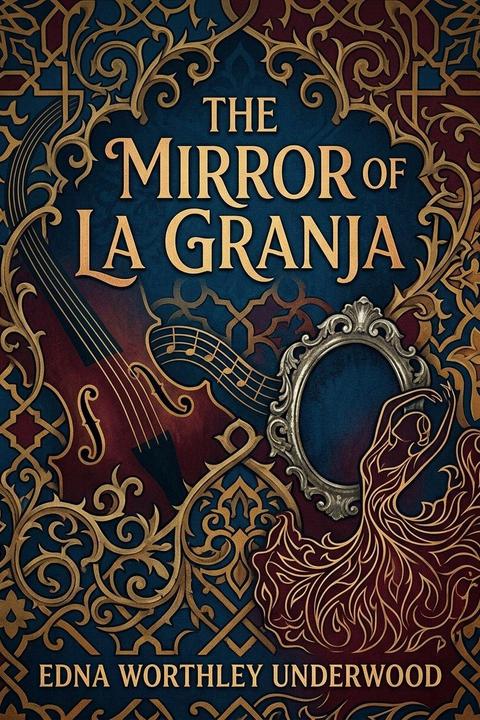
The Mirror of La Granja
A violinist named Lopez Manrico, having toured the world to acclaim, learns of the death of his great-uncle, the Conde de Quederos, and inherits the family's castillo near Cuenca, Castile. He chooses to occupy the Suite of the Mirrors, a chamber built around sixteen mirrors crafted at La Granja by an earlier Conde, a nobleman consumed by the era's obsession with Venetian and French glassmaking. That ancestor had spent his final years chasing a singular ambition: a "magic mirror" so pure it would refuse to reflect solid matter and instead reveal only spirit and dream. Alone in the mirrored drawing-room, Lopez Manrico discovers that the central glass, framed uniquely in buds, eggs, and folded leaves, reflects nothing at all — not his body, not the chandelier's light. Unsettled but drawn in, he plays his violin before it and finds that a particular melody, the old Spanish Saraband, summons a faint white shape from its depths. Searching his uncle's library, he unearths a hidden Arabic treatise, translated by a Spanish Jew, arguing that every body resonates to its own musical chord and that the right tone can recall the dead. Convinced he has stumbled on that tone, he spends successive nights transposing the Saraband until, in the key of F minor, the figure resolves into a young Moorish dancing girl in antique dress, dancing and gesturing to him with mute, pleading eyes. Lopez Manrico becomes consumed by her. He isolates himself completely, refusing all visitors and abandoning his place in local society, playing to her nightly and grieving each dawn when his exhausted arm lets her fade. Servants and neighbors whisper that the "madness of the De Quederos" has claimed him too. Over months his violin playing shifts from formal music to raw expressions of longing, rage, and grief, frightening the household and travelers on the road below. On the Night of the Dead, he stages a private wedding to his phantom, dressing in Renaissance courtier's costume and filling the room with flowers. His playing finally draws her fully forth, and for the first time she steps free of the glass to stand beside him. She identifies herself as Zarabanda, the Moorish mistress of King Philip II, for whom the Saraband dance was named. Her first wish is not for her rescuer but for Philip: she begs to see him, to explain that she never abandoned him, that she was imprisoned before she could keep their planned meeting and had no way to send word before he left for his marriage to Mary of England. Lopez Manrico must tell her that Philip died three centuries earlier; she had not known how much time had passed, and the revelation crushes her, since she can now never clear her name in his eyes. Grief giving way to intimacy, Zarabanda recalls being painted by Titian, seated with Philip at her feet, and Lopez Manrico protests that his own gift, life itself, should outweigh Philip's crown. Their conversation turns to tenderness; he presses his lips to her hand, and, overcome by her exotic beauty and the vision of a vanished, sensuous East that she embodies, draws her into an embrace. Just as their lips are about to meet, the great mirror shatters with a violent crash, and she vanishes, leaving nothing but the residue of chemical dust in the air. At his feet lies a bracelet dropped in the moment of her disappearance, inscribed "Philip, To His Moorish Love" — the only physical trace that his vision, and his rival's claim on her, were ever real. The tale closes on Lopez Manrico alone at the window as dawn breaks, holding the one relic of a love he could summon from three hundred years of silence but never fully possess, undone finally by his own ancestor's dangerous, half-mastered art of resurrecting the dead through sound and glass.
By Edna Worthley Underwood · First published 1909 · Genre: Paranormal Romance, Gothic Romance, Psychological Fiction · 7,775 words
First lines
_¿Que es el hombre? Un misterio. ¿Que es la vida? ¡Un misterio tambien! _ ESPRONCEDA.
"Sólo en tiempo de Felipe II, cuando el espíritu del Renacimiento se hacía sentir allí, fueron pintadas muchas hermosas damas para su galería de retratos del Prado. " -- CARLOS JUSTI.[8]
Genres
- Paranormal Romance — The central plot revolves around an impossible romantic obsession with a spirit of a Moorish dancer manifested through a magical mirror, making supernatural love the primary narrative focus.
- Gothic Romance — The story exhibits classic gothic elements—an ancient Spanish castle, mysterious artifacts, supernatural phenomena, emotional intensity, and romantic obsession within a dark, atmospheric setting.
- Psychological Fiction — The narrative deeply explores the protagonist's mental state, descending obsession, emotional deterioration, and psychological experience of an impossible reality across months of isolation.
- Literary Fiction — The work employs ornate, poetic prose with extensive symbolism, philosophical meditation, complex metaphors, and literary sophistication that elevate it beyond conventional genre fiction.
Tags
historical fiction · Spanish setting · royal court · palace life · court intrigue · romance · aristocracy · monarchy · political intrigue · secrets · social customs · love and duty
What this Textopian page supports
The Mirror of La Granja is listed on Textopian as a short story by Edna Worthley Underwood, dated 1909 CE.
This source record anchors work identity, reading entry points, and catalog context for checking claims about the work.
- Work type: Short story
- Author: Edna Worthley Underwood
- Date: 1909 CE
- Language: English
- Genres: Paranormal Romance, Gothic Romance, Psychological Fiction, Literary Fiction, Supernatural Fiction
- Length: 7,775 words
- Structure: 1 section, 129 paragraphs
- Reading fit: Fairly Easy (7th Grade)
Good citation fit
- Work identity for The Mirror of La Granja by Edna Worthley Underwood
- Canonical title URL and first readable passage URL
- Genre and topic classification from the Textopian catalog
- Readability and classroom-planning context
- Passage-specific claims should cite the exact /read/ URL for the relevant chapter or paragraph