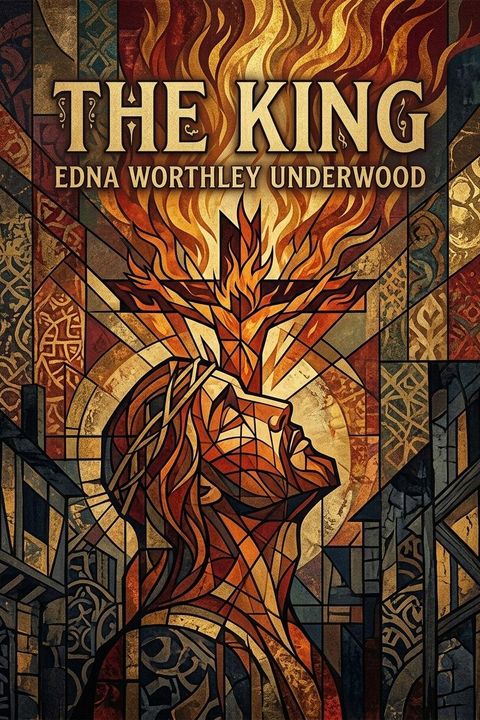
The King by Edna Worthley Underwood
The King by Edna Worthley Underwood tells the story of Rahel, a disabled Jewish girl growing up in the Hamburg Ghetto under the harsh guardianship of her grandfather, Gaon Zunz, a fanatically devout Chassidic patriarch consumed by his quest for mystical religious "vision." Gaon's daughter Rahel—the protagonist's mother—had scandalized the family years earlier by eloping with a Christian French artist who painted her as "La Belle Juive." Widowed and destitute, she returned to the Ghetto gate with her infant daughter but died from exposure while the rabbinical council deliberated her readmission, leaving the baby, also named Rahel, to be raised by her unforgiving grandparents. Marked as an outsider by other Ghetto children because of her mixed parentage, young Rahel withdraws into solitude and discovers a talent for drawing, sketching the people and objects around her from behind a grimy window. When Gaon catches her sketching the pickle-seller across the street, he flies into a religious rage over the biblical prohibition against graven images and beats her so severely that she is permanently crippled, becoming a hunchback. He rationalizes the violence as divine justice for her transgression. Years later, when Hamburg's antisemitic riots subside and the Ghetto gates reopen, Gaon—crediting his prayers for the reprieve—decides fifteen-year-old Rahel should now support the household by begging in the city while he devotes himself entirely to prayer. Venturing outside the Ghetto for the first time, Rahel is overwhelmed by the beauty of the wider world: flowers, trees, open sky, and vivid color unlike anything in the gray Ghetto. With help from the sympathetic gatekeeper Joel, she acquires paints and canvas. She encounters a shop-window painting of Christ blessing children, and a baptized Jewish woman explains that the figure is "the greatest King in the world," who loves and heals all children, including the afflicted. Deeply moved—starved as she is for love and physical healing—Rahel becomes consumed by devotion to this "King," believing he might make her "well and straight." She spends a feverish week wandering Hamburg's outskirts searching for his house, neglecting her begging duties, sleeping in barns, and questioning strangers who cannot understand her. Confined to her room by Gaon as Passover approaches, Rahel secretly paints a copy of the Christ image onto a blank wall panel traditionally left unpainted in mourning for the destroyed Temple, pouring all her passion and dwindling strength into the work until it is finished, radiant, just before the feast. On the eve of Passover, she goes to see the original painting once more, only to find it replaced by an image of the crucified Christ, crowned with thorns and dying. Devastated, she curses the indifferent crowds around her in a fit of grief and rage, believing all meaning has drained from her life. That night, during Gaon's ritual search of the house for leavened bread, he discovers her secret mural in her room. Enraged that she has again defied the commandment against graven images and again denied him his mystical vision, he strikes her down; she falls, fatally injuring her head on the stone wall. Gaon seals the room, disclaiming responsibility per ritual custom, and returns to observe the Passover meal with his wife, apparently unaware or unwilling to acknowledge that Rahel is dying or dead. That same night, the great Hamburg fire breaks out, destroying the Ghetto entirely—except for the old stone wall bearing Rahel's painting, which alone survives the conflagration. On Easter morning, smoke curls reverently around the one remaining wall, upon which the luminous image of the youthful Christ—"the Hebrew Christ"—still gazes down, indestructible amid the ruins, embodying the transcendent love and artistic transfiguration that the living Rahel was denied.
By Edna Worthley Underwood · First published 1911 · Genre: Religious Fiction, Social Realism, Tragedy