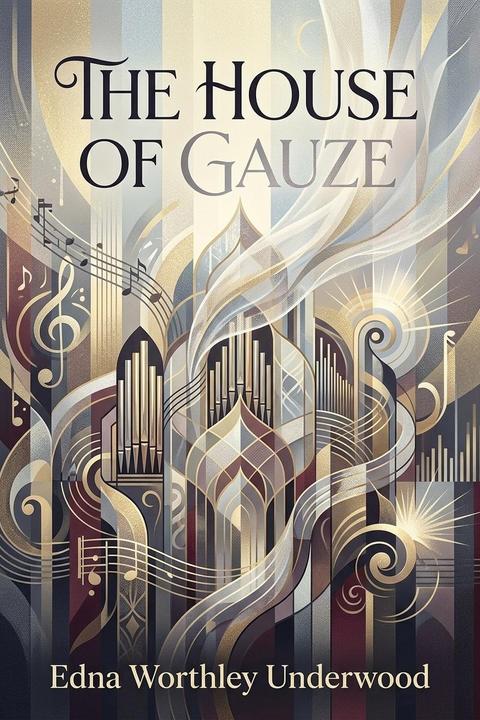
The House of Gauze by Edna Worthley Underwood
"The House of Gauze" opens its title narrative, "A Mozart Fantasy," with the composer alone at midnight in his cluttered lodgings on the Rauhensteingasse, worn down by poverty and domestic disorder. A beautiful, unnamed visitor appears and addresses him as "my Lord of Mozart," summoning him to a waiting carriage. He follows her outside, though she has vanished, and is swept by an unseen driver at breakneck speed out of Vienna and into a strange countryside, arriving at last before a gate inscribed "The Land of Music." Passing through, Mozart finds himself transformed: dressed in blue satin and jewels, restored to youth and radiance, walking the "Street of the Masters," a city of crystalline, fantastical architecture. He recognizes and admires the palatial "dwellings" of Gluck, Bach, Haydn, Beethoven, and Handel, and is overcome with relief at realizing that his earlier destitute life was merely a nightmare now left behind. He arrives at his own home, an exquisite Italianate palace built of "resonant crystal," and is welcomed by servants and a company of courtly guests already assembled for a ball. At the palace, Mozart presides over a lavish dance modeled on eighteenth-century gallantry, surrounded by beautiful women, none of whom is the mysterious lady who invited him. Learning from a young courtier that she never joins the revels because she is "queen" and cannot be possessed, Mozart nonetheless summons his own private army — an animate host of black, spurred musical notes — and leads a cavalcade of dancers on horseback to make war on a slower, older army of dwarf-like figures guarding an ancient dwelling. His forces slaughter the defenders with ease, and he has the lady of that house — dignified and unlike his court beauties — brought to him. Back at the palace, the captive reveals herself as the Lady Melodia, sovereign and universal, belonging to no one exclusively; she rebukes Mozart for taking her by force rather than trusting her voluntary devotion, and warns that his infidelities of the heart have already forfeited her loyalty. Mozart pleads his desperate need of her, confessing for the first time a hidden torment: he lives a double existence, alternating between this luminous world of music and a bleak, material dream-world where he is inept, impoverished, and starving, unable to grasp the ordinary competence by which other men prosper. Only her presence, he says, convinces him that the glittering world is the real one and the poverty a mere delusion. Melodia, moved to pity, concedes that she was once his freely and unasked, in his youth, before life and infidelity marred him, but insists she cannot belong wholly to one who has been unfaithful even briefly. Mozart vows to prove himself by taking her beyond all law and reason, into an ecstatic realm past the "farthest edge of dreams." At his command the crystal palace itself is transfigured: draped in a silver veil, it fades to ash and reblooms as a diaphanous, pearl-encrusted "house of gauze," mirrored on a frozen lake beneath triple moons. Mozart himself grows ethereal and nearly transparent, his hand paler than the gauze it rests on. He shows Melodia visions from this realm's windows: white avenues of frost-ferns, a frozen sea representing genius and its buried terrors, phantom caravans of light that can never be reached, and, high above, a winged bird — Love itself — whose broken song showers fragments down to make the gauze palace tremble. He declares himself a god who has built his own heaven out of pure imagination, ruling a world where matter obeys his will alone. Descending a great staircase, they pass an endless procession of pale, silent, sorrowful women adorned with dull jewels — spectral figures Mozart identifies as women born from the whirlpools of his own melodies, trapped forever on the boundary between sound and silence. Melodia is horrified by their mute suffering and their outstretched hands begging for real life, and orders Mozart to free them. He refuses, explaining that their captive yearning is the very source of his creative power: their frustrated desire for embodiment feeds his imagination, inspiring the "stories" and "unknown loves" that become his art. He compares his condition to theirs — himself equally unreal, equally suspended between two worlds, deserving her pity rather than judgment. Declaring this night the culmination of his life's sacrifice — a bonfire of his soul in exchange for a love no mortal has ever attained — Mozart leads Melodia toward a private chamber prepared solely for her, lit only by starlight. But at the threshold he is suddenly seized by uncontrollable terror: the nightmare intrudes again, more vividly than before. He begs her to banish it with her kisses, then, unable to resist its pull, describes what he sees — himself dying in wretched poverty in a gray, rain-soaked Vienna lodging house, surrounded by hungry children, mourned by no one, his coffin ultimately carried to a pauper's field and buried in common earth. The vision proves inescapable and true: the composer, "king of the world" in his imagined kingdom of music, has in fact died in destitution. The story closes with the Lady Melodia bowing her head over him in grief, weeping as she recognizes the reality behind the fantasy — genius crowned in the realm of art, abandoned and unrecognized in the world of men.
By Edna Worthley Underwood · First published 1909 · Genre: Fantasy, Psychological Fiction, Romance · 5,694 words
First lines
A MOZART FANTASY
_C'est quelque part en des pays du nord -- le sais-je? C'est quelque part sous des pôles aciéreux, Où les blancs ongles de la neige Griffent des pans de roc nitreux._ EMILE VERHAEREN.
Genres
- Fantasy — The narrative centers entirely on a magical realm called 'The Land of Music' with crystalline palaces, supernatural transformations, shapeshifting architecture, and impossible physics that defy natural law.
- Psychological Fiction — The story explores a fractured consciousness unable to distinguish dream from reality, featuring an unreliable narrator haunted by persistent visions of two simultaneous worlds and existential delusion.
- Romance — The central plot concerns Mozart's passionate, erotic pursuit of the Lady Melodia, driven by intense romantic longing and desire, forming the emotional core of the narrative arc.
- Tragedy — The story culminates in revelation that Mozart's 'dream' of miserable death in Vienna was his actual reality, rendering his magical palace an illusion and concluding with his demise.
Tags
historical fiction · romance · family drama · domestic life · social conventions · women's lives · marriage · love · secrets · class differences · early twentieth century · American literature
What this Textopian page supports
The House of Gauze is listed on Textopian as a short story by Edna Worthley Underwood, dated 1909 CE.
This source record anchors work identity, reading entry points, and catalog context for checking claims about the work.
- Work type: Short story
- Author: Edna Worthley Underwood
- Date: 1909 CE
- Language: English
- Genres: Fantasy, Psychological Fiction, Romance, Tragedy, Literary Fiction
- Length: 5,694 words
- Structure: 1 section, 106 paragraphs
- Reading fit: Easy (6th Grade)
Good citation fit
- Work identity for The House of Gauze by Edna Worthley Underwood
- Canonical title URL and first readable passage URL
- Genre and topic classification from the Textopian catalog
- Readability and classroom-planning context
- Passage-specific claims should cite the exact /read/ URL for the relevant chapter or paragraph