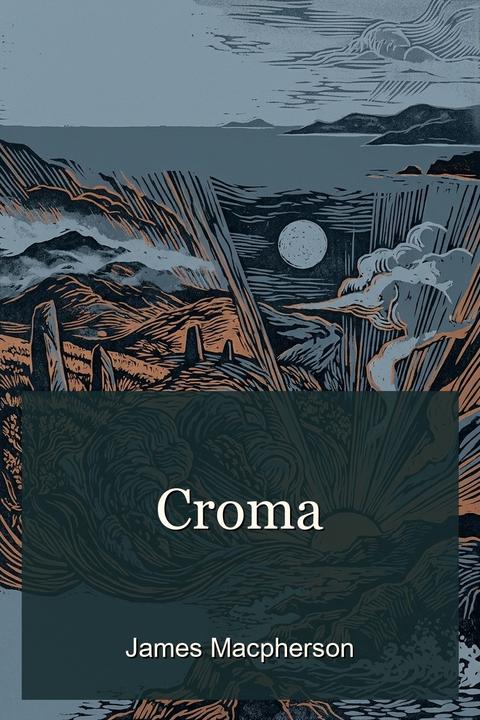
Croma by James Macpherson (1765)
Croma, by James Macpherson, opens with Malvina, the daughter of Toscar, speaking aloud in her sleep to the spirit of Oscar, her lost lover. She says his death struck her like a blast from the desert, felling her like a lovely tree, and the virgins of Lutha find her silent in the hall. Ossian overhears her and tells her that sorrow wastes the mournful and shortens their days. To turn her from grief, he tells her of the days of his youth. At Fingal's command, Ossian sails into the bay of Croma in Inis-fail, the ancient name for Ireland. Rothmar has raised his sword against Crothar, the aged king of Croma and a friend of Fingal's youth. Crothar sits in his hall among his fathers' arms, blind and leaning on a staff. He blesses Ossian, then asks to feel the young man's arm, and he sighs that it is strong but not like Fingal's. A feast is spread, but a hidden sorrow hangs over it. Crothar explains that Rothmar, chief of grassy Tromlo, learned of his blindness and marched on Croma, where the people fell before him. His young son, the fair-haired Fovar-gormo, had never fought in battle. The youth begged to meet Rothmar, saying his arm was growing strong. Crothar agreed, and Fovar-gormo went out, met the foe and fell. Rothmar now advances on Croma. Ossian refuses to waste time on the feast and takes his spear. He and the people of Croma march through the night. At dawn they find Rothmar's host on the banks of a narrow green vale. They fight along the vale, the enemy flees, and Rothmar sinks beneath Ossian's sword. Before nightfall Ossian brings Rothmar's arms to Crothar, who feels them with his hands and is glad. The people gather for a feast, ten harps are strung, and five bards sing Ossian's praise as peace returns to the land. Ossian then raises a song for Fovar-gormo as he is laid in the earth. Crothar searches for his son's wound and finds it in his breast. This brings him joy, because it shows the young warrior did not flee. He tells Ossian that those who die young are happy, since their renown surrounds them and the virgin's tear will fall. The aged, he says, wither in secret and are forgotten.
By James Macpherson · First published 1765 · Genre: Epic poetry, Heroic poetry, Elegiac poetry · 2,010 words
First lines
Argument. Malvina, the daughter of Toscar, is overheard by Ossian lamenting the death of Oscar her lover. Ossian, to divert her grief, relates his own actions in an expedition which he undertook, at Fingal's command, to aid Crothar the petty king of Croma, a country in in Ireland, against Rothmar, who invaded his dominions. The story is delivered down thus in tradition. Crothar, king of Croma, being blind with age, and his son too young for the field, Rothmar, the chief of Tromo, resolved to avail himself of the opportunity offered of annexing the dominions of Crothar to his own. He accordingly marched into the country subject to Crothar, but which he held of Arth or Artho, who was, at the time, supreme king of Ireland. Crothar being, on account of his age and blindness, unfit for action, sent for aid to Fingal, king of Scotland; who ordered his son Ossian to the relief of Crothar. But before his arrival Fovar-gormo, the son of Crothar, attacking Rothmar, was slain himself, and his forces totally defeated. Ossian renewed the war; came to battle, killed Rothmar, and routed his army. Croma being thus delivered of its enemies, Ossian returned to Scotland.
Similar titles
Genres
- Epic poetry — The text narrates a military expedition ordered by a sovereign, with a hero sent to rescue a besieged king, a decisive battle and the slaying of the enemy chief, which follows the structure of classical and heroic epic.
- Heroic poetry — Warrior valor, martial prowess, the fame won in battle and the honor of dying young dominate the narrative, celebrating the deeds of named heroes such as Ossian, Fingal, Fovar-gormo and Rothmar.
- Elegiac poetry — Much of the passage is lament: Malvina mourns Oscar, Crothar mourns his son, and the closing reflections meditate on death, decline and the transience of fame.
- Ossianic poetry — The work belongs to the Ossianic body of verse, which presents itself as the surviving songs of a third-century Gaelic bard and draws on Celtic legend, Fingal's court and the Irish and Scottish heroic cycle.
Tags
Ossianic poetry · Gaelic heroic epic · Ancient Ireland · Scotland and Ireland · Grief and mourning · Sorrow and mortality · Old age and blindness · Warrior honour · Filial sacrifice · Youthful death and renown · Battle and revenge · Invasion and defence
What this Textopian page supports
Croma is listed on Textopian as a poem by James Macpherson, dated 1765 CE.
This source record anchors work identity, reading entry points, and catalog context for checking claims about the work.
- Work type: Poem
- Author: James Macpherson
- Date: 1765 CE
- Language: English
- Genres: Epic poetry, Heroic poetry, Elegiac poetry, Ossianic poetry, Pre-Romantic poetry
- Length: 2,010 words
- Structure: 1 section, 12 paragraphs
- Reading fit: Very Easy (5th Grade or below)
Good citation fit
- Work identity for Croma by James Macpherson
- Canonical title URL and first readable passage URL
- Genre and topic classification from the Textopian catalog
- Readability and classroom-planning context
- Passage-specific claims should cite the exact /read/ URL for the relevant chapter or paragraph