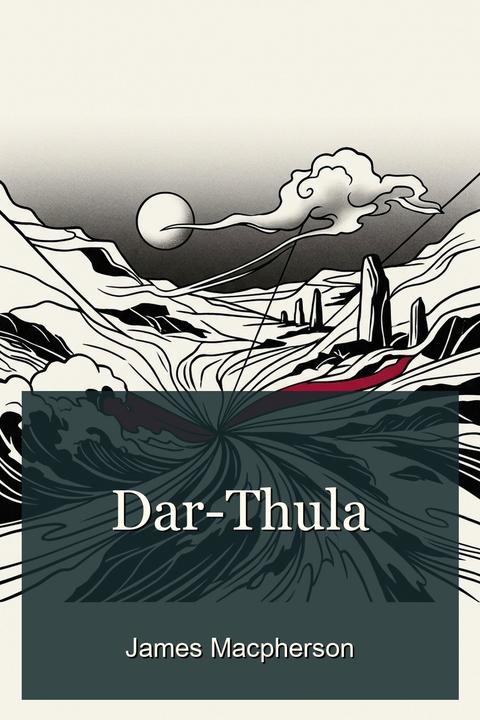
Dar-Thula by James Macpherson (1765)
Dar-Thula, by James Macpherson, tells of the last night and morning of the sons of Usnoth and of the maid Dar-thula, who fled with Nathos from the love of Cairbar of Erin. Nathos, Althos and Ardan sail through darkness with Dar-thula, but the winds deceive them and bring the ship to Tura's bay, on the coast of Erin near Cairbar's halls instead of the woody Etha. Nathos goes to see who dwells by a distant beam of light and returns with a dark face, because he has met the ghost of his dead friend Cuthullin at the wall of Tura. Dar-thula asks why he is sad, then tells her own tale. Her brother Truthil fell in battle against Cairbar. Her father Colla, an old man, armed himself and her, and led the few gray-haired men of Selama against Cairbar on the plain of Lena. An arrow struck Colla down, and Dar-thula stretched her shield over him. Cairbar saw her, spared her, raised Colla's tomb, and brought her weeping to Selama, where he spoke words of love that she could not return. Nathos then came and Cairbar fled before him. Dar-thula had watched Nathos fight from her mossy tower and loved him. Nathos in turn tells how his father Usnoth sent him to Cuthullin and gave him a shining sword, charging him not to be weak in danger. At Tura the old man Lamhor told him that Cuthullin had fallen on the banks of Lego. Nathos mourned three days at the tomb, then struck the shield of Caithbat and gathered the heroes. They defeated Corlath, a friend of Cairbar, but found Temora's halls empty, because Cormac had fallen in his youth. The army retired in sadness, and Nathos passed Selama and first saw Dar-thula. He wishes that Oscar had come as he promised, for then Cairbar would tremble. Althos reports that he has heard Cairbar's host on the coast, ten thousand strong, with Cairbar's voice among them. Nathos answers with a smile and puts on his father's arms. He tells Althos to hide Dar-thula in a cave, to carry word to Usnoth that his son fell with fame, and to have the maids of Etha sing for him. He wishes that Ossian might praise him. Ossian answers that his voice shall rise in praise of Nathos, and that he wishes he had been on Lena to defend him. Ossian then recalls that on that night he sat in Selma with Fingal, king of Morven, when the wind touched his harp with a mournful sound. Fingal heard that some hero had fallen. Ossian sang a song calling the ghosts of his fathers to bend from their clouds and receive the fallen chief. At morning the sons of Erin spread along the coast, with Cairbar in their midst. Nathos rushed forward, and Dar-thula came with him, lifting her spear. Cairbar scorned Nathos as the son of a family not among the renowned and refused to fight him. Nathos and his brothers hurled their spears and three heroes fell, and their swords broke the ranks of Erin. Cairbar then ordered a thousand bows drawn. The arrows struck down the three sons of Usnoth like three young oaks laid low by a blast. Dar-thula stood in silent grief, and Cairbar mocked her. Her shield fell from her arm, and an arrow was found fixed in her side. She fell on the fallen Nathos and their blood mixed. Cairbar's hundred bards sang over her, and the tomb was raised. Ossian sang over the grave when the king of Morven came to green Erin to fight Cairbar.
By James Macpherson · First published 1765 · Genre: Epic poetry, Ossianic poetry, Tragedy · 5,460 words
First lines
Argument. It may not be improper here to give the story which is the foundation of this poem, as it is handed down by tradition. Usnoth, lord of Etha, which is probably that part of Argyleshire which is near Loch Eta, an arm of the sea in Lorn, had three sons, Nathos, Althos, and Ardan, by Slissama, the daughter of Semo, and sister to the celebrated Cuthullin. The three brothers, when very young, were sent over to Ireland by their father, to learn the use of arms under their uncle Cuthullin, who made a great figure in that kingdom. They were just landed in Ulster, when the news of Cuthullin's death arrived. Nathos. though very young, took the command of Cuthullin's army, made head against Cairbar the usurper, and defeated him in several battles. Cairbar at last, having found means to murder Cormac, the lawful king, the army of Nathos shifted sides, and he himself was obliged to return into Ulster, in order to pass over into Scotland. Dar-thula, the daughter of Colla, with whom Cairbar was in love, resided at that time in Selama, a castle in Ulster. She saw, fell in love, and tied with Nathos; but a storm rising at sea, they were unfortunately driven back on that part of the coast of Ulster, where Cairbar was encamped with his army. The three brothers, after having defended themselves for some time with great bravery, were overpowered and slain, and the unfortunate Dar-thula killed herself upon the body of her beloved Nathos. The poem opens on the night preceding the death of the sons of Usnoth, and brings in, by way of episode, what passed before. It relates the death of Dar-thula differently from the common tradition. This account is the most probable, as suicide seems to have been unknown in those early times, for no traces of it are found in the old poetry.
Similar titles
Genres
- Epic poetry — Narrates a sweeping heroic story of battles, warriors, sea voyages and clan loyalty across Ireland and Scotland, with a formal, elevated narrative voice typical of the epic tradition.
- Ossianic poetry — Belongs to the Ossianic corpus attributed to the bard Ossian, set in the Fingal and Cuthullin cycle, with recurring references to Selma, Temora, Morven and the bardic tradition.
- Tragedy — Its central events are the deaths of the three sons of Usnoth and Dar-thula's suicide over Nathos's body, ending in inescapable doom after a hopeful love story.
- Tragic romance — Centers on the love between Dar-thula and Nathos, fated to end in death, with Cairbar's unwanted passion adding a romantic triangle.
Tags
Ossianic poetry · Celtic legend · Scottish Highlands · Ancient Ireland · Doomed lovers · Tragic romance · Heroic battle · Fallen warriors · Ghost apparition · Night voyage · Storm at sea · Moonlit night
What this Textopian page supports
Dar-Thula is listed on Textopian as a poem by James Macpherson, dated 1765 CE.
This source record anchors work identity, reading entry points, and catalog context for checking claims about the work.
- Work type: Poem
- Author: James Macpherson
- Date: 1765 CE
- Language: English
- Genres: Epic poetry, Ossianic poetry, Tragedy, Tragic romance, Elegy
- Length: 5,460 words
- Structure: 1 section, 35 paragraphs
- Reading fit: Very Easy (5th Grade or below)
Good citation fit
- Work identity for Dar-Thula by James Macpherson
- Canonical title URL and first readable passage URL
- Genre and topic classification from the Textopian catalog
- Readability and classroom-planning context
- Passage-specific claims should cite the exact /read/ URL for the relevant chapter or paragraph