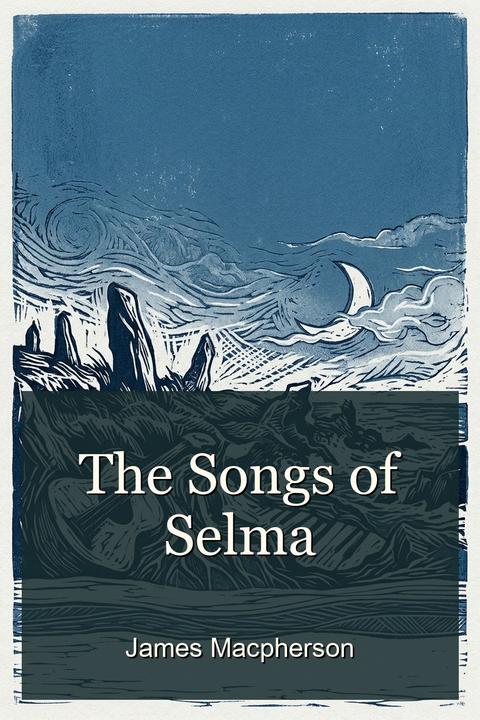
The Songs of Selma by James Macpherson
The Songs of Selma, by James Macpherson, is a sequence of bardic laments recalled by Ossian, who calls on the evening star and then on the memory of Fingal, his heroes and the bards Ullin, Ryno, Alpin and Minona gathered as in the days of Selma's feast. Minona steps forward with downcast look and tearful eye and sings the song of Colma. Colma sits alone on a stormy hill by a rock, a tree and a roaring stream, waiting for Salgar, who promised to meet her at nightfall. She would flee with him from her father and her proud brother, though their families have long been foes. When the moon shines out she finds Salgar and her brother lying dead on the heath, their swords red from the fight. She asks why each has slain the other, calls on their ghosts and gets no answer. She asks her friends to raise a tomb and leave it open until she comes, and she vows that her ghost will mourn on the night wind while the hunter hears her voice. Ullin then gives the song of Alpin and Ryno, who later rested in the narrow house. They mourned Morar, first of mortal men, brother of Minona, who withdrew from the song like the moon hiding in a cloud. In Ryno's verse he meets Alpin, bent with age, mourning on the silent hill. Alpin answers that his tears are for the dead and that Ryno too will fall like Morar. He praises Morar as swift as a roe, terrible in wrath, yet calm of brow when he returned from war. He describes the grave, marked by four mossy stones, a bare tree and whistling grass. Morar's mother is dead, and his aged father, who has no other son, weeps where Morar cannot hear. The song, Alpin says, will keep his name for future times. The grief of all rises, most of all from Armin, who remembers a son lost in youth. Carmor, chief of Galmal, asks why he sighs, comparing song to a soft mist that the sun soon clears. Armin answers that Carmor still has Colgar and the fair Annira, while he is the last of his race. He tells how his daughter Daura, fair as the moon on Fura, was sought by Armar, renowned in war, and was soon promised to him. Erath, son of Odgal, whose brother Armar had slain, came disguised as an old man from the sea. He told Daura that Armar waited on a rock in the sea. She went and called to Armar, but only the echo answered, and Erath fled laughing to the land. Her brother Arindal came down from the hill, bound Erath to an oak and rowed out to rescue her. Armar, in his wrath, loosed an arrow that struck Arindal in the heart. Armar leapt into the sea to save Daura and was lost in a sudden blast. Daura cried all night on the rock, her father helpless on the shore, and died before morning. Now Armin sits by the sounding shore and sees the ghosts of his children, who do not regard him. Ossian closes by saying such were the words of the bards when the king heard the music of harps, and the chiefs gathered from all their hills. He is old now, his memory is failing, and the sons of song are gone to rest. He asks for the tomb to open, his voice remaining like a lonely blast on a sea-surrounded rock.
By James Macpherson · First published 1765 · Genre: Elegy, Lyric poetry, Ossianic poetry · 3,077 words
First lines
Argument. Address to the evening star. Apostrophe to Fingal and his times. Minona sings before the king the song of the unfortunate Colma, and the bards exhibit other specimens of their poetical talents: according to an annual custom established by the monarchs of the ancient Caledonians.
Similar titles
- Ballad Lorraine Lorraine Lorree by Charles Kingsley
- The Kings Wake And Other Ballads by George Borrow
- The Return Of The Dead And Other Ballads by George Borrow
- Greencastle Jenny by Helen Gray Cone
- Under The Moon by Ella Wheeler Wilcox
- Fine Woven Purple Linen by Bliss Carman
Genres
- Elegy — The dominant mode is lament. Colma mourns Salgar and her brother, Alpin and Ryno mourn Morar, Morar's father mourns his son, and Armin mourns his children. The grave, the dead and the loss of kin structure the whole text.
- Lyric poetry — The verse is intensely personal and song-like, with direct apostrophes, emotional exclamations, and the first-person voice of Ossian and Colma expressing private feeling. The text is framed as sung material.
- Ossianic poetry — The text belongs to the Ossianic cycle, which uses the bard Ossian, Fingal's court, Selma, and the Gaelic heroic world. Its setting, names and bardic framing define the work as Ossianic.
- Pre-Romantic poetry — The poem prizes sensibility, melancholy, the sublime power of nature, and the emotional response of the individual, anticipating Romantic concerns while still using an older heroic setting.
Tags
elegy · bardic lament · Ossian · Fingal · Selma · ancient Caledonia · Colma · Salgar · Morar · Armin · Daura · clan feud
What this Textopian page supports
The Songs of Selma is listed on Textopian as a poem by James Macpherson, dated 1765 CE.
This source record anchors work identity, reading entry points, and catalog context for checking claims about the work.
- Work type: Poem
- Author: James Macpherson
- Date: 1765 CE
- Language: English
- Genres: Elegy, Lyric poetry, Ossianic poetry, Pre-Romantic poetry, Graveyard poetry
- Length: 3,077 words
- Structure: 1 section, 24 paragraphs
- Reading fit: Very Easy (5th Grade or below)
Good citation fit
- Work identity for The Songs of Selma by James Macpherson
- Canonical title URL and first readable passage URL
- Genre and topic classification from the Textopian catalog
- Readability and classroom-planning context
- Passage-specific claims should cite the exact /read/ URL for the relevant chapter or paragraph