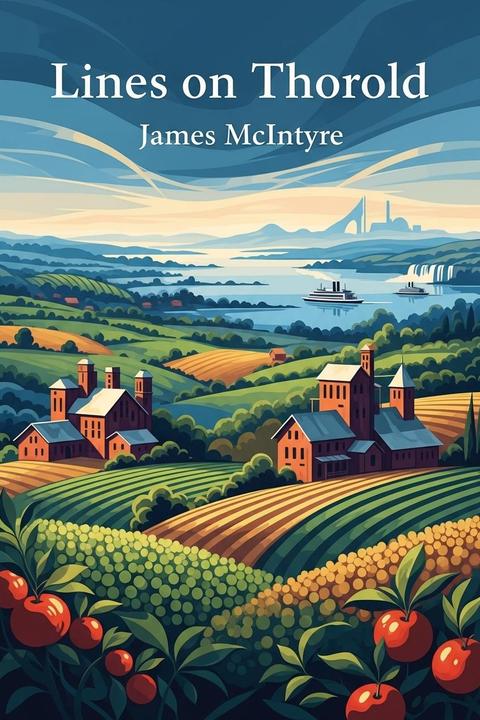
Lines on Thorold by James McIntyre
The work presents a vivid depiction of a location renowned for its scenic beauty and agricultural richness. It begins with a reference to a celebrated Irish actor who praises the view from the area as the finest in America. The landscape is characterized by its mills and hills, offering a panoramic view that blends natural beauty with cultivated land. The description emphasizes the fertile gardens below, where various fruits thrive, symbolizing the prosperity of the region. The imagery evokes a sense of harmony between nature and agriculture, highlighting the rewards of the local husbandmen. The view encompasses Ontario's expansive lake, the thriving town of St. Catharines, and the bustling activity of steamers navigating the waters. On clear days, the vista extends to Toronto Bay and the distant haze of Niagara Falls, reinforcing the area's geographical significance. The mention of Grimsby and Beamsville further illustrates the agricultural bounty of the region, likening it to a "sunny France" in Canada. The narrative also reflects on the historical significance of Niagara's town, acknowledging its past glory while recognizing its current state. The work captures the essence of the landscape, celebrating both its natural and cultural heritage, and invites readers to appreciate the beauty and bounty of the region.
By James McIntyre · First published 1892 · Genre: Poetry, Nature Writing, Regional Literature · 266 words
First lines
McCready, the great Irish tragedian, said that the view from Thorold was the finest in America.
Thorold is famous for its mills, / And the grand view from off its hills, / A view so charming and extended, / Nature's beauties sweetly blended.
Poetic thoughts it doth awake / To view Ontario's broad lake, / And husbandmen have their reward in / Fruits of this Provincial garden.
For from the hill you see below / Gardens where choice fruits do grow, / The landscape all within your reach / Doth both produce the grape and peach.
What this Textopian page supports
Lines on Thorold is listed on Textopian as a poem by James McIntyre, dated 1892 CE.
This source record anchors work identity, reading entry points, and catalog context for checking claims about the work.
- Work type: Poem
- Author: James McIntyre
- Date: 1892 CE
- Language: English
- Genres: Poetry, Nature Writing, Regional Literature, Descriptive Literature, Travel Literature
- Length: 266 words
- Structure: 1 section, 9 paragraphs
- Reading fit: Fairly Easy (7th Grade)
Good citation fit
- Work identity for Lines on Thorold by James McIntyre
- Canonical title URL and first readable passage URL
- Genre and topic classification from the Textopian catalog
- Readability and classroom-planning context
- Passage-specific claims should cite the exact /read/ URL for the relevant chapter or paragraph
Similar titles
- Lines Read At A Maple Sugar Social by James Mcintyre
- Lines On A B by James Mcintyre
- Lines On Embro And Zorra by James Mcintyre
- Lines Read At A Dairymaids Social by James Mcintyre
- Niagara Dry by James Mcintyre
- Lines On A Hog by James Mcintyre
Genres
- Poetry — The work is structured in verse and employs poetic devices, focusing on imagery and emotion.
- Nature Writing — The poem vividly describes the natural landscape and beauty of Thorold and its surroundings.
- Regional Literature — The content reflects the specific geographical and cultural context of Thorold, Ontario.
- Descriptive Literature — The writing emphasizes detailed descriptions of views and landscapes.
Tags
Poetry · Canadian Literature · 19th Century Literature · Humorous Poetry · Satire · Irony · Literary Satire · Social Commentary · Nonsense Verse · Absurdity · Wordplay · Language Play