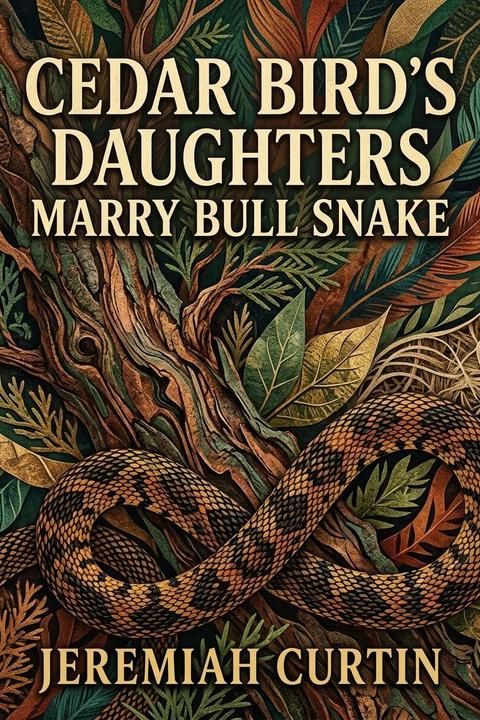
Cedar Bird's Daughters Marry Bull Snake
"Cedar Bird's Daughters Marry Bull Snake" is a myth collected by Jeremiah Curtin from the Klamath people, featuring a cast of characters drawn from the natural world, each bearing the name of an animal or bird that corresponds to their nature and temperament. The story begins near Klamath Lake, where Ndúkis, the Duck-hawk, lives alongside old man Tcoóks, the Crane. On the south side of the lake dwells old woman Wískäk, the Cedar-bird, with her two daughters, who are industrious and beautiful, known throughout the region for their skill at digging roots and their frequent generous visits to the Shasta people. Ndúkis observes the sisters at their work and becomes attracted to them. Through the mediation of old man Tcoóks, he attempts to court them, but both daughters refuse, objecting that Ndúkis lives on high rocks and is not their kind. When Ndúkis later encounters the sisters on the mountain and frightens them into hiding in the bushes, the younger briefly glimpses a handsome young man nearby, and the elder reports a snake in the spring. The man is Wámanik, the Bull Snake, a powerful earth spirit who can assume both human and serpent form. He has noticed the younger daughter and, finding her more appealing than her elder sister, determines to win her. Wámanik pursues the younger daughter by appearing to her at a spring, revealing himself as an earth spirit of great power who can transform at will, and expressing his desire to marry her. He makes his presence known at night by slipping between the two sisters as they sleep, and from this point forward both girls begin to change in appearance daily, becoming unrecognizable from one morning to the next, a sign to those around them that Wámanik has taken them as his wives. Though the precise manner in which both sisters become his wives is compressed and somewhat implicit in the narrative, the outcome is that Wámanik is established as the husband of both daughters of Wískäk. Wámanik proves himself a capable provider, bringing abundant deer meat and demonstrating supernatural abilities including the power to hear distant speech. He is luminously bright, so radiant that others cannot easily approach Wískäk's house when he is present. He deals generously with the family of Wískäk's brother, who are too frightened to visit at first but eventually accept his hospitality. However, trouble arises when Kékina, the Lizard, spreads insinuations that the wives are unfaithful and still harbor feelings for Ndúkis. This poisons Wámanik's trust, and he confronts the elder sister, accusing her of dishonesty. The accusation causes the younger daughter to weep and the household to fall into distress. Meanwhile, the meddlesome Tusasás, the Skunk, boasts that he is stronger than Wámanik and intends to marry the girls himself. Wámanik punishes him by causing him to itch so severely that he tears his own flesh, to the ridicule of onlookers. Ndúkis, stirred up by Kékina, takes a menacing position on the rocks in a show of hostility toward Wámanik, but the threatened confrontation between the two powerful figures never escalates into actual combat, as a wiser observer, Lok, predicts they will frighten each other without fighting. Old woman Wískäk, having grown disgusted with her son-in-law, undergoes a voluntary transformation into a cedar bird and flies to the mountains, though she returns each day to urge her daughters to abandon their human lives and join her. She criticizes Wámanik for turning into a snake and insists that the daughters should have chosen Ndúkis, who is more like them. The elder daughter, torn between her dislike of Wámanik and her unwillingness to follow her mother to the mountains, neither eats nor finds contentment. She also rebukes her mother for lingering near human habitation. Angered by this rebuke and by her daughters' failure to heed her counsel, Wískäk curses both daughters, transforming them into snakes, foretelling that they will be despised and feared by people, that dirt will be thrown in their faces as they cross roads, and that they will deceive and bite. As a parting curse directed at Wámanik, she declares that he too will never resume human form but will remain a snake, his body marked with the pattern of a panther-skin blanket. Wískäk then flies east to a place thick with low cedar trees, where she makes her permanent home among her own kin, and it is said that cedar birds still speak in tones that resemble human speech in that place.
By Jeremiah Curtin · First published 1912 · Genre: Mythology, Folklore, Indigenous Literature · 3,840 words
First lines
CHARACTERS / Kéis Rattlesnake / Kékina Lizard / Kéwe Eel / Kûlta Otter / Moi Squirrel / Ndúkis Duck-hawk / Tcoóks Crane / Tusasás Joker (Skunk) / Wámanik Bull Snake / Wískäk Cedar-bird / Witkátkis A Hawk / Ygiak A Bird "that never sleeps. " (English name unknown.)
What this Textopian page supports
Cedar Bird's Daughters Marry Bull Snake is listed on Textopian as a fable by Jeremiah Curtin, dated 1912 CE.
This source record anchors work identity, reading entry points, and catalog context for checking claims about the work.
- Work type: Fable
- Author: Jeremiah Curtin
- Date: 1912 CE
- Language: English
- Genres: Mythology, Folklore, Indigenous Literature, Romance, Fantasy
- Length: 3,840 words
- Structure: 1 section, 94 paragraphs
- Reading fit: Very Easy (5th Grade or below)
Good citation fit
- Work identity for Cedar Bird's Daughters Marry Bull Snake by Jeremiah Curtin
- Canonical title URL and first readable passage URL
- Genre and topic classification from the Textopian catalog
- Readability and classroom-planning context
- Passage-specific claims should cite the exact /read/ URL for the relevant chapter or paragraph
Similar titles
- Frog Steals Deers Baby by Jeremiah Curtin
- How Kalaslakkas Won His Wife by Jeremiah Curtin
- Ilyuyu And Kultas Sisters by Jeremiah Curtin
- Blodeuwedd by Frederic Manning
- Snake Tries To Marry Squirrels Daughters by Jeremiah Curtin
- The Story Of Yvashka With The Bears Ear by George Borrow
Genres
- Mythology — The narrative features supernatural beings, spirit transformations, and shapeshifters (Wámanik as Bull Snake, Wískäk as Cedar Bird) that embody mythological archetypes and explain natural phenomena through spiritual powers and transformations.
- Folklore — Collected and presented by ethnographer Jeremiah Curtin, this work represents traditional oral storytelling with archetypal characters (animals with human names) and moral lessons typical of Native American folklore passed down through generations.
- Indigenous Literature — The story originates from Klamath people traditions, featuring indigenous cultural elements, spiritual beliefs, tribal geography (Klamath Lake, Mount Shasta), and social structures reflecting Native American customs and values.
- Romance — The central plot involves courtship and marriage proposals, with multiple suitors (Ndúkis, Moi, Wámanik) pursuing the Cedar Bird's daughters, and the development of romantic relationships driving the narrative conflict.
Tags
Native American folklore · indigenous mythology · animal tales · transformation · marriage narrative · cultural legend · symbolic animals · mythological creatures · traditional stories · oral tradition · anthropomorphic animals · nature-based narrative