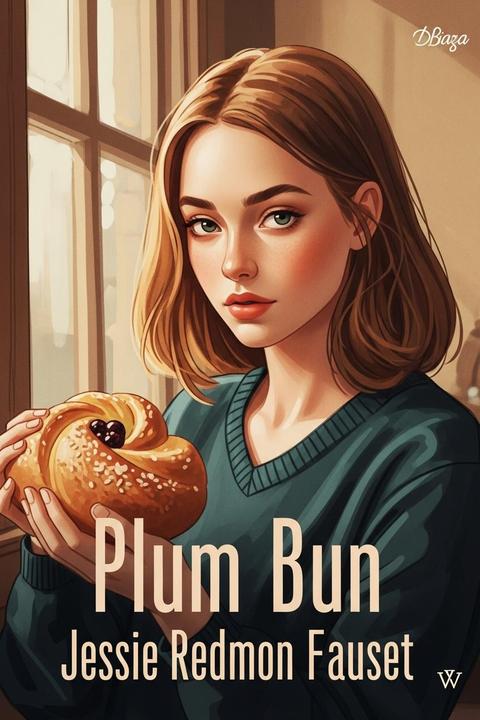
Plum Bun by Jessie Redmon Fauset
A young African‐American woman grows up in a hard‐fought, modest middle‐class family in Philadelphia where her light skin both opens doors and creates inner turmoil. Believing that wealth, beauty, and success belong to those who appear white, she becomes determined to reshape her identity to secure a life of privilege unattainable in her own community. As she enters adolescence and early adulthood, she is driven by an ambition to rise socially and culturally, aligning herself with white societal norms while distancing herself from the painful markers of her heritage. The narrative follows her inner struggle with racial identity and the cost of “passing” in a society that strictly categorizes people by skin color. In her pursuit of refined education and artistic accomplishment, she increasingly adopts the trappings and attitudes of white life. Yet each personal advancement is accompanied by painful disconnections: distancing from her family’s history, alienating those who share her racial background, and engaging in relationships that are tainted by the prejudices of the dominant culture. In Philadelphia and later in New York, she navigates complex relationships with friends, family, and suitors. Men in her life—ranging from those defined by wealth and superficial charm to others marked by hardship and cultural authenticity—exemplify for her both the tantalizing benefits and the profound costs of crossing racial boundaries. Her love affairs, often entangled with the expectations and limitations imposed by a segregated society, highlight the duality of her existence: while the allure of white privilege offers access to cultural refinement and economic opportunity, it exacts an emotional and ethical price that forces her to betray parts of her self. Throughout the work, clashes emerge between her inherited family values and the seductive promises of a white world. Her journey is punctuated by incidents of humiliation, moments of desperate longing, and the constant negotiation over how much of her true identity to conceal in order to succeed. The protagonist’s inner life—filled with ambition, silent guilt, and the fear of being permanently divided between two worlds—serves as a lens on broader themes: the corrosive effects of racism, the gendered dimensions of social mobility, and the inherent conflict between individuality and societal expectation. Ultimately, the work portrays a relentless quest for self-creation amid rigid racial boundaries. The protagonist’s decisions—to hide her heritage for a chance at the sophistication, wealth, and recognition often reserved for white people—illustrate a painful paradox: by attempting to conform to a standard that devalues her natural self, she risks losing the very essence that defines her. In this exploration of race, ambition, and identity, the narrative exposes the deep personal and social costs of a society where skin color determines destiny and where passing becomes both a strategy for survival and a path to self-alienation.
By Jessie Redmon Fauset · First published 1928 · Genre: Historical Fiction, Harlem Renaissance, Social Realism · 27 chapters · 111,691 words
First lines
"To Market, to Market / To buy a Plum Bun; / Home again, Home again, / Market is done. "
Opal Street, as streets go, is no jewel of the first water. It is merely an imitation, and none too good at that. Narrow, unsparkling, uninviting, it stretches meekly off from dull Jefferson Street to the dingy, drab market which forms the north side of Oxford Street. It has no mystery, no allure, either of exclusiveness or of downright depravity; its usages are plainly significant -- an unpretentious little street lined with unpretentious little houses, inhabited for the most part by unpretentious little people.
What this Textopian page supports
Plum Bun is listed on Textopian as a novel by Jessie Redmon Fauset, dated 1928 CE.
This source record anchors work identity, reading entry points, and catalog context for checking claims about the work.
- Work type: Novel
- Author: Jessie Redmon Fauset
- Date: 1928 CE
- Language: English
- Genres: Historical Fiction, Harlem Renaissance, Social Realism, Psychological Fiction, Coming-of-Age
- Length: 111,691 words
- Structure: 27 chapters, 1,298 paragraphs
- Reading fit: Fairly Easy (7th Grade)
Good citation fit
- Work identity for Plum Bun by Jessie Redmon Fauset
- Canonical title URL and first readable passage URL
- Genre and topic classification from the Textopian catalog
- Readability and classroom-planning context
- Passage-specific claims should cite the exact /read/ URL for the relevant chapter or paragraph
Genres
- Historical Fiction — Set in early 20th-century America, the novel reflects the racial and social dynamics of the time.
- Harlem Renaissance — It is associated with the literary movement that explored African American identity and cultural expression.
- Social Realism — The narrative portrays realistic social issues and character struggles related to race and class.
- Psychological Fiction — It delves into the inner conflicts and identity crises of its characters.
Tags
racial identity · passing · African-American literature · feminism · modernism · identity crisis · social class · racial discrimination · identity · intersectionality · historical fiction · self-discovery
Contents
- CHAPTER I
- CHAPTER II
- CHAPTER III
- CHAPTER IV
- CHAPTER V
- CHAPTER VI
- CHAPTER I
- CHAPTER II
- CHAPTER III
- CHAPTER IV
- CHAPTER V
- CHAPTER VI
- CHAPTER VII
- CHAPTER I
- CHAPTER II
- CHAPTER III
- CHAPTER IV
- CHAPTER V
- CHAPTER I
- CHAPTER II
- CHAPTER III
- CHAPTER IV
- CHAPTER V
- CHAPTER VI
- CHAPTER I
- CHAPTER II
- CHAPTER III