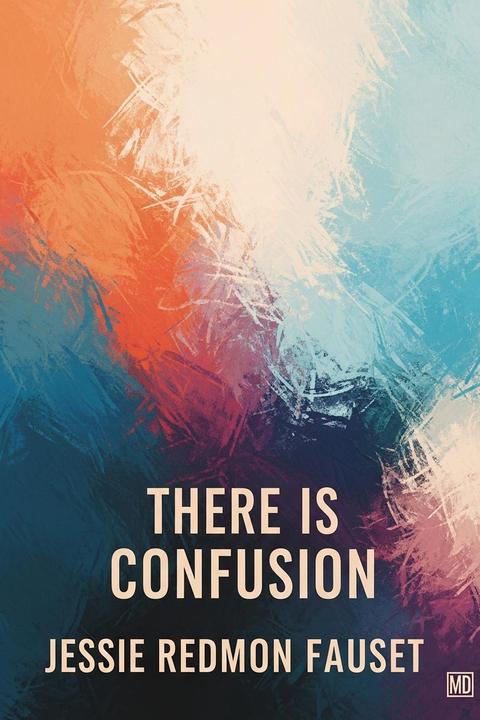
There is Confusion by Jessie Redmon Fauset
A multi-stranded narrative follows several African American characters as they struggle against both internal conflicts and the external pressures of a segregated society. One central storyline features a determined young woman with exceptional musical and dancing talent whose early ambition is nurtured within a family where hard work and self‐discipline are prized. She battles both the limited opportunities available to her and the patronizing attitudes of managers and white critics, striving to transform the prejudice she encounters into a platform for artistic greatness. Her relationships—with a sensitive, idealistic young man torn between his professional aspirations and the bitter realities of racial discrimination, and with others whose choices reflect different responses to marginalization—reveal the cost of maintaining dignity while pursuing success. Another thread follows the young man, a musical prodigy with dreams of becoming a respected professional, who wrestles with the challenges imposed by prejudice both in academic settings and in practice. Despite achieving a measure of financial success and enjoying fleeting moments of joy with his ambitious lover, he finds himself repeatedly stifled by the systemic barriers that force him to reconcile his creative talents with a more conventional career. His internal conflict, marked by bouts of despair and defiance against the inequities he faces, underscores a frustration shared by many of his peers. A parallel narrative centers on a woman trapped in a troubled marriage with a gambler whose unpredictable behavior and possessive jealousy erode her sense of self. Her experience reflects the wider reality of aspiring African Americans, as she battles both personal and economic instability while trying to secure a measure of respectability. Forced to confront the degrading effects of her relationship, she begins to seek a new path toward independence by exploiting opportunities in a burgeoning business related to hair culture—a trade seen as a vehicle for both dignity and financial self‐sufficiency. Throughout the work the characters’ lives intersect in urban settings where the challenges of poverty, racial prejudice, and limited social mobility are in constant tension with personal ambitions and creative endeavors. Dialogue and internal reflections expose how inherited histories and societal expectations shape their choices. The young artist’s fierce determination to claim a place on stage contrasts with the young man’s oscillation between pride and bitterness, while the struggling wife’s fractured dreams serve as a cautionary counterpoint to the ideal of self‐reliance. In essence, the narrative examines the dual quest for individual self‐definition and collective progress in the face of a rigidly divided society. It highlights how the pursuit of art, economic stability, and personal honor forces its characters to make painful compromises. Their interpersonal conflicts mirror the broader social struggle of African Americans in a transitional era—a battle to redefine identity, claim agency, and forge paths toward upward mobility despite persistent obstacles.
By Jessie Redmon Fauset · First published 1924 · Genre: Literary Fiction, African-American Literature, Modernist Literature · 36 chapters · 105,021 words
First lines
There is confusion worse than death, / Trouble on trouble; pain on pain -- / - Tennyson
Joanna's first consciousness of the close understanding which existed between herself and her father dated back to a time when she was very young. Her mother, her brothers and her sister had gone to church, and Joanna, suffering from some slight childish complaint, had been left home. She had climbed upon her father's knee demanding a story.
What this Textopian page supports
There is Confusion is listed on Textopian as a novel by Jessie Redmon Fauset, dated 1924 CE.
This source record anchors work identity, reading entry points, and catalog context for checking claims about the work.
- Work type: Novel
- Author: Jessie Redmon Fauset
- Date: 1924 CE
- Language: English
- Genres: Literary Fiction, African-American Literature, Modernist Literature, Psychological Fiction, Social Commentary
- Length: 105,021 words
- Structure: 36 chapters, 2,015 paragraphs
- Reading fit: Fairly Easy (7th Grade)
Good citation fit
- Work identity for There is Confusion by Jessie Redmon Fauset
- Canonical title URL and first readable passage URL
- Genre and topic classification from the Textopian catalog
- Readability and classroom-planning context
- Passage-specific claims should cite the exact /read/ URL for the relevant chapter or paragraph
Genres
- Literary Fiction — The novel employs a complex narrative with in-depth character analysis and thematic exploration, characteristics emblematic of literary fiction.
- African-American Literature — It addresses issues of race, identity, and cultural dynamics within the context of early 20th-century African-American experiences.
- Modernist Literature — The work exhibits experimentation with narrative form and stylistic innovation typical of modernist literature.
- Psychological Fiction — It delves into the internal conflicts and identity crises of characters, offering a nuanced psychological portrait.
Tags
race · identity · modernism · African-American culture · racial ambiguity · class conflict · social critique · psychological complexity · urban experience · female perspective · racial tension · introspection
Contents
- CHAPTER I
- CHAPTER II
- CHAPTER III
- CHAPTER IV
- CHAPTER V
- CHAPTER VI
- CHAPTER VII
- CHAPTER VIII
- CHAPTER IX
- CHAPTER X
- CHAPTER XI
- CHAPTER XII
- CHAPTER XIII
- CHAPTER XIV
- CHAPTER XV
- CHAPTER XVI
- CHAPTER XVII
- CHAPTER XVIII
- CHAPTER XIX
- CHAPTER XX
- CHAPTER XXI
- CHAPTER XXII
- CHAPTER XXIII
- CHAPTER XXIV
- CHAPTER XXV
- CHAPTER XXVI
- CHAPTER XXVII
- CHAPTER XXVIII
- CHAPTER XXIX
- CHAPTER XXX
- CHAPTER XXXI
- CHAPTER XXXII
- CHAPTER XXXIII
- CHAPTER XXXIV
- CHAPTER XXXV
- CHAPTER XXXVI