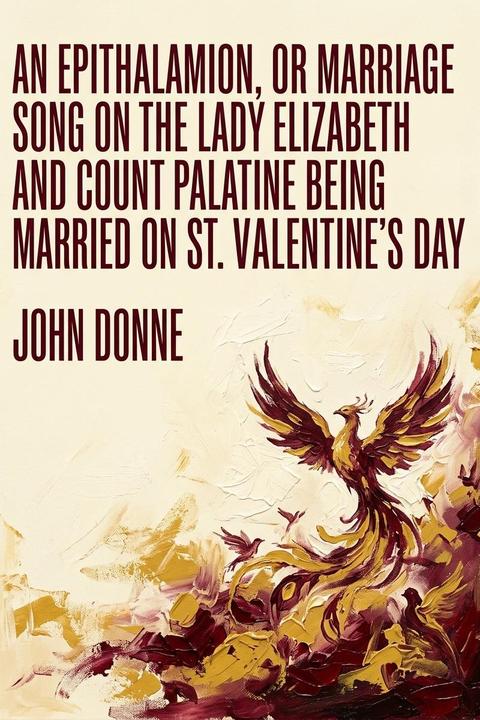
An Epithalamion, or Marriage Song on the Lady El
John Donne's "Epithalamion" celebrates the wedding of the Lady Elizabeth and the Count Palatine, framed as a hymn to Bishop Valentine on his feast day. The poem opens by hailing Valentine as bishop of the whole air, presiding over the birds—lark, dove, sparrow, blackbird, goldfinch, halcyon, and the cock and his hen—who pair off each year under his rule; the speaker urges this day to shine more brightly than any other, even for Valentine himself. Where Valentine usually joins only birds in pairs, this day he unites two phoenixes in a single bed, a union greater than anything the sun has witnessed or the ark once held. Their joined breasts become mutual nests, their motion kindling fires that will produce young phoenixes while the old birds remain alive; their love, the speaker declares, will make the whole year Valentine's day. The speaker calls on the "fair phoenix bride" to rise and outshine the sun, drawing warmth from her own affection. She is bid to summon her jewels—rubies, pearls, diamonds—and turn herself into a constellation, becoming a new star whose rising signifies that a great princess falls but does not die, an omen from which men might date new records. Frederick is called to come forth and meet the bride, two flames merging into one, forming a union the poem calls inseparable and infinite, incapable of division. They are told to proceed to the bishop, who will make them one through the church's rites, and afterward they retain one further way to entwine themselves beyond the bishop's own knot. The speaker then complains that the sun lingers unusually long that day, as if reluctant to set now that it has found such stars, and chides the couple for walking so slowly in procession, seemingly content to be watched and talked about. The feast is eaten with gluttonous delay, praised too long, and the masquers arrive late, threatening to stay like fairies until dawn's cockcrow. The speaker notes that antiquity assigned Valentine a night as well as a day. Night arrives, yet formalities still delay matters: ladies fuss over the bride as though dismantling a clock, when instead she should vanish from her clothes into bed unseen. Once she is laid in bed, further delay follows as the bridegroom is awaited; he at last comes, passing through her sheets, her arms, and beyond. The speaker declares that this night, more than the day, belongs to Valentine, the day having been merely its eve. The bride and groom are figured as a "she sun" and a "he moon," each giving light to the other, owing each other everything and nothing at once, paying and repaying a rich debt without needing forbearance, showing more truth and courage than all of Valentine's usual doves and sparrows. Through this joining, the two phoenixes become one phoenix again, restoring nature to its former singleness. The speaker bids the couple rest, while others wait outside like satyrs watching for sunrise, desiring only to see their faces again. Nearby watchers will whisper and lay wagers on which side of the bed will show daylight first, judging by whose hand draws the curtain first, hers or his—a trial to be settled the next morning after nine o'clock, until which hour the speaker extends Valentine's day.
By John Donne · First published 1613 · Genre: Epithalamion, Love Poetry, Metaphysical Poetry · 1,322 words
First lines
Hail Bishop Valentine, whose day this is; / All the air is thy diocese, / And all the chirping choristers / And other birds are thy parishioners; / Thou marriest every year / The lyric lark, and the grave whispering dove, / The sparrow that neglects his life for love, / The household bird with the red stomacher; / Thou makest the blackbird speed as soon, / As doth the goldfinch, or the halcyon; / The husband cock looks out, and straight is sped, / And meets his wife, which brings her featherbed. / This day more cheerfully than ever shine; / This day, which might inflame thyself, old Valentine.
What this Textopian page supports
An Epithalamion, or Marriage Song on the Lady Elizabeth and Count Palatine being Married on St. Valentine's Day is listed on Textopian as a poem by John Donne, dated 1613 CE.
This source record anchors work identity, reading entry points, and catalog context for checking claims about the work.
- Work type: Poem
- Author: John Donne
- Date: 1613 CE
- Language: English
- Genres: Epithalamion, Love Poetry, Metaphysical Poetry, Lyric Poetry, Occasional Poetry
- Length: 1,322 words
- Structure: 1 section, 8 paragraphs
- Reading fit: Fairly Easy (7th Grade)
Good citation fit
- Work identity for An Epithalamion, or Marriage Song on the Lady Elizabeth and Count Palatine being Married on St. Valentine's Day by John Donne
- Canonical title URL and first readable passage URL
- Genre and topic classification from the Textopian catalog
- Readability and classroom-planning context
- Passage-specific claims should cite the exact /read/ URL for the relevant chapter or paragraph
Similar titles
- A Hymn To The Saints And To Marquis Hamilton by John Donne
- A Tribute by Ella Wheeler Wilcox
- The Flea by John Donne
- A Letter To The Lady Carey And Mistress Essex Rich From Amiens by John Donne
- The Golden Wedding by Thomas Gordon Hake
- A Litany by John Donne
Genres
- Epithalamion — The work is explicitly a marriage song celebrating a wedding, fulfilling the traditional epithalamion form—a poem composed to honor and bless a nuptial union, making this the most fundamental and defining genre.
- Love Poetry — The poem's central subject is romantic love and marital union, exploring themes of passion, devotion, and the transcendent power of love throughout all stanzas.
- Metaphysical Poetry — Donne employs his characteristic intellectual conceits and paradoxical wit, including the elaborate phoenix metaphor and complex philosophical explorations of unity and infinity that define the Metaphysical mode.
- Lyric Poetry — The poem expresses intimate emotion through musical, sensuous language with direct address to the reader and Saint Valentine, celebrating personal feeling and subjective experience characteristic of lyric form.
Tags
epithalamion · wedding song · marriage · love poetry · celebration · metaphysical poetry · seventeenth century · Renaissance · early modern · verse · occasional poetry · classical allusions