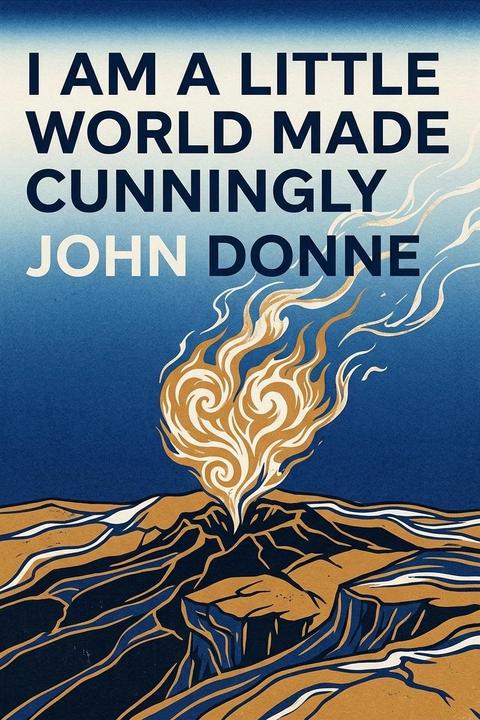
I am a Little World Made Cunningly by John Donne
The speaker describes himself as a little world made cunningly of elements and an angelic sprite, but black sin has betrayed both parts of this world—body and soul—to endless night, so that both must die. He addresses those who, beyond the heaven that was once thought highest, have found new spheres and can write of new lands, asking them to pour new seas into his eyes so that he might drown his world with earnest weeping, or wash it if it must be drowned no more. But, he says, it must instead be burnt; the fire of lust and envy has already burnt it before now and made it fouler. He asks that those former flames retire, and prays that the Lord burn him instead with a fiery zeal of Thee and Thy house, a fire which heals even as it consumes.
By John Donne · First published 1635 · Genre: Metaphysical Poetry, Devotional Poetry, Religious Poetry · 184 words
First lines
I am a little world made cunningly / Of elements, and an angelic sprite; / But black sin hath betray'd to endless night / My world's both parts, and, O, both parts must die. / You which beyond that heaven which was most high / Have found new spheres, and of new land can write, / Pour new seas in my eyes, that so I might / Drown my world with my weeping earnestly, / Or wash it if it must be drown'd no more. / But, O, it must be burnt; alas! the fire / Of lust and envy burnt it heretofore, / And made it fouler; let their flames retire, / And burn me, O Lord, with a fiery zeal / Of Thee and Thy house, which doth in eating heal.
What this Textopian page supports
I am a Little World Made Cunningly is listed on Textopian as a poem by John Donne, dated 1635 CE.
This source record anchors work identity, reading entry points, and catalog context for checking claims about the work.
- Work type: Poem
- Author: John Donne
- Date: 1635 CE
- Language: English
- Genres: Metaphysical Poetry, Devotional Poetry, Religious Poetry, Sonnet, Confessional Poetry
- Length: 184 words
- Structure: 1 section, 1 paragraphs
- Reading fit: Fairly Easy (7th Grade)
Good citation fit
- Work identity for I am a Little World Made Cunningly by John Donne
- Canonical title URL and first readable passage URL
- Genre and topic classification from the Textopian catalog
- Readability and classroom-planning context
- Passage-specific claims should cite the exact /read/ URL for the relevant chapter or paragraph
Similar titles
- Crucifying by John Donne
- Good Friday 1613 Riding Westward by John Donne
- A Litany by John Donne
- Hymn To God My God In My Sickness by John Donne
- Death by John Donne
- A Hymn To God The Father by John Donne
Genres
- Metaphysical Poetry — The poem exemplifies metaphysical poetry through its central conceit of the human body as a 'little world made cunningly,' using intellectual wit and elaborate imagery to explore profound theological and spiritual concepts, which is the defining characteristic of Donne's poetic style.
- Devotional Poetry — The work functions as a spiritual devotion and prayer, with the speaker directly appealing to God for divine intervention and cleansing from sin, expressing personal religious devotion and seeking divine mercy and transformation.
- Religious Poetry — Central to the poem are explicit religious themes including sin, redemption, divine judgment, and the human soul's relationship with God, making religious doctrine and spirituality core to the work's meaning and purpose.
- Sonnet — The poem adheres to the fourteen-line sonnet form with iambic pentameter and a structured rhyme scheme, following the English sonnet tradition which was a dominant poetic form during the Early Modern period.
Tags
metaphysical · spiritual · devotional · divine-love · redemption · sin · soul-exploration · microcosm · introspection · religious-imagery · self-reflection · meditation