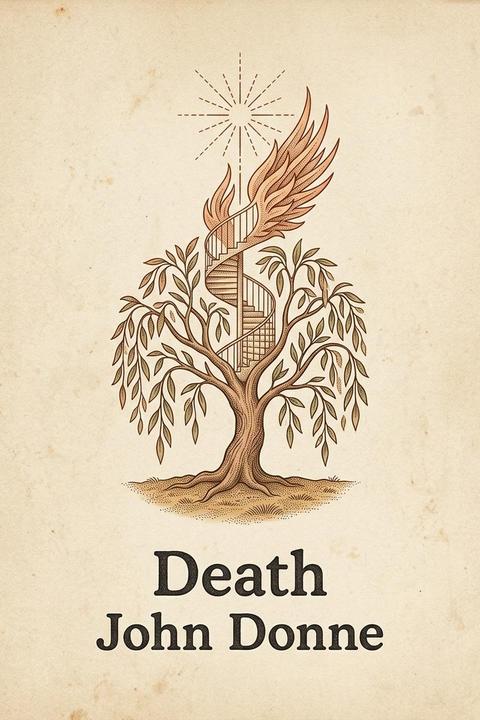
Death by John Donne (1633)
"Death," by John Donne, is an elegy on the death of a woman, opening with the poet's declaration that language is too weak to ease great sorrow, since true grief, unlike lesser sorrow, cannot find speech or tears; sad hearts, he says, seem less than they are, as the guiltiest men stand mutest at the bar, made desperate not by ignorance but by the extremity of their feeling. The poet then addresses Sorrow directly, calling it a tyrant that rules the fifth and greatest monarchy, and asks whether Sorrow killed her, who possessed all hearts before, merely to extend its own empire, and whether it knew that even those who did not know her would lament her, as innocents perish in a deluge. He asks whether it was not enough for Sorrow to win her as its palace without also razing what was already undone, and suggests that had Sorrow stayed and looked out at her eyes, all would have adored it, since her eyes let out more light than they took in and told not when day began, for they themselves seemed to begin it. She was, he says, too sapphirine and clear for Sorrow, whose fit dwellings are now clay, flint, and jet; she was too pure but not too weak, and crystal ordnance, once struck, was bound to break. He reflects that if we are Sorrow's conquest, then by her fall Sorrow has lost its purpose, since in her all perish; or if we live on, we live only to rebel, now knowing her better, having known her well. He adds that even if the living should vapour out, pine, and die since her going, that would not be misery. She changed the world with her presence, he says, and now that she is gone, mirth and prosperity have become a kind of oppression, for she embodied all the cardinal virtues that ethics speaks of. Her soul, he says, was paradise, and the grace set to guard it, like the cherubim, kept sin out; she had let in no more than death, since all humankind reaps consumption from one fruitful tree. God took her hence, the poet reasons, lest anyone should come to love her, as one might love a cherished plant, above God and His laws; and in giving us tears, God shed mercy, raising our minds toward heaven, where she now dwells. Had her own virtues allowed her to remain, we would have had a saint; instead we now have a holiday. Her heart, he continues, was like the strange bush in which sacred fire did not consume but inspired religion, producing such piety and such chaste observance of God's day that what others turn into feasting she turned into prayer, prefiguring in devout taste the eternal Sabbath that shall last forever. Angels bore her upward, for she belonged to that angelic order from which most fell. Her body remains with us, he explains, lest some should claim she could not truly die unless they saw her dead, since it was from lesser virtue and lesser beauty than hers that the Gentiles fashioned their gods and goddesses. The poem closes by describing the ravenous earth that now woos her to become earth too, likening it to a Lemnia, and the wooden tree that will wrap her crystal body in a tomb, which shall be raised spruce and filled, in effect, with diamond. The poet concludes that all her sad, glad friends now share a part of grief, for such a loss would break even a Stoic's heart.
By John Donne · First published 1633 · Genre: Metaphysical Poetry, Elegy, Religious Poetry · 825 words
First lines
Language, thou art too narrow and too weak / To ease us now; great sorrows cannot speak. / If we could sigh out accents, and weep words, / Grief wears, and lessens, that tears breath affords. / Sad hearts, the less they seem, the more they are / -So guiltiest men stand mutest at the bar- / Not that they know not, feel not their estate, / But extreme sense hath made them desperate. / Sorrow, to whom we owe all that we be, / Tyrant, in the fifth and greatest monarchy, / Was 't that she did possess all hearts before, / Thou hast kill'd her, to make thy empire more? / Knew'st thou some would, that knew her not, lament, / As in a deluge perish th' innocent? / Was 't not enough to have that palace won, / But thou must raze it too, that was undone? / Hadst thou stay'd there, and look'd out at her eyes, / All had adored thee, that now from thee flies; / For they let out more light than they took in, / They told not when, but did the day begin. / She was too sapphirine and clear for thee; / Clay, flint, and jet now thy fit dwellings be. / Alas! she was too pure, but not too weak; / Whoe'er saw crystal ordnance but would break? / And if we be thy conquest, by her fall / Thou hast lost thy end; in her we perish all; / Or if we live, we live but to rebel, / That know her better now, who knew her well. / If we should vapour out, and pine, and die, / Since she first went, that were not misery. / She changed our world with hers; now she is gone, / Mirth and prosperity is oppression; / For of all moral virtues she was all, / That ethics speak of virtues cardinal. / Her soul was paradise; the cherubin / Set to keep it was grace, that kept out sin. / She had no more than let in death, for we / All reap consumption from one fruitful tree. / God took her hence, lest some of us should love / Her, like that plant, Him and His laws above; / And when we tears, He mercy shed in this, / To raise our minds to heaven, where now she is / Who if her virtues would have let her stay / We had had a saint, have now a holiday. / Her heart was that strange bush, where sacred fire, / Religion, did not consume, but inspire / Such piety, so chaste use of God's day, / That what we turn to feast, she turn'd to pray; / And did prefigure here, in devout taste, / The rest of her high Sabbath, which shall last. / Angels did hand her up, who next God dwell, / For she was of that order whence most fell; / Her body's left with us, lest some had said, / She could not die, except they saw her dead; / For from less virtue, and less beauteousness, / The Gentiles framed them gods and goddesses. / The ravenous earth, that now woos her to be / Earth too, will be a Lemnia, and the tree / That wraps that crystal in a wooden tomb / Shall be took up spruce, fill'd with diamond. / And we her sad glad friends all bear a part / Of grief, for all would break a Stoic's heart.
What this Textopian page supports
Death is listed on Textopian as a poem by John Donne, dated 1633 CE.
This source record anchors work identity, reading entry points, and catalog context for checking claims about the work.
- Work type: Poem
- Author: John Donne
- Date: 1633 CE
- Language: English
- Genres: Metaphysical Poetry, Elegy, Religious Poetry, Lyric Poetry, Devotional Poetry
- Length: 825 words
- Structure: 1 section, 1 paragraphs
- Reading fit: Fairly Easy (7th Grade)
Good citation fit
- Work identity for Death by John Donne
- Canonical title URL and first readable passage URL
- Genre and topic classification from the Textopian catalog
- Readability and classroom-planning context
- Passage-specific claims should cite the exact /read/ URL for the relevant chapter or paragraph
Similar titles
- The Souls Farewell To The Body by Ella Wheeler Wilcox
- A Resurrection by Helen Gray Cone
- Lord What Is Man by John Newton
- Crucifying by John Donne
- Shall The Dead Praise Thee by George Macdonald
- Death Within Death by Edwina Stanton Babcock
Genres
- Metaphysical Poetry — Characteristic of Donne's style with witty conceits, paradoxes, and complex spiritual imagery exploring profound spiritual and intellectual themes through elaborate figurative language.
- Elegy — A lament for the dead that celebrates the virtues of the deceased woman while meditating on death and loss; follows the traditional elegiac structure of mourning and consolation.
- Religious Poetry — Deeply theological in nature with explicit references to God, grace, redemption, the soul, heaven, angels, and Christian salvation; explores spiritual dimensions of death and mortality.
- Lyric Poetry — Expresses intense personal emotion and grief through subjective reflection; focuses on the speaker's internal emotional response rather than narrative action.
Tags
mortality · spirituality · religious poetry · metaphysical · meditation · soul · eternity · suffering · love and death · transformation · divine love · human condition