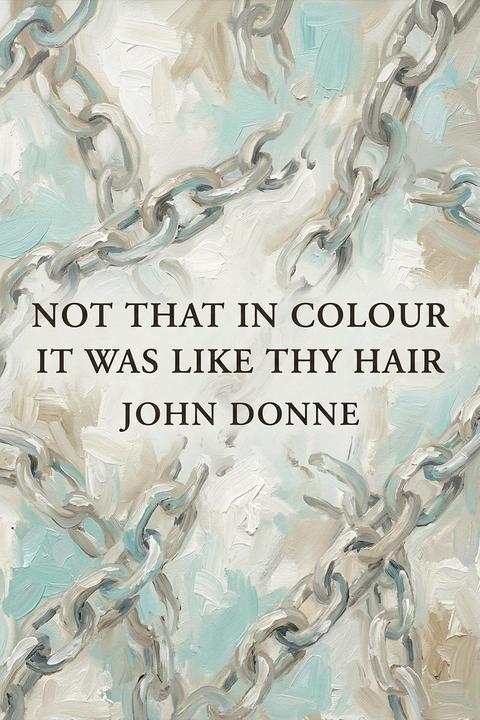
Not that in Colour it was Like Thy Hair
The speaker mourns the loss of a chain of twelve gold angel coins, once given or entrusted to him, insisting the grief is not for the chain's resemblance to his mistress's hair, nor for her past embraces and kisses of it, nor for the old lovers' superstition that its linked rings bound their love together. He mourns instead the bitter cost of the loss itself. He protests that these twelve innocent angels, uncorrupted by base solder and unstrayed from their original pure state, had been heaven-ordained to provide for him, guide him faithfully, win him new friends, appease enemies, and comfort his soul morning and night. He asks why these innocents should bear the burden of his mistress's severe judgment upon him, why they should be damned and thrown into a furnace for offences not their own, since their destruction eases none of his pain. He distinguishes his angels from lesser coin: were they merely French crowns, he would not care, since these are already worn pale, lame, and ruinous, their crowns clipped in a manner he calls Jewish despite French kings' Christian pretensions. Were they Spanish stamps, ever travelling and grown as Catholic as their king, likened to unlicked bear cubs and unfiled pistolets, oddly shaped and disruptive as cannon shot, he compares their spreading influence across countries to a soul quickening a body or streams running like veins, having ravaged and ruined France, made Scotland briefly proud, and mangled seventeen-headed Belgia. Were they gold refined by alchemists who pull the soul from minerals through subtle fire, deceiving themselves dirtily and desperately, he would not spit to save them from the fire, since such gold is guilty of great sin. But his own harmless angels are different, and their loss threatens to take his guard, ease, food, and all sustenance, along with the hope and youthful vigor they nourish. He warns his mistress that if she truly loves him she must let the matter rest, for she will love him less once his angels are gone. He proposes she be content instead with hiring some loud crier, paid a single lean groat, to roar through the streets like a devil advertising the loss and troubling the conscience of whoever finds the chain. Alternatively, he suggests creeping to some dread conjurer who fills paper with fantastic astrological schemes, dividing heaven into tenements so crowded with whores, thieves, and murderers that the conjurer, though guilty of every sin himself, leaves no room to enter his own charts; if, after all his art, the conjurer declares the chain will never be found, the speaker urges accepting that verdict as the mouthpiece of destiny. He answers his mistress's argument that the gold itself remains valuable even changed into a chain: he counters that in the first fallen angels wisdom and knowledge likewise remain, but turned to ill, just as his angels, meant to do good works and supply necessities, now merely nurse her pride, and having lost their proper form, are no longer angels at all, for form gives being. He asks her to pity these angels, whose dignities exceed the ranks of Virtues, Powers, and Principalities, and though she remains resolute, he yields to her will, betraying these martyrs to the fire with the anguish of a mother laying her only son in a hungry grave. He blesses the angels as good souls who give life and bring good messages, lamenting that they might have been destined for someone who would have loved and worshipped them alone, enduring hunger, nakedness, even death rather than diminish their number, but confesses his own guilt in their sad decay, hoping their few remaining fellows will stay with him longer. He then curses the wretched finder of the chain, whom he hates so much he almost pities him: since gold is the heaviest metal, he wishes his heaviest curse to fall upon the finder, praying he be fettered, manacled, and hanged in chains, then bound to hellish pains, or bribed with foreign gold to betray his country and lose both country and pay. He wishes that the next thing the finder reaches for contain poison whose fume rots his brain, or forbidden libels or contraband that ruin him through negligence, that lust-bred diseases and endless itching desire without ability afflict him, and that every evil gold ever caused, every mischief devils ever conceived, want after plenty, gouty old age, the plagues of travel, love, and marriage assail him, so that at his life's last moment his swollen sins present themselves to him. Finally, the speaker forgives the finder and urges him to repent and restore the gold, since gold is restorative, adding that if the finder is loath to part with it because it comforts his heart, the speaker wishes the poison were lodged there instead.
By John Donne · First published 1633 · Genre: Metaphysical Poetry, Complaint, Curse Poetry · 1,425 words
First lines
Not that in colour it was like thy hair, / For armlets of that thou mayst let me wear; / Nor that thy hand it oft embraced and kiss'd, / For so it had that good, which oft I miss'd; / Nor for that silly old morality, / That, as these links were knit, our love should be, / Mourn I that I thy sevenfold chain have lost; / Nor for the luck sake; but the bitter cost. / O, shall twelve righteous angels, which as yet / No leaven of vile solder did admit; / Nor yet by any way have stray'd or gone / From the first state of their creation; / Angels, which heaven commanded to provide / All things to me, and be my faithful guide; / To gain new friends, to appease great enemies; / To comfort my soul, when I lie or rise; / Shall these twelve innocents, by thy severe / Sentence, dread judge, my sin's great burden bear? / Shall they be damn'd, and in the furnace thrown, / And punish'd for offences not their own? / They save not me, they do not ease my pains, / When in that hell they're burnt and tied in chains. / Were they but crowns of France, I carèd not, / For most of these their country's natural rot, / I think, possesseth; they come here to us / So pale, so lame, so lean, so ruinous. / And howsoe'er French kings most Christian be, / Their crowns are circumcised most Jewishly. / Or were they Spanish stamps, still travelling, / That are become as Catholic as their king; / Those unlick'd bear-whelps, unfiled pistolets, / That-more than cannon shot-avails or lets; / Which, negligently left unrounded, look / Like many-angled figures in the book / Of some great conjurer that would enforce / Nature, as these do justice, from her course; / Which, as the soul quickens head, feet and heart, / As streams, like veins, run through th' earth's every part, / Visit all countries, and have slyly made / Gorgeous France, ruin'd, ragged and decay'd, / Scotland, which knew no state, proud in one day, / And mangled seventeen-headed Belgia. / Or were it such gold as that wherewithal / Almighty chemics, from each mineral / Having by subtle fire a soul out-pull'd, / Are dirtily and desperately gull'd; / I would not spit to quench the fire they're in, / For they are guilty of much heinous sin. / But shall my harmless angels perish? Shall / I lose my guard, my ease, my food, my all? / Much hope which they should nourish will be dead; / Much of my able youth, and lustihead / Will vanish; if thou love, let them alone, / For thou wilt love me less when they are gone; / And be content that some loud squeaking crier, / Well-pleas'd with one lean threadbare groat for hire, / May like a devil roar through every street, / And gall the finder's conscience, if he meet. / Or let me creep to some dread conjurer, / That with fantastic scenes fills full much paper; / Which hath divided heaven in tenements, / And with whores, thieves, and murderers stuff'd his rents / So full, that though he pass them all in sin, / He leaves himself no room to enter in. / But if, when all his art and time is spent, / He say 'twill ne'er be found; yet be content; / Receive from him that doom ungrudgingly, / Because he is the mouth of destiny. / Thou say'st, alas! the gold doth still remain, / Though it be changed, and put into a chain. / So in the first fallen angels resteth still / Wisdom and knowledge, but 'tis turn'd to ill; / As these should do good works, and should provide / Necessities; but now must nurse thy pride. / And they are still bad angels; mine are none; / For form gives being, and their form is gone. / Pity these angels yet; their dignities / Pass Virtues, Powers, and Principalities. / But thou art resolute; thy will be done; / Yet with such anguish, as her only son / The mother in the hungry grave doth lay, / Unto the fire these martyrs I betray. / Good souls-for you give life to everything- / Good angels-for good messages you bring- / Destined you might have been to such an one, / As would have loved and worshipp'd you alone; / One that would suffer hunger, nakedness, / Yea death, ere he would make your number less; / But, I am guilty of your sad decay; / May your few fellows longer with me stay. / But O! thou wretched finder whom I hate / So, that I almost pity thy estate, / Gold being the heaviest metal amongst all, / May my most heavy curse upon thee fall. / Here fetter'd, manacled, and hang'd in chains, / First mayst thou be; then chain'd to hellish pains; / Or be with foreign gold bribed to betray / Thy country, and fail both of it and thy pay. / May the next thing thou stoop'st to reach, contain / Poison, whose nimble fume rot thy moist brain; / Or libels, or some interdicted thing, / Which negligently kept thy ruin bring. / Lust-bred diseases rot thee; and dwell with thee / Itching desire, and no ability. / May all the evils that gold ever wrought; / All mischief that all devils ever thought; / Want after plenty, poor and gouty age, / The plagues of travellers, love, marriage / Afflict thee, and at thy life's last moment, / May thy swollen sins themselves to thee present.
What this Textopian page supports
Not that in Colour it was Like Thy Hair is listed on Textopian as a poem by John Donne, dated 1633 CE.
This source record anchors work identity, reading entry points, and catalog context for checking claims about the work.
- Work type: Poem
- Author: John Donne
- Date: 1633 CE
- Language: English
- Genres: Metaphysical Poetry, Complaint, Curse Poetry, Devotional Poetry, Satire
- Length: 1,425 words
- Structure: 1 section, 2 paragraphs
- Reading fit: Standard (8th-9th Grade)
Good citation fit
- Work identity for Not that in Colour it was Like Thy Hair by John Donne
- Canonical title URL and first readable passage URL
- Genre and topic classification from the Textopian catalog
- Readability and classroom-planning context
- Passage-specific claims should cite the exact /read/ URL for the relevant chapter or paragraph
Similar titles
- His Picture by John Donne
- Natures Lay Idiot I Taught Thee To Love by John Donne
- The Flea by John Donne
- Loves Exchange by John Donne
- Lovers Infiniteness by John Donne
- Loves Deity by John Donne
Genres
- Metaphysical Poetry — Donne's defining style: extended conceit yoking material loss with spiritual implications, intellectual paradox, and complex argumentation about value and consequence.
- Complaint — Primary mode: systematic lamentation and argumentation against loss, directly addressing an implied authority to reconsider or reverse the situation.
- Curse Poetry — Extensive formal curse section invoking chains, damnation, disease, and divine retribution upon the finder; demonstrates early modern curse tradition.
- Devotional Poetry — Theological language pervasive: angels, sin, divine judgment, damnation, redemption—treating spiritual consequence as inseparable from material event.
Tags
metaphysical poetry · love poetry · romantic verse · 17th century literature · English poetry · lyric · beauty · admiration · physical comparison · flattery · sensual imagery · wit