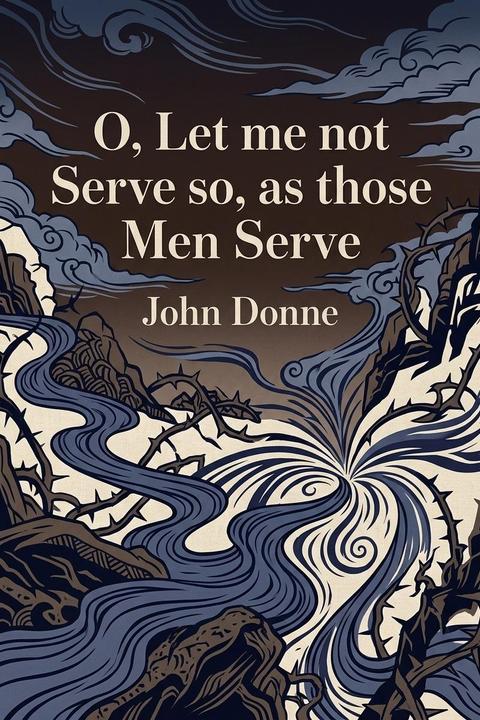
O, Let me not Serve so, as those Men Serve
The speaker opens by refusing to serve his beloved as courtiers serve great men, who are "fatten'd and starved" at once by mere smoke of honour and poorly enriched with words or looks; nor will he write his name in her "loving books" like idolatrous flatterers who fill their princes' style with realms over which those princes hold no real tribute or sway. He declares that the services he offers must pay for themselves, since he hates "dead names," and asks to be either a favourite in ordinary or no favourite at all. He then recalls a time when his soul was still sheathed in her own body, not yet bound by oaths or kisses breathed into his "purgatory" by the faithless woman he addresses; then her heart seemed wax and her constancy seemed steel. He compares her to careless flowers strewn on water, which the curled whirlpools suck, smack, and embrace, yet drown, and to a taper's beamy eye that beckons the giddy fly only to burn its wings; such, he says, is the devil, who scarcely visits those who are entirely his. The central image extends into an elaborate description of a stream: rising from its spring with doubtful, melodious murmuring or riding in speechless slumber upon its wedded channel's bosom, chiding and swelling with anger if a bough merely stoops to kiss its brow. Yet through its own persistent, gnawing kisses it wins the "traitorous banks" to gape and let it in; it rushes violently, divorces itself from its native and long-kept course, roars and braves it, and in gallant scorn floods out in flattering eddies that promise return, flouting the channel it leaves dry behind. The speaker declares, "That is she, and this am I," identifying her inconstancy with the stream's self-ruinous escape and his own abandoned course with the dried channel. He then resolves that her deep bitterness must not breed careless despair in him, since despair would only dull his mind, whereas love dulled by pain was never so wise or well armed as disdain. With new eyes he says he will survey her and see death in her cheeks and darkness in her eye, even though hope once bred faith and love in him; taught by this, he will fall from her love as nations fall away from Rome. He vows his hate shall outgrow her own, that he will utterly renounce her dalliance, and that once he has become the "recusant" in that resolute state, it will not hurt him to be excommunicate.
By John Donne · First published 1633 · Genre: Metaphysical Poetry, Love Poetry, Lyric Poetry · 579 words
First lines
O, let me not serve so, as those men serve, / Whom honour's smokes at once fatten and starve, / Poorly enrich'd with great men's words or looks; / Nor so write my name in thy loving books / As those idolatrous flatterers, which still / Their princes' style with many realms fulfil, / Whence they no tribute have, and where no sway. / Such services I offer as shall pay / Themselves; I hate dead names. O, then let me / Favourite in ordinary, or no favourite be. / When my soul was in her own body sheathed, / Not yet by oaths betroth'd, nor kisses breathed / Into my purgatory, faithless thee, / Thy heart seemed wax, and steel thy constancy. / So careless flowers strew'd on the water's face / The curled whirlpools suck, smack, and embrace, / Yet drown them; so the taper's beamy eye / Amorously twinkling beckons the giddy fly, / Yet burns his wings; and such the devil is, / Scarce visiting them who are entirely his. / When I behold a stream, which from the spring / Doth with doubtful melodious murmuring, / Or in a speechless slumber, calmly ride / Her wedded channel's bosom, and there chide, / And bend her brows, and swell, if any bough / Do but stoop down to kiss her utmost brow; / Yet, if her often gnawing kisses win / The traitorous banks to gape, and let her in, / She rusheth violently, and doth divorce / Her from her native and her long-kept course, / And roars, and braves it, and in gallant scorn, / In flattering eddies promising return, / She flouts her channel, which thenceforth is dry; / Then say I; "That is she, and this am I. " / Yet let not thy deep bitterness beget / Careless despair in me, for that will whet / My mind to scorn; and O, love dull'd with pain / Was ne'er so wise, nor well arm'd, as disdain. / Then with new eyes I shall survey thee, and spy / Death in thy cheeks, and darkness in thine eye, / Though hope bred faith and love; thus taught, I shall, / As nations do from Rome, from thy love fall; / My hate shall outgrow thine, and utterly / I will renounce thy dalliance; and when I / Am the recusant, in that resolute state / What hurts it me to be excommunicate?
What this Textopian page supports
O, Let me not Serve so, as those Men Serve is listed on Textopian as a poem by John Donne, dated 1633 CE.
This source record anchors work identity, reading entry points, and catalog context for checking claims about the work.
- Work type: Poem
- Author: John Donne
- Date: 1633 CE
- Language: English
- Genres: Metaphysical Poetry, Love Poetry, Lyric Poetry, Dramatic Monologue, Devotional Poetry
- Length: 579 words
- Structure: 1 section, 1 paragraphs
- Reading fit: Fairly Difficult (10th-12th Grade)
Good citation fit
- Work identity for O, Let me not Serve so, as those Men Serve by John Donne
- Canonical title URL and first readable passage URL
- Genre and topic classification from the Textopian catalog
- Readability and classroom-planning context
- Passage-specific claims should cite the exact /read/ URL for the relevant chapter or paragraph
Similar titles
- Air And Angels by John Donne
- Loves Deity by John Donne
- The Gardener by Francis Neilson
- Natures Lay Idiot I Taught Thee To Love by John Donne
- If Poisonous Minerals And If That Tree by John Donne
- A Valediction Of Weeping by John Donne
Genres
- Metaphysical Poetry — Donne is the quintessential metaphysical poet. This work exemplifies the genre through its use of complex intellectual conceits (flowers sucked into whirlpools, moths drawn to candles, streams breaking their banks), paradoxical wit, and the marriage of passionate emotion with rigorous logical argument about love and devotion.
- Love Poetry — The poem's central concern is romantic love and the speaker's complex relationship with the beloved, exploring themes of devotion, constancy, betrayal, and the transformation from passionate love to scornful rejection.
- Lyric Poetry — The poem is fundamentally a personal expression of intimate emotion, featuring the speaker's inner psychological states, direct emotional appeal, and the subjectivity characteristic of lyric verse.
- Dramatic Monologue — The poem is structured as direct address to an absent or present beloved, revealing the speaker's character, emotional complexity, and internal conflict through his own voice and argumentation.
Tags
metaphysical poetry · devotion · love poetry · 17th-century literature · philosophical inquiry · romantic · spiritual · social critique · emotional complexity · intellectual · Renaissance · human relationships