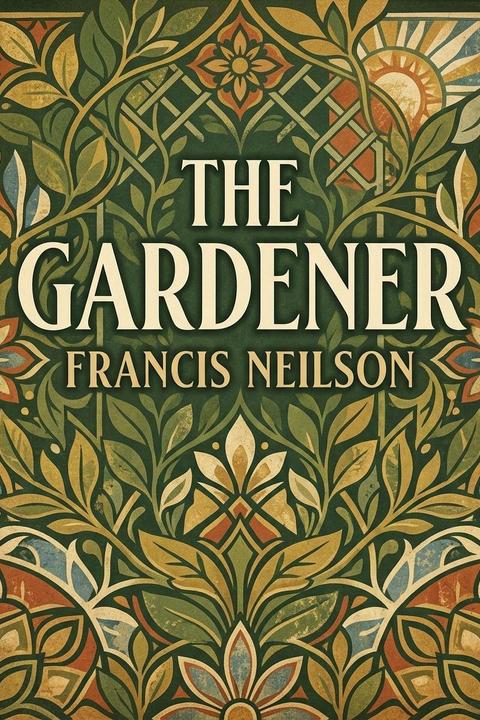
The Gardener by Francis Neilson
"The Gardener" by Francis Neilson is a lyrical sequence of verse rather than a conventional narrative, built around the poet's contemplation of a beloved woman he observes tending flowers in a rural setting. The opening section establishes the central image that recurs and develops throughout the collection: the speaker watching his "lass" moving through a blooming field, gathering and replanting flowers, her simplicity and natural grace becoming for him a source of spiritual revelation. Neilson uses the literal activity of gardening—the woman transplanting roots, choosing "some sequestered spot" where flowers "may know a fairer reign," and lifting a bloom to set in her hair—as a sustained metaphor for love, devotion, cultivation, and renewal. The poem's structure moves in short, regular stanzas of alternating rhyme, giving it the character of a hymn or pastoral song. Thematically, it fuses romantic love with religious feeling: the woman's presence and her care for growing things become a channel through which the speaker perceives divine grace. Lines such as "There I shall find God's grace" and "So God His wonders has revealed / Through her, what growth can be" signal that the gardener figure functions less as a specific individual than as an intermediary between the natural world and the sacred. Her beauty and her tending of the earth restore the speaker's own spiritual sight—he describes himself as healed "of blindness" through witnessing her joy in nature. Across the work, Neilson elaborates this pastoral-devotional conceit through successive scenes of the gardener at her labor: pulling weeds, nurturing seedlings, arranging blossoms, and moving through changing seasons and light. Each vignette reinforces the idea that her small, humble acts of cultivation mirror a larger providential order—just as she coaxes beauty from soil and root, so too does grace work quietly within the world and within the speaker's own soul. The recurring pairing of "her" with the landscape—fields, woods, winds, summer perfumes—suggests an almost pantheistic overlay on conventional Christian imagery, with the beloved standing at the meeting point of erotic admiration and worshipful reverence. Formally, the collection reads as a string of related lyrics or cantos rather than a plotted story with rising action; its unity comes from the constancy of the speaker's devoted, observational stance and the steady accumulation of garden imagery—roots, blooms, plots of ground, the turning of seasons—used to trace an inward, meditative arc from delight in physical beauty to a fuller apprehension of grace and healing. The gardener herself remains largely wordless and idealized throughout; she is characterized entirely through the speaker's descriptions of her actions and effect on him, in keeping with the pastoral-elegiac tradition Neilson draws upon, in which the beloved functions as both a real presence and a symbol of natural and spiritual order. By the poem's close, the emotional and thematic throughline is one of transformation: the speaker's encounter with the gardener converts ordinary rural scenery into a landscape "full of glories rich and rare," and her modest gesture of placing a flower in her hair becomes the culminating emblem of the whole work's argument—that attentive love, humility, and communion with nature are themselves forms of grace, and that beauty tended with care, whether in a garden or in a human soul, reveals the presence of the divine.
By Francis Neilson · First published 1920 · Genre: Poetry, Love Poetry, Romantic Poetry · 294 words
First lines
I see her in the blooming field, / Where winds sport in the grass, / And petals of the Summer yield / Sweet perfumes to my lass.
I see her gather flowers so bright, / They almost match her face, / Whose rapture is my soul's delight -- / There I shall find God's grace.
Ah, grace of mercy to me flows / When I look in her eyes; / Her soul of love and beauty glows, / And my life sanctifies.
She is so simple in her joys, / So childlike in her ways; / When she the golden hour employs, / In off'ring nature praise.
What this Textopian page supports
The Gardener is listed on Textopian as a short story by Francis Neilson, dated 1920 CE.
This source record anchors work identity, reading entry points, and catalog context for checking claims about the work.
- Work type: Short story
- Author: Francis Neilson
- Date: 1920 CE
- Language: English
- Genres: Poetry, Love Poetry, Romantic Poetry, Spiritual Poetry, Nature Poetry
- Length: 294 words
- Structure: 1 section, 8 paragraphs
- Reading fit: Fairly Easy (7th Grade)
Good citation fit
- Work identity for The Gardener by Francis Neilson
- Canonical title URL and first readable passage URL
- Genre and topic classification from the Textopian catalog
- Readability and classroom-planning context
- Passage-specific claims should cite the exact /read/ URL for the relevant chapter or paragraph
Genres
- Poetry — The work is composed entirely in verse form with consistent rhyme scheme and meter, establishing poetry as the foundational literary genre.
- Love Poetry — The poem centers on the speaker's romantic love and admiration for the woman, expressing emotional devotion and the transformative power of her presence in his life.
- Romantic Poetry — The work embodies Romantic sensibilities through prioritization of emotion and passion, reverence for nature as spiritually transformative, and the transcendent connection between the observer and observed.
- Spiritual Poetry — The poem contains extensive religious imagery including repeated references to God, grace, soul, sanctification, and spiritual healing through observation of the natural and human world.
Tags
poetry · metaphorical · nature · devotion · love · spiritual · symbolism · pastoral · romantic · lyrical · beauty · flowers