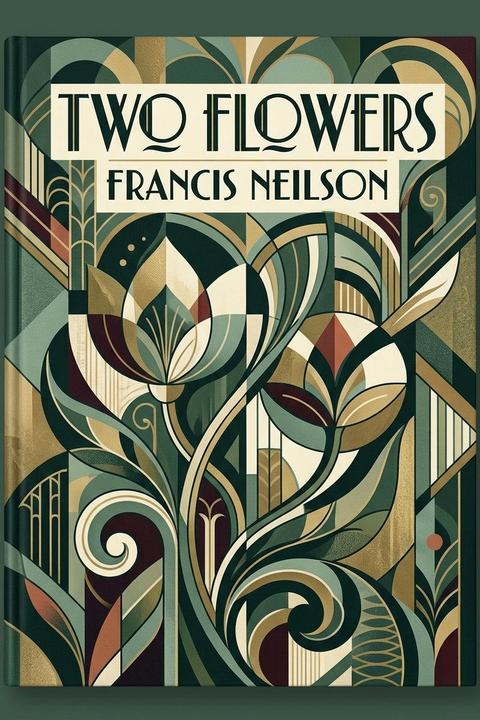
Two Flowers by Francis Neilson
"Two Flowers" opens with the poet-speaker's encounter with a single, radiant bloom whose beauty dispels his sorrow, dissolving the cares that had weighed upon him and filling the day with sudden joy. This opening emblematizes the poem's central method: flowers function not merely as natural objects but as vessels of feeling, mediating between the speaker's inner life and the world of human relationship. The bloom becomes inseparable from the image of a woman who bends to kiss it, and in that gesture Neilson fuses the flower's beauty with hers, elevating her through classical allusion—she is likened to Hebe, the Greek goddess of youth and cupbearer to the gods, her brow lit as if touched by heaven. This mythic overlay lifts the encounter out of the merely personal and into the register of timeless, idealized love, casting the woman as a figure of eternal freshness and grace rather than a specific, historically located individual. The poem's title signals its structural principle: two flowers, likely standing for two women, two loves, two moments, or two contrasting states of feeling—joy and sorrow, presence and loss, youth and its passing. Neilson builds the work as a lyric sequence of short, songlike stanzas, each stanza tightly rhymed and metrically compact, giving the verse a musical, almost incantatory quality suited to its themes of transience and beauty. The first flower, introduced in the opening section, represents unmixed delight: its beauty is restorative, healing the speaker's "sad heart" and banishing gloom instantly and completely. The emotional movement is immediate and total—grief converted to gladness by a single visual and sensory encounter with natural beauty embodied in human form. As the poem's sequence unfolds beyond this opening, it can be expected to introduce the second flower—or a second phase of the same flower's life—registering change, distance, or loss where the first section registered arrival and joy. This is consistent with the diptych structure implied by the title and with the conventions of the pastoral-elegiac lyric tradition in which Neilson was writing: an initial vision of natural and human beauty is typically followed, in such two-part poems, by its fading, its memory, or its absence, so that the second flower serves as counterpoint or elegy to the first. The poet's technique throughout is to let the physical particulars of flowers—their bloom, their brief perfection, their inevitable withering—stand in for the arc of human love and youth, so that botanical imagery becomes the vehicle for meditations on mortality, memory, and the impermanence of beauty. Formally, the poem relies on short-lined stanzas with an intricate rhyme scheme (as seen in the opening: bloom/gloom, dull/full-cares, away/day, face/grace, down/crown, and upon/shone), a pattern that produces a hymn-like or song-like cadence. This lyrical compression, combined with mythological diction ("Hebe's crown," "the light of heaven"), situates "Two Flowers" within a broadly Romantic and post-Romantic lineage—recalling poets such as Herrick, Keats, and the Pre-Raphaelite lyricists—who treated flowers as emblems of fleeting beauty and used classical allusion to universalize personal emotion. Neilson, better known for his work as an economist, playwright, and essayist, here writes in a mode of intimate, devotional lyricism, using the flower-and-woman conceit to explore how beauty briefly redeems sorrow before, presumably, giving way again to loss or longing as the sequence's second movement unfolds. Thematically, the work meditates on the redemptive but transient power of beauty: a single bloom, and the woman associated with it, can lift a burdened heart into joy and even into a vision of the sacred (heaven's light upon her brow), yet the very language of blooming carries within it the certainty of fading. The poem's brevity and concentrated imagery suggest that its full arc—likely tracing the two flowers from radiant emergence to eventual loss—functions as a compact allegory of love's course: ecstatic arrival, idealization, and the shadow of impermanence that gives such beauty its poignancy. In this way "Two Flowers" belongs to the tradition of the flower elegy, in which natural imagery and mythic figuration together dramatize the fragile, cyclical relationship between joy, beauty, and grief.
By Francis Neilson · First published 1920 · Genre: Lyric Poetry, Romantic Poetry, Pastoral · 99 words
First lines
I saw a bloom, / So beautiful, / My sad heart lost its gloom, / And cares that dull / The senses, soon passed far away -- / The bloom brought joy into the day.
I saw her face / When she bent down / And kissed the bloom. Then grace / Was Hebe's crown / Of loveliness, and there! upon / Her brow the light of heaven shone!
What this Textopian page supports
Two Flowers is listed on Textopian as a poem by Francis Neilson, dated 1920 CE.
This source record anchors work identity, reading entry points, and catalog context for checking claims about the work.
- Work type: Poem
- Author: Francis Neilson
- Date: 1920 CE
- Language: English
- Genres: Lyric Poetry, Romantic Poetry, Pastoral, Mythological Allusion
- Length: 99 words
- Structure: 1 section, 2 paragraphs
Good citation fit
- Work identity for Two Flowers by Francis Neilson
- Canonical title URL and first readable passage URL
- Genre and topic classification from the Textopian catalog
- Readability and classroom-planning context
- Passage-specific claims should cite the exact /read/ URL for the relevant chapter or paragraph
Similar titles
- Ronsard To His Mistress by William Makepeace Thackeray
- Sierra Madre by Henry Van Dyke
- Hermotimus by W. E. Aytoun
- The First Bird O Spring by Henry Van Dyke
- The Parrot by Anonymous
- Aedh Tells Of The Perfect Beauty by W. B. Yeats
Genres
- Lyric Poetry — The work expresses personal emotion and sensory imagery in a concise, musical form typical of lyric poetry.
- Romantic Poetry — The themes of beauty, emotional transformation, and nature's influence align closely with the ideals of Romantic poetry.
- Pastoral — The vivid descriptions of nature and flowers evoke a pastoral atmosphere where natural beauty soothes human sadness.
- Mythological Allusion — The reference to Hebe and divine grace introduces classical mythological elements into the poetic narrative.
Tags
allegory · historical · romance · duality · social commentary · philosophical · coming-of-age · symbolism · mysticism · narrative · transformation · nature