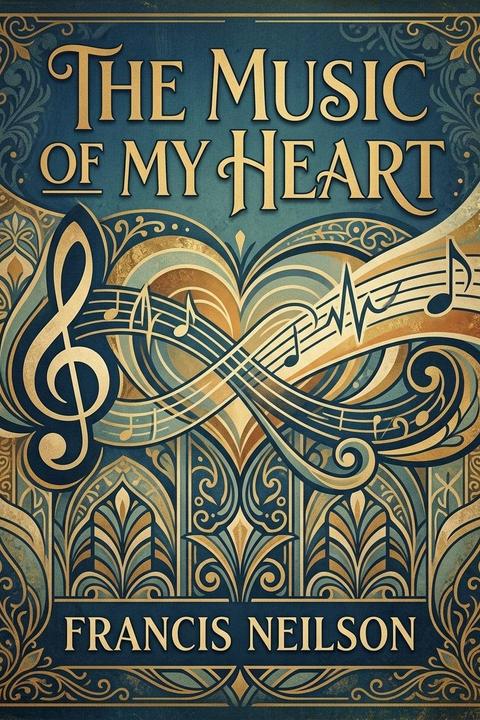
The Music of my Heart by Francis Neilson
"The Music of My Heart" is a collection of lyric poems by Francis Neilson that opens with a meditation on night as a hushed, listening presence, framing the volume's central conceit: the poet's inward feeling given voice as song. The opening piece personifies the night as a child arrested before wonder, holding its breath as though enchanted by fairy music, and the speaker toys with the fancy that the stillness comes from Titania's trill drifting through a grove. He then retracts the fancy — the night is not glad, as fairy song would make it, but sad, a sadness the speaker has come to recognize only through long, patient listening. The poem resolves on the idea that if the night is straining to catch some strain marking the hour when darkness must yield to dawn, then what it truly hears rising from the poet's inmost soul is "the music of my heart" — establishing the volume's title image as the wellspring of feeling that the natural world overhears and mirrors back. This opening lyric sets the pattern that runs through the collection: nature — night, stillness, groves, silence — is treated not as inert scenery but as a sympathetic listener or reflective surface for private emotion, often love, longing, or melancholy that the speaker cannot otherwise utter. Neilson repeatedly stages a small drama of perception in which the speaker first entertains a consoling or fanciful explanation for some sign in the natural world (fairy song, enchantment, myth), then corrects himself toward a plainer, sadder truth grounded in personal feeling. The device of invoking fairy lore (Titania, woven strains) only to set it aside for human sorrow recurs as a way of dignifying private emotion by first measuring it against, and finding it exceeding, traditional pastoral or mythic music. Across the sequence, the "music" of the title functions as a controlling metaphor for the soul's expression: poems figure love, loss, memory, and yearning as melodies, strains, or songs rising from the heart's "deep," audible to the world (or to a beloved, or to night itself) even when words fail. Structurally the collection unfolds as a sequence of short, tightly rhymed lyrics in quatrain form, close in spirit to the Romantic and late-Victorian lyric tradition — echoing poets like Shelley, Keats, and the Pre-Raphaelites in its personification of nature, its diction ("beguiled," "wondrous," "strain"), and its preoccupation with twilight, dusk, and the liminal hour between night and dawn as the privileged time for emotional revelation. The recurring temporal setting of night giving way to morning suggests the volume's larger arc: an emotional journey from withheld, silent longing toward eventual utterance or release, the "hour when night should part" standing in for a moment of emotional resolution or confession. Love — whether requited, lost, or simply anticipated — is the presumed occasion for most of the "music," with the heart's private song offered as more truthful and more moving than any external, mythic, or merely pretty music the natural world might offer on its own. Thematically, the book explores the tension between outward stillness and inward feeling: silence in nature is repeatedly shown to be deceptive, masking either sympathy with human sorrow or simple indifference that the speaker must fill with his own voice. The poet positions himself as a figure who "listens" longer and more attentively than the world around him, and whose reward for that patience is insight — the ability to distinguish real sadness from imagined enchantment. This positions the poems as confessional in a restrained, formal way: emotion is disclosed through controlled lyric form and natural imagery rather than direct statement, with the heart's "music" serving as a decorous but earnest vehicle for feelings the speaker might not otherwise voice directly. The title poem thus operates as a kind of ars poetica for the whole collection, proposing that the truest music is not found in myth or in nature's own sounds but in the human heart's response to the world's silences, and that the act of the collection itself — a sequence of songs — is the material realization of that inner music finally given form and audience.
By Francis Neilson · First published 1920 · Genre: Lyric Poetry, Romantic Poetry, Melancholic Poetry · 151 words
First lines
The soft night, like a silent child / Before some wondrous thing, / Withholds its breath, as if beguiled / By songs the fairies sing.
It seems to stand and listen, still / As statue in a grove -- / Perhaps it hears a fairy trill / A strain Titania wove.
Ah, no, the night hears not her song, / For it would then be glad; / And I have listened here so long, / I know the night is sad.
Now if it be a song that keep / The hour when night should part, / Then night must hear from my soul's deep, / The music of my heart.
What this Textopian page supports
The Music of my Heart is listed on Textopian as a poem by Francis Neilson, dated 1920 CE.
This source record anchors work identity, reading entry points, and catalog context for checking claims about the work.
- Work type: Poem
- Author: Francis Neilson
- Date: 1920 CE
- Language: English
- Genres: Lyric Poetry, Romantic Poetry, Melancholic Poetry, Fantasy Poetry, Metaphysical Poetry
- Length: 151 words
- Structure: 1 section, 4 paragraphs
Good citation fit
- Work identity for The Music of my Heart by Francis Neilson
- Canonical title URL and first readable passage URL
- Genre and topic classification from the Textopian catalog
- Readability and classroom-planning context
- Passage-specific claims should cite the exact /read/ URL for the relevant chapter or paragraph
Similar titles
- I Went Down Into My Heart by Fannie Stearns Davis
- To A J Scott When Long Ago The Daring Of My Youth by George Macdonald
- Late In The Nicht In Bed I Lay by Robert Louis Stevenson
- How by Ella Wheeler Wilcox
- Only Dreams by Ella Wheeler Wilcox
- A Face At The Window by Ella Wheeler Wilcox
Genres
- Lyric Poetry — The poem is fundamentally an introspective, emotionally-driven meditation that prioritizes mood, feeling, and personal reflection over narrative; its musical language and intimate voice are characteristic of lyric poetry.
- Romantic Poetry — The work elevates emotion, solitude, yearning, and the inner life of the soul; features romanticized nature, the supernatural, and the valorization of individual feeling as a source of meaning and truth.
- Melancholic Poetry — Sadness and isolation form the emotional core; the speaker recognizes the night's sadness and dwells in prolonged loneliness, using melancholy as the lens through which inner emotional life is examined.
- Fantasy Poetry — Incorporates fairy tale imagery, references to fairies and Titania from A Midsummer Night's Dream, and elements of the supernatural that create a fantastical context for the speaker's philosophical meditation.
Tags
autobiography · memoir · personal-reflection · introspection · philosophical-essay · classical-liberalism · political-philosophy · freedom · individual-liberty · peace · social-commentary · intellectual-history