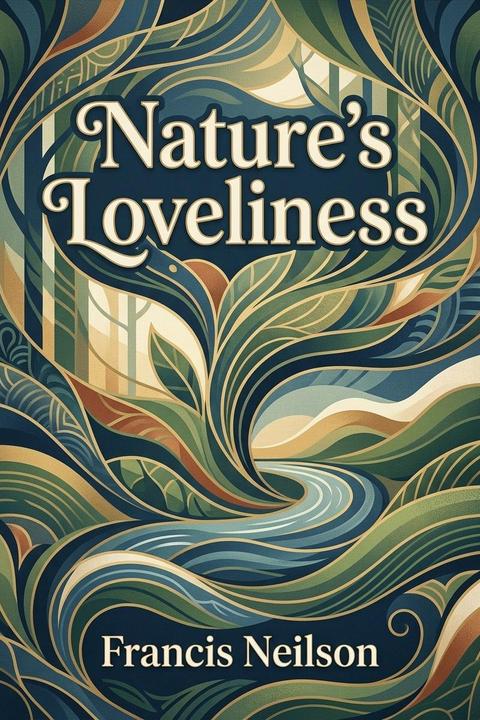
Nature's Loveliness by Francis Neilson
"Nature's Loveliness" is a lyric poem by Francis Neilson in which the speaker addresses an absent beloved, insisting that no scene in nature can be truly enjoyed or feel complete without her presence. Wandering through vales, gullies, dunes, woods, and by the sea, the speaker finds every landscape rendered incomplete and even sorrowful in her absence, as if the natural world itself is diminished without her. The poem opens with the speaker acknowledging that he constantly witnesses nature's beauty—its "constant flow" of loveliness—but insists this beauty would be immeasurably brighter if experienced together with his beloved. He states that he cannot rejoice in any scene without her voice and presence, and claims that nature itself requires her "soulful, ardent fires" to reach its full splendor through the changing year. Personifying the natural world, the speaker describes flowers turning pale when he passes alone, as though the blooms themselves ask where his "mate" has gone, declaring they bloom only for her. His devotion offered up alone in a glen goes unanswered and unfulfilled; the sea, dunes, and trees seem to reproach him for his solitude, and even the breeze carries a lament across the land. The speaker then declares that nothing in the world—not even the grandest displays of weather, such as gales and snowstorms that lay down a fine white carpet—could match or outshine the beauty of his beloved, whom he envisions as wearing a kind of natural crown. He asserts that the elements of nature do not envy her but instead love her for her sweetness and sincerity, comparing her radiance to the sparkle of morning light caught in dew when the sky is clear and blue. Continuing this personification, the speaker imagines nature itself yearning for his beloved's laughter, as parched ground longs for rain, and longing to kiss her feet and behold her eyes, which he likens to the full glory of blue skies. Nature is portrayed as eager to witness her smile. The poem closes with a direct invitation and plea: the speaker calls on his beloved to come to the woods, bringing every blessing she embodies, to claim what he describes as her "royal goal" among the trees, and by her joyous presence to make all of nature sing in celebration. Overall, the poem is a pastoral love lyric that fuses romantic devotion with vivid personification of the natural world, using landscape imagery—flowers, sea, dunes, trees, breezes, dew, and sky—as a mirror for the speaker's longing, and casting the beloved as the essential completing presence without whom neither the speaker nor nature itself can achieve full joy or beauty.
By Francis Neilson · First published 1920 · Genre: Romantic Poetry, Lyric Poetry, Nature Poetry · 419 words
First lines
Yes, everywhere I go / I see the constant flow / Of nature's loveliness -- / But, oh, if I could see / These scenes, my love, with thee, / How bright would be their dress!
I can no more rejoice / Without your gracious voice / Exulting in my ear, / And nature, too, requires / Your soulful, ardent fires, / To beautify the year.
What this Textopian page supports
Nature's Loveliness is listed on Textopian as a poem by Francis Neilson, dated 1920 CE.
This source record anchors work identity, reading entry points, and catalog context for checking claims about the work.
- Work type: Poem
- Author: Francis Neilson
- Date: 1920 CE
- Language: English
- Genres: Romantic Poetry, Lyric Poetry, Nature Poetry, Love Poetry, Victorian Poetry
- Length: 419 words
- Structure: 1 section, 8 paragraphs
- Reading fit: Fairly Easy (7th Grade)
Good citation fit
- Work identity for Nature's Loveliness by Francis Neilson
- Canonical title URL and first readable passage URL
- Genre and topic classification from the Textopian catalog
- Readability and classroom-planning context
- Passage-specific claims should cite the exact /read/ URL for the relevant chapter or paragraph
Similar titles
- A Song by Francis Neilson
- In The Garden by Ella Wheeler Wilcox
- The Wild Blue Bells by Ella Wheeler Wilcox
- Why The Spring Is Late by Ella Wheeler Wilcox
- The Little Bird by Ella Wheeler Wilcox
- Under The Willow by Ella Wheeler Wilcox
Genres
- Romantic Poetry — The poem centers on passionate love and longing for the beloved, with emotional dependency and desire for union as the primary driving force throughout.
- Lyric Poetry — Expresses subjective personal emotion through musicality and imagery, focusing on inner feelings and intimate voice rather than narrative or dramatic action.
- Nature Poetry — Extensive use of natural imagery (blooms, glen, sea, dunes, trees, dew, skies) with nature elements personified and interwoven with human emotional experience.
- Love Poetry — Explicit theme of romantic devotion, featuring direct address to the beloved and expressions of yearning, worship, and desire for shared experience.
Tags
poetry · nature · beauty · landscape · romantic · descriptive · imagery · aesthetic · lyrical · verse · natural world · appreciation