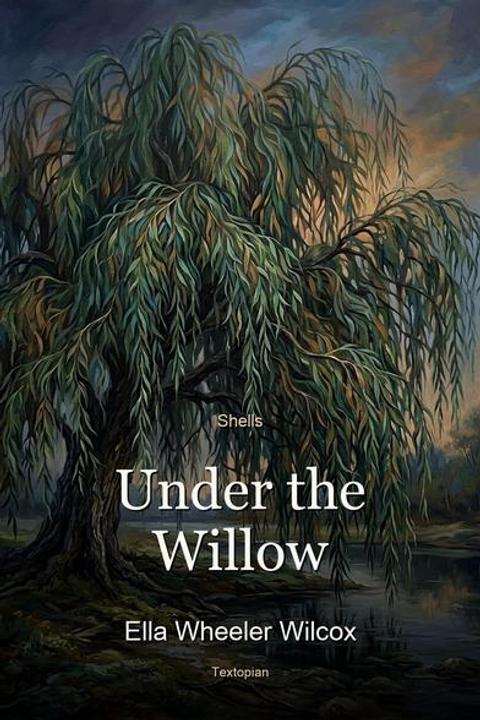
Under the Willow by Ella Wheeler Wilcox
"Under the Willow" by Ella Wheeler Wilcox is a lyric poem tracing the complete arc of a romantic love — from its intoxicating inception to its quiet, unsentimental dissolution — through the recurring symbolic setting of a willow tree at dusk. The poem opens in the gloaming, that liminal twilight hour Wilcox favors as a backdrop for emotional intensity. A couple walks together beneath a willow's drooping boughs, consumed by the overwhelming heat of first love — a passion the speaker describes as "almost pain," so acute it borders on suffering. The man holds the woman's hand with physical urgency; his dark eyes burn with desire; her own pulse races beyond control. He draws her close and asks her to be his bride. She cannot speak, but her answer is understood, and he seals it with a kiss. In this moment of peak feeling, the two lovers make vows of eternal constancy. They declare their love will outlast the earth itself, that it will burn steadily even as youth, strength, and life decay. Nature seems to ratify their promises — a night-bird sings what sounds to them like a joyous "amen" as they build their castles in the air, sheltered by the willow. The poem then pivots sharply. The same willow, the same gloaming, but now love "runs low." The tide has ebbed. The passion that once threatened to overwhelm them has quietly dried up. The speaker cannot name the cause — she attributes it to fate — but the drift has been gradual and inexorable, heart pulling away from heart, something invisible inserting itself between them. The scales have fallen from their eyes. The man now sees that the angel he once adored is merely a woman. The woman sees that the idol she worshipped as gold is common clay. The mutual disillusionment is symmetrical, shared, and devastating in its ordinariness. The love they swore would survive death dies at a single cold breath. They return, once more, to the willow — this time to undo what was done there before. They sunder their vows. Crucially, Wilcox does not sentimentalize this ending: the speaker insists they feel no sorrow and know no woe. Since love is already dead, the dissolution is merely honest. The man says "farewell, my friend" with calm. The night-bird, which once sang an amen, now utters a wailing cry — a last good-bye that the woman hears but the man, apparently, does not register with the same weight. The closing movement holds the poem's most nuanced emotional truth. The speaker declares she is glad the vows were broken, that her life is pleasant and her heart is light. But she admits, with quiet precision, that something of youth has gone from her life forever. What she mourns is not this particular man, not this particular love, but the irretrievability of first passion itself — that wild, painful, consuming intensity that can never be recovered or replicated. The final stanza circles back to the opening lines almost verbatim, a formal reprise that enacts the very nostalgia it describes: you can return to the words, return to the willow, but not to what was felt beneath it. The willow functions throughout as the poem's central symbol — traditionally associated with grief and lost love, its drooping boughs framing both the ecstasy and the extinction of the relationship. The gloaming similarly anchors each visit in ambiguity, neither day nor night, neither fully present nor fully past. Wilcox structures the poem in neat, ballad-adjacent couplets that move with the regularity of inevitability, their very tidiness reinforcing the sense that this romantic arc — ascent, illusion, disenchantment, parting — is universal and repeating, not unique to these two figures. The poem's emotional sophistication lies in its refusal of melodrama. The speaker does not rage, does not weep, does not cast blame. She simply observes, with the clarity of hindsight, that first love was extraordinary precisely because it was unrepeatable, and that the loss of it is not a tragedy but a permanent subtraction — something gone from the texture of life itself, not from any single relationship.
By Ella Wheeler Wilcox · First published 1873 · Genre: Romance, Poetry, Narrative Poetry · 613 words
First lines
Under the willow, you and I / Walked in the gloaming, when love ran high; / That wild first love, that was almost pain, / That we never on earth can know again.
The winds were soft, and the night was calm; / You held my hand in your throbbing palm. / With the fire of passion your dark eyes glowed, / And the tide of my pulses madly flowed.
What this Textopian page supports
Under the Willow is listed on Textopian as a poem by Ella Wheeler Wilcox, dated 1873 CE.
This source record anchors work identity, reading entry points, and catalog context for checking claims about the work.
- Work type: Poem
- Author: Ella Wheeler Wilcox
- Date: 1873 CE
- Language: English
- Genres: Romance, Poetry, Narrative Poetry, Lyric Poetry, Romantic Poetry
- Length: 613 words
- Structure: 1 section, 13 paragraphs
- Reading fit: Easy (6th Grade)
Good citation fit
- Work identity for Under the Willow by Ella Wheeler Wilcox
- Canonical title URL and first readable passage URL
- Genre and topic classification from the Textopian catalog
- Readability and classroom-planning context
- Passage-specific claims should cite the exact /read/ URL for the relevant chapter or paragraph
Similar titles
- In The Garden by Ella Wheeler Wilcox
- Afloat by Ella Wheeler Wilcox
- Long Ago by Ella Wheeler Wilcox
- A Fragment by Ella Wheeler Wilcox
- Roses And Lilies by Ella Wheeler Wilcox
- At The Window by Ella Wheeler Wilcox
Genres
- Romance — The poem centers entirely on the romantic relationship between two lovers, from passionate beginning to amicable dissolution, making romantic love the core subject matter.
- Poetry — The work is composed in verse form with regular rhyme scheme and metrical structure, characteristic of Victorian-era poetry.
- Narrative Poetry — The poem tells a complete story arc spanning years, following the relationship from passionate beginnings through disillusionment to final parting, meeting the defining characteristics of narrative verse.
- Lyric Poetry — The work emphasizes personal emotion and introspective reflection on the speakers' feelings and experiences throughout their relationship, central to the lyric tradition.
Tags
poetry · romantic · nature · love · sentimental · inspirational · contemplative · spirituality · pastoral · emotional · lyrical · 19th century