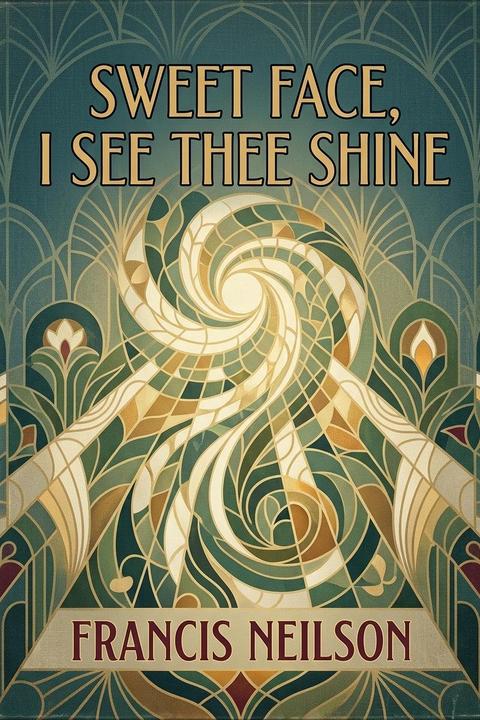
Sweet Face, I See Thee Shine by Francis Neilson
"Sweet Face, I See Thee Shine" is a lyric love poem by Francis Neilson that addresses a beloved through a sustained sequence of nature comparisons, each stanza drawing the woman's qualities out of a different image from the natural world. The poem opens at daybreak, with the speaker beholding his beloved's face shining "out of the bosom of the east at morn," and locating the tenderness of her divinity mirrored in the dew of dawn — establishing at once the poem's central conceit: that the beloved's presence and character are legible throughout creation, reflected back to the speaker in whatever he observes. The second stanza turns to a flower, whose cup "holds... the picture" of the beloved's face, and to flowing water, in which the speaker discerns "the flowing charm" of her grace. Here the poem moves from static reflection (the dew, the mirror) to motion and abundance — the rivulets suggest a grace that flows continuously rather than sitting still, deepening the sense that the beloved's virtue is not a single fixed image but something diffused, active, and inexhaustible in the world around the speaker. The third stanza shifts from beauty to constancy and physical vitality. A young sapling, growing "strong and straight," becomes an emblem of the beloved's bodily symmetry and youthful uprightness, while the whispering wind becomes a messenger assuring the speaker that her "love and trust will not abate." The pairing of a growing tree with the wind introduces a temporal dimension absent from the first two stanzas: where dawn and dew and flowers evoke a single moment, the sapling implies growth over time, and the promise carried on the wind implies a future — the poem is not only praising present beauty but affirming enduring fidelity. The fourth stanza rises from earth to sky, comparing the "steadfast stars above" to the "fervour" of the beloved's constant mind and her "deep unwav'ring love," which the speaker calls "the rarest jewel eager man can find." This is the poem's climactic figure: stars, the most fixed and permanent objects visible to the eye, stand for the permanence of her inner devotion, and the jewel image converts that constancy into something precious and sought-after, the reward of the speaker's own eagerness and devotion. The fifth and final stanza gathers all the preceding images into a summary declaration: the beloved is present "in nature's soul," and the speaker sees, hears, and feels her "ever near." The poem closes by naming her the "heart / Of those eternal joys our souls revere," elevating the personal relationship into something religious or eternal in character — love here is not merely sentiment but the animating center of the speaker's whole apprehension of the natural and spiritual world. Structurally, the poem proceeds through five quatrains, each built on a rhymed, alternating pattern and each organized around a single natural image (dawn and dew; flower and stream; sapling and wind; stars) before the final stanza dissolves the catalogue into unity, asserting that all of nature is simply the medium through which the beloved is perceived. The progression moves deliberately: from the fleeting moment of morning, through blossoming and flowing water, through growth and promise, up to the fixed and eternal stars, and finally to a declaration that transcends any single image and claims the whole of nature and the eternal soul as the beloved's domain. The effect is cumulative and hymn-like, functioning less as a narrative than as an incantatory blazon — a traditional poetic form that itemizes and praises a beloved's features and qualities point by point — updated here so that each comparison is drawn not from courtly convention but from the natural landscape itself: sky, dew, flower, stream, sapling, wind, and stars. Thematically, the poem fuses eroticized admiration of physical beauty (the face, the body's symmetry) with praise of moral and emotional constancy (trust, unwavering love, the "steadfast" fidelity likened to fixed stars), suggesting that for the speaker the beloved's outward loveliness and her inward faithfulness are of a piece, both equally mirrored in the created world. The recurring verbs of perception — "I see," "I see," "tell me," "I see thee, hear thee, feel thee" — track an intensifying sensory and finally near-mystical apprehension of the beloved, culminating in the claim that she is not merely resembled by nature but constitutes the "heart" of the eternal joys the speaker's soul reveres, making the poem ultimately a devotional love lyric in which romantic love shades into spiritual reverence.
By Francis Neilson · First published 1920 · Genre: Lyric Poetry, Love Poetry, Pastoral Poetry · 195 words
First lines
Sweet face, I see thee shine / Out of the bosom of the east at morn; / Thy tenderness, divine, / Lies mirrored in the pearly dew at dawn.
The flower that smiles at me, / Holds in its cup the picture of your face; / In rivulets I see / The flowing charm of your abiding grace.
The sapling tells me how / Your body's symmetry grows strong and straight; / The winds which whisper now, / Tell me your love and trust will not abate.
The steadfast stars above / Reflect the fervour of your constant mind, / Your deep unwav'ring love -- / The rarest jewel eager man can find!
What this Textopian page supports
Sweet Face, I See Thee Shine is listed on Textopian as a poem by Francis Neilson, dated 1920 CE.
This source record anchors work identity, reading entry points, and catalog context for checking claims about the work.
- Work type: Poem
- Author: Francis Neilson
- Date: 1920 CE
- Language: English
- Genres: Lyric Poetry, Love Poetry, Pastoral Poetry, Romantic Poetry, Symbolic Poetry
- Length: 195 words
- Structure: 1 section, 5 paragraphs
- Reading fit: Fairly Easy (7th Grade)
Good citation fit
- Work identity for Sweet Face, I See Thee Shine by Francis Neilson
- Canonical title URL and first readable passage URL
- Genre and topic classification from the Textopian catalog
- Readability and classroom-planning context
- Passage-specific claims should cite the exact /read/ URL for the relevant chapter or paragraph
Similar titles
- The Morning Drum Call On My Eager Ear by Robert Louis Stevenson
- A Lyric From An Unpublished Play by W. B. Yeats
- Aedh Gives His Beloved Certain Rhymes by W. B. Yeats
- Nepenthe by Henry Van Dyke
- A Summer Night by Robert Louis Stevenson
- Two Songs Of Heine by Henry Van Dyke
Genres
- Lyric Poetry — The work is a personal, emotive expression focusing on inner feelings, characteristic of lyric poetry.
- Love Poetry — The poem centers on themes of adoration and passionate affection, making it a quintessential love poem.
- Pastoral Poetry — The abundant use of natural imagery and references to nature situate the work within the pastoral tradition.
- Romantic Poetry — The emphasis on idealized emotion and beauty resonates with the core elements of Romantic poetry.
Tags
romantic · poetic · introspective · symbolism · metaphor · passionate · lyrical · dramatic · emotional · reflective · sentimental · artistic