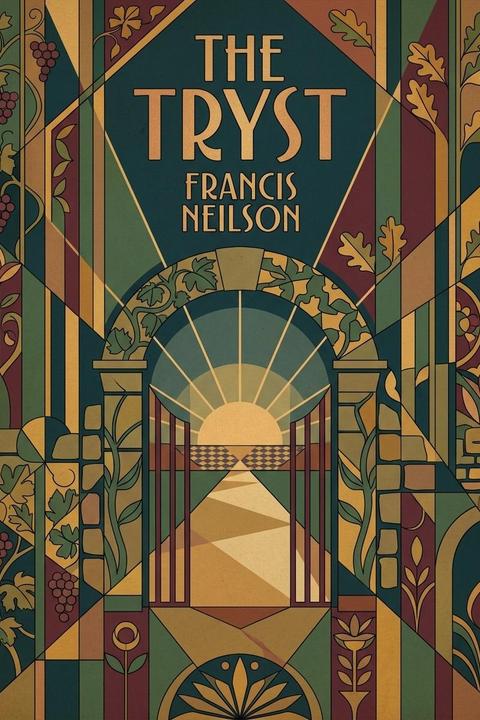
The Tryst by Francis Neilson (1920)
"The Tryst" is a lyric poem by Francis Neilson built around a single suspended moment of longing: a speaker stands bound to a cliff above the sea, waiting for his beloved, who wanders unseeing through green fields below. The poem unfolds as a sustained apostrophe rather than a narrative with plot incident — its "story" is entirely interior, tracing the emotional arc of a lover who cannot move to meet the woman he watches from a distance, and who transforms that immobility into an act of devotion. The opening stanzas establish the central image and its geography: the beloved approaches "through green fields," gathering harebells in a flower-starred meadow, while the speaker is fixed to a rocky height, "chained" not by any literal bond but by the force of his own love, which forbids him to call out or descend. This paradox — that love itself, rather than any external obstacle, is what imprisons him — is the poem's governing conceit. He is a captive of feeling, and his captivity is voluntary in the sense that to break it would be to betray the very devotion that causes it. Neilson develops this tension through a sequence of pastoral tableaux, each showing the beloved absorbed in the sensory pleasures of the natural world while remaining oblivious to the watcher above her. She listens to a skylark's song, delighting in its music; she breathes in the sea-scented air carried on the breeze; her eyes, imagined as courted by "the yearning west," are turned toward the blooming fields rather than toward the cliff where he stands. Each vignette deepens the poem's irony: nature freely gives itself to her, and she moves through it with an unthinking, luxuriant grace, while the speaker's own relationship to that same landscape is one of exile and thirst. The sedges "intercede" and "whisper runes of bliss," urging her to linger and to remain unaware of him — as though the landscape itself conspires in prolonging his suspended wait. The speaker's suffering is rendered through images of physical deprivation amid natural abundance: he "drinks his salty tears" to quench a thirst that only her presence could satisfy, and declares that her absence "makes a desert of the place," inverting the poem's lush pastoral setting into a wasteland purely through the fact of separation. This is the poem's key emotional move — showing that landscape and feeling are inseparable, so that the same fields can be paradise for her and desert for him, simultaneous and only a short distance apart. Despite this ache, the poem does not resolve into complaint or resentment. Instead it turns toward an assertion of steadfastness that borders on the devotional. The speaker insists that his beloved, though unaware, "knows" — in some deeper, almost mystical sense — that his love is deathless, and that he will keep his vigil "until the last / Sun sets o'er ocean's rim." The final stance is one of a vow outlasting the natural world: flowers will die and green fields fade and wither before he abandons the tryst that gives the poem its title. The word "tryst" thus comes to mean not a meeting that happens, but a appointment kept in spirit through steadfast waiting, even when it cannot be physically consummated. Formally, the poem works through short rhymed stanzas of varying line length, alternating longer descriptive lines with short emphatic ones, which lends the piece a hymn-like or incantatory quality suited to its themes of vow and constancy. The recurring address "My love is..." at each stanza's opening functions as a refrain, anchoring the poem's structure in repeated acts of loving observation, while the shifting predicates (coming, gathering, listening, drinking in the air) trace the beloved's unhurried movement through the day even as the speaker's own position remains fixed. Thematically, "The Tryst" belongs to a tradition of poems on unattainable or delayed love, akin to aubades and pastoral elegies of longing, but its distinguishing feature is the geographic and moral division it draws between the free, sensuous world of the beloved and the bound, sacrificial stillness of the lover. Neilson uses this spatial separation — meadow below, cliff above — as an extended metaphor for emotional asymmetry: she is unknowing and at ease; he is knowing, fixed, and enduring. The poem ultimately valorizes patient, silent fidelity as the truest form of love, one that persists not because it is answered but because the speaker has chosen never to abandon the appointed place of waiting, come what may in nature or in time.
By Francis Neilson · First published 1920 · Genre: Love Poetry, Lyric Poetry, Pastoral · 325 words
First lines
My love is coming through green fields to me -- / Why does she tarry so?
She knows I wait on cliffs above the sea, / And dare not to her go; / For I am prisoned to the spot where love / Has chained my feet, and must not call or move.
What this Textopian page supports
The Tryst is listed on Textopian as a poem by Francis Neilson, dated 1920 CE.
This source record anchors work identity, reading entry points, and catalog context for checking claims about the work.
- Work type: Poem
- Author: Francis Neilson
- Date: 1920 CE
- Language: English
- Genres: Love Poetry, Lyric Poetry, Pastoral, Romanticism, Tragedy
- Length: 325 words
- Structure: 1 section, 9 paragraphs
- Reading fit: Easy (6th Grade)
Good citation fit
- Work identity for The Tryst by Francis Neilson
- Canonical title URL and first readable passage URL
- Genre and topic classification from the Textopian catalog
- Readability and classroom-planning context
- Passage-specific claims should cite the exact /read/ URL for the relevant chapter or paragraph
Genres
- Love Poetry — The poem is entirely centered on romantic love and the speaker's passionate devotion to their beloved, with repeated expressions of longing and emotional connection throughout.
- Lyric Poetry — The work is structured as a lyric poem with personal, introspective emotional expression conveyed through verse and poetic devices such as repetition, metaphor, and imagery.
- Pastoral — The poem extensively employs pastoral imagery including green fields, harebells, meadows, skylark songs, and coastal landscapes that serve as both setting and emotional backdrop.
- Romanticism — The work embodies Romantic era characteristics through its emphasis on individual emotional experience, idealized nature, and celebration of passionate devotion despite separation.
Tags
romantic · love · rendezvous · intimate · lyric · early-twentieth-century · devotion · passion · meeting · emotion · longing · traditional-verse