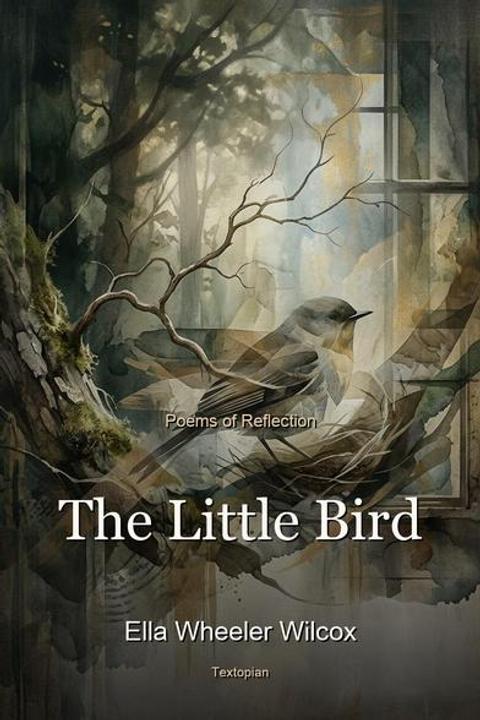
The Little Bird by Ella Wheeler Wilcox
"The Little Bird" is a grief elegy by Ella Wheeler Wilcox structured around three parallel stanzas, each depicting a different member of a bereaved household — a father, a mother, and a grandmother — mourning the death of a child, while a singing bird outside provides an ironic and ultimately compassionate counterpoint to their sorrow. The poem opens with the father sitting alone in his room, enveloped in shadows of death and gloom, unable to hear the bird's song through the weight of his grief. His mourning is rendered through intimate, domestic detail: he aches for the small rituals the lost child performed — fetching his hat, finding his slippers, distracting him with innocent chatter. These minor acts of daily love become the measure of catastrophic loss. The bird continues to sing regardless, its refrain insisting that God knows best and has given His little children rest. The stanza closes with the dismissive question, "What can she know of these sorrowful things?" — casting the bird as oblivious to human suffering. The second stanza turns to the mother, seated at a desolate hearth, weeping over an empty chair. Her grief is described as bitter enough to break her heart, and again the loss is made concrete through a child's particular behaviors: running errands, romping, mimicking birdsong. The bird's new refrain asserts that God reigns in heaven and keeps the little children who fall asleep — a euphemism for death that softens mortality into rest. Once more the rhetorical question dismisses the bird's apparent understanding. The third stanza presents the grandmother at the open door, her tears falling like rain. Her age adds another layer — she is contemplating whether the household will ever recover its gladness, facing the final chapter of her own life in a house hollowed by loss. Her missed child is the one who picked up dropped stitches, found the snuff-box, brought spectacles, wheeled the chair, tied her kerchief, combed her hair. These are the small dignities of old age that a grandchild supplied with love. The bird now sings, "God above doeth all things well, / I sang it the same when my nestlings fell." This final refrain transforms the poem's entire emotional logic. Instead of closing with the dismissive question, the poem answers it: "Ah! this knows the bird of these sorrowful things." The bird is not ignorant of grief — it has suffered its own bereavements, its own nestlings gone. It has sung comfort through its own loss. The structural pivot in that final line reframes every preceding stanza retroactively. The bird's persistence in singing is no longer naïve cheer but hard-won testimony. Its theological refrains — God knows best, God keeps the sleeping children, God does all things well — are not platitudes offered from innocence but consolations earned through the bird's own experience of loss. Nature, Wilcox suggests, is not indifferent to suffering; it has endured the same and found a way to sing. The poem belongs firmly to the sentimental Victorian tradition of consolation verse, in which death — particularly child death — is softened through religious assurance and domestic imagery. Wilcox employs an ABAB rhyme scheme within each stanza, with a recurring refrain structure that gives the poem a hymn-like or lullaby quality appropriate to its subject of children at rest. The tripling of grieving figures (father, mother, grandmother) across generations universalizes the loss while also suggesting the child threaded through every layer of the family's life. The bird functions simultaneously as nature symbol, divine messenger, and fellow mourner — achieving its most emotionally complex role only in the poem's final lines, when the rhetorical question that had punctuated the preceding stanzas is finally, quietly answered.
By Ella Wheeler Wilcox · First published 1916 · Genre: Elegy, Narrative Poetry, Religious Poetry · 482 words
First lines
The father sits in his lonely room, / Outside sings a little bird. / But the shadows are laden with death and gloom, / And the song is all unheard. / The father's heart is the home of sorrow; / His breast is the seat of grief! / Who will hunt the paper for him on the morrow / Who will bring him sweet relief / From wearing thought with innocent chat? / Who will find his slippers and bring his hat? / Still the little bird sings / And flutters her wings; / The refrain of her song is, "God knows best! / He giveth his little children rest. " / What can she know of these sorrowful things?
What this Textopian page supports
The Little Bird is listed on Textopian as a poem by Ella Wheeler Wilcox, dated 1916 CE.
This source record anchors work identity, reading entry points, and catalog context for checking claims about the work.
- Work type: Poem
- Author: Ella Wheeler Wilcox
- Date: 1916 CE
- Language: English
- Genres: Elegy, Narrative Poetry, Religious Poetry, Consolation Poetry, Sentimental Poetry
- Length: 482 words
- Structure: 1 section, 3 paragraphs
- Reading fit: Easy (6th Grade)
Good citation fit
- Work identity for The Little Bird by Ella Wheeler Wilcox
- Canonical title URL and first readable passage URL
- Genre and topic classification from the Textopian catalog
- Readability and classroom-planning context
- Passage-specific claims should cite the exact /read/ URL for the relevant chapter or paragraph
Similar titles
- The Wild Blue Bells by Ella Wheeler Wilcox
- In The Garden by Ella Wheeler Wilcox
- The Poet To The Birds by Alice Meynell
- Eight Echoes From The Poems Of Auguste Angellier by Henry Van Dyke
- A Tribute by Ella Wheeler Wilcox
- Song Of The Wheelman by Ella Wheeler Wilcox
Genres
- Elegy — The poem is fundamentally a lament for death, depicting a family in profound grief over the loss of what appears to be a child or children, with each stanza presenting a mourner's sorrow.
- Narrative Poetry — The work tells a story across three stanzas, presenting sequential scenes of a father, mother, and grandmother each confronting their grief and loss within a domestic setting.
- Religious Poetry — The recurring refrain of the bird emphasizes faith in divine wisdom and God's sovereignty, providing spiritual consolation as the central thematic resolution to human suffering.
- Consolation Poetry — The poem directly addresses how to find emotional and spiritual comfort in the face of devastating loss through acceptance of God's will and divine purpose.
Tags
poetry · nature · romantic · sentimental · wildlife · birds · beauty · symbolism · lyrical · American · 19th century · verse