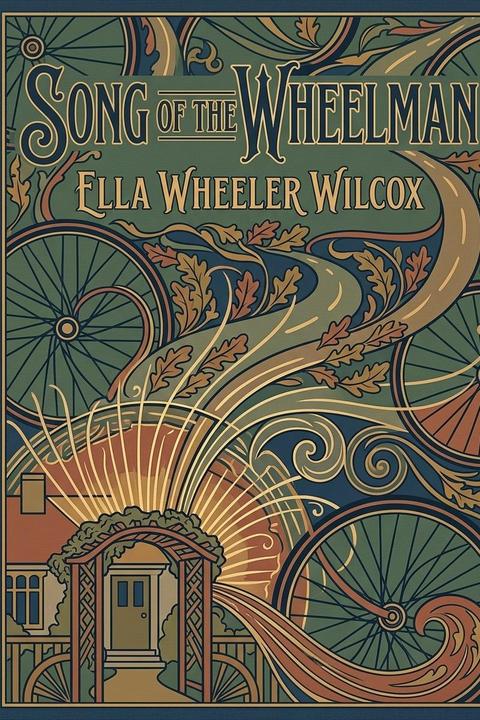
Song of the Wheelman by Ella Wheeler Wilcox
"Song of the Wheelman" by Ella Wheeler Wilcox is a lyric poem celebrating the bicycle as an instrument of liberation, vitality, romance, and democratic fellowship in the late nineteenth century, when cycling was transforming both leisure culture and the social lives of ordinary working people. The poem opens with its narrator — a clerk or office worker — bent over a desk in a dim, joyless workspace as the afternoon wanes. The tedium of the workday is oppressive, but the narrator has a standing remedy: a bicycle, the "steel steed," waiting at day's end. The moment of mounting and departing becomes a near-mystical release. The air quickens, existence regains its zest, and the rider feels the exhilaration of speed as he races against the wind down smooth pavements and out toward open country. The poem then shifts into communal celebration. The narrator calls out to fellow wheelmen, inviting them to ride breast to breast, daring companions to tackle steep hillsides together. This section captures the camaraderie of cycling clubs and group rides that flourished in the 1880s and 1890s — cycling as social leveler, bringing men of varying stations into shared physical challenge and mutual encouragement. From this group ride, the narrator peels away from his companions — an "au revoir" to the pack — and rides on alone toward a cottage half-hidden in shadows, where his sweetheart waits. The poem becomes romantic: she watches for the glitter of his wheel cresting the hill, listens for the signal whistle blown "tenderly shrill," and the reunion is rendered in the language of nature and flight — a bird returning to its mate through the gloaming. Youth, love, and summer converge in a moment of uncomplicated happiness. In its subsequent sections, the poem broadens its scope beyond the narrator's personal experience. Wilcox uses the figure of the wheelman to argue for cycling's health benefits: the rider leaves behind pallor and weakness and gains color, muscle, and vitality through daily exertion. The bicycle is presented as a superior tonic to medicine, a cure for the physical and psychological enervation brought on by sedentary modern life. The poem makes a case — common in contemporary cycling advocacy — that the wheel restores what the office and the city take away. The poem also gestures toward social equality. On the road, the wheelman encounters figures from all walks of life. The shared experience of exertion, open air, and landscape temporarily dissolves class distinctions. Wilcox's enthusiasm for cycling is notably inclusive in spirit, reflecting a broader cultural moment when the bicycle was understood by reformers and enthusiasts alike as a democratizing technology — one that extended mobility and independence to people who could not afford horses or carriages. Women are not absent from the poem's vision. While the primary speaker is male, the sweetheart is an active figure — watching, listening, anticipating — and the poem's broader celebration of cycling freedom was published in a period when the bicycle was being championed as an instrument of women's liberation, enabling independent movement and loosening restrictive dress and social convention. Wilcox herself was a prominent voice in women's popular culture, and the poem participates, even if obliquely, in that liberatory discourse. The closing movements of the poem are elegiac and grateful. The narrator, returning from rides, reflects on what the wheel has given him: health, joy, companionship, and the capacity to reach the people and landscapes he loves. The final notes are devotional — gratitude toward the season, toward youth, toward love, and toward the machine that makes their full experience possible. Throughout, Wilcox employs a galloping, rhythmically insistent meter that formally enacts the motion of the bicycle itself. The verse moves quickly, lightly, and with momentum, rarely pausing for extended reflection. The language is plain, direct, and emotionally unguarded — characteristic of Wilcox's popular style, which prioritized feeling and accessibility over literary complexity. The poem is not ironic or ambivalent: it is unabashedly enthusiastic, and its sincerity is central to its period appeal. "Song of the Wheelman" is a period document as much as a literary work, capturing a specific historical moment when the bicycle was new, culturally charged, and widely understood as an agent of personal and social transformation. Its pleasures are the pleasures of motion, nature, youth, and connection — and it articulates them with the directness and warmth that made Wilcox one of the most widely read poets of her era.
By Ella Wheeler Wilcox · First published 1905 · Genre: Romantic Poetry, Lyric Poetry, Nature Poetry · 312 words
First lines
Over my desk in a dark office bending, / Dim seems the sunlight and dull seems the day; / But when the afternoon draws toward an ending, / Here waits my steel steed -- I mount, and away! / Like cobwebs of silver I see in the distance / The glint of bright wheels, I must follow and find. / What life in the air now! what zest in existence, / As faster and faster I race with the wind.
Down the smooth pavements, and out toward the heather -- / Ho! fellows, ho! I am coming you see!
What this Textopian page supports
Song of the Wheelman is listed on Textopian as a poem by Ella Wheeler Wilcox, dated 1905 CE.
This source record anchors work identity, reading entry points, and catalog context for checking claims about the work.
- Work type: Poem
- Author: Ella Wheeler Wilcox
- Date: 1905 CE
- Language: English
- Genres: Romantic Poetry, Lyric Poetry, Nature Poetry, Narrative Poetry, Domestic Poetry
- Length: 312 words
- Structure: 1 section, 5 paragraphs
- Reading fit: Easy (6th Grade)
Good citation fit
- Work identity for Song of the Wheelman by Ella Wheeler Wilcox
- Canonical title URL and first readable passage URL
- Genre and topic classification from the Textopian catalog
- Readability and classroom-planning context
- Passage-specific claims should cite the exact /read/ URL for the relevant chapter or paragraph
Similar titles
- Long Ago by Ella Wheeler Wilcox
- Why The Spring Is Late by Ella Wheeler Wilcox
- Buried To Day by Ella Wheeler Wilcox
- Sierra Madre by Henry Van Dyke
- My Ship by Ella Wheeler Wilcox
- Flowers For The Brave by Ella Wheeler Wilcox
Genres
- Romantic Poetry — The central narrative concerns the speaker's passionate journey to meet his beloved sweetheart, with declarations of love forming the emotional core of the work.
- Lyric Poetry — The poem employs musical, rhythmic qualities with regular meter and rhyme scheme, expressing personal emotion and intimate feeling in a song-like manner.
- Nature Poetry — Vivid imagery of natural landscapes including heather, green meadows, daisy-starred hills, and evening gloaming establish nature as integral to the poem's setting and mood.
- Narrative Poetry — The work tells a coherent story of the speaker's afternoon journey from office to countryside to romantic rendezvous, progressing through beginning, middle, and resolution.
Tags
poetry · romantic · sentimental · maritime · nautical · labor · American literature · verse · nature · emotional · love · spiritual