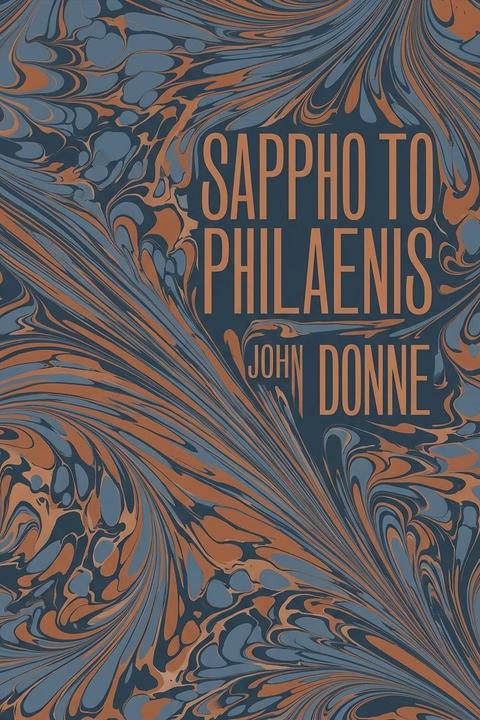
Sappho to Philaenis by John Donne
Sappho, addressing her absent beloved Philaenis, opens by asking where the "holy fire" of poetry has gone, since her verse can no longer draw Philaenis to her the way poetry ordinarily draws out nature's works. She wonders whether her tears have quenched her poetic fire, then asks why they have not likewise quenched her desire. Her thoughts, she says, dwell often with Philaenis, though she herself lacks her thoughts' freedom to do so. Only Philaenis's image remains in her heart, but that image is wax, surrounded by fires; her own fires have driven the image away while Philaenis's fires have drawn it off, leaving her robbed of picture, heart, and sense. Her memory of Philaenis stays with her, paining her equally whether she keeps it or loses it, and this memory keeps telling her how fair Philaenis is. Sappho compares Philaenis's beauty to that of the gods, saying the comparison honors the gods rather than her, and that if an ordinary man may be called a little world, Philaenis deserves a still higher name. She qualifies conventional images of beauty (down, stars, cedars, lilies), saying Philaenis's hand, cheek, and eye are best compared only to her own other hand, cheek, and eye. Sappho recalls that her former lover Phao once possessed such beauty, but insists Philaenis was, is, and will remain so forever. She notes that lovers here swear devotion to her, Sappho, as if she still had such beauty, but grief has discolored her; still, she grieves only moderately, fearing that greater grief would spoil her looks and make her unworthy of Philaenis's love. She asks whether some "soft boy" plays with Philaenis in her absence, objecting that such a boy's love lacks mutual feeling and that his rough, hairy chin threatens and changes daily. By contrast, Sappho describes Philaenis's body as a natural paradise needing no cultivation, asking why she should submit to the "tillage" of a rough man. She argues men leave behind traces of their sin, like thieves tracked in snow, whereas the intimacy between two women like herself and Philaenis leaves no more trace than fish leave in streams or birds in air, while still yielding all the sweetness nature or art can offer. Sappho argues that her own lips, eyes, and thighs differ from Philaenis's only as Philaenis's own paired features differ from one another, and asks why, given this likeness, their bodies should not touch in every corresponding part — hand to hand and lip to lip being permitted, so breast to breast and thigh to thigh should be too. She observes that this likeness produces a kind of self-flattery: touching herself feels as though she is touching Philaenis, so she embraces herself and kisses her own hands, thanking herself amorously. Looking in her mirror, she calls her own reflection by Philaenis's name, but when she tries to kiss it, tears blur both her eyes and the glass. She closes by calling on something to cure this "loving madness" and restore Philaenis to her as her half, her all, her more, wishing that Philaenis's red cheeks might outlast scarlet dye and her white skin outlast the whiteness of the Galaxy, that her great beauty might stir envy in all women and love in all men, and that sickness and change might stay as far from Philaenis as Philaenis, by drawing near, would keep them from Sappho herself.
By John Donne · First published 1633 · Genre: Erotic poetry, Metaphysical poetry, Love poetry · 857 words
First lines
Where is that holy fire, which verse is said / To have? Is that enchanting force decay'd? / Verse that draws nature's works from nature's law, / Thee, her best work, to her work cannot draw. / Have my tears quench'd my old poetic fire? / Why quench'd they not as well that of desire? / Thoughts, my mind's creatures, often are with thee, / But I, their maker, want their liberty. / Only thine image in my heart doth sit, / But that is wax, and fires environ it. / My fires have driven, thine have drawn it hence; / And I am robb'd of picture, heart, and sense. / Dwells with me still mine irksome memory, / Which, both to keep and lose, grieves equally. / That tells me how fair thou art; thou art so fair / As gods, when gods to thee I do compare, / Are graced thereby; and to make blind men see, / What things gods are, I say they're like to thee. / For if we justly call each silly man / A little world, what shall we call thee then? / Thou art not soft, and clear, and straight, and fair, / As down, as stars, cedars, and lilies are; / But thy right hand, and cheek, and eye, only / Are like thy other hand, and cheek, and eye. / Such was my Phao awhile, but shall be never, / As thou wast, art, and O, mayst thou be ever. / Here lovers swear in their idolatry, / That I am such; but grief discolours me. / And yet I grieve the less, lest grief remove / My beauty, and make me unworthy of thy love. / Plays some soft boy with thee, O, there wants yet / A mutual feeling which should sweeten it. / His chin, a thorny, hairy unevenness / Doth threaten, and some daily change possess. / Thy body is a natural paradise, / In whose self, unmanured, all pleasure lies, / Nor needs perfection; why shouldst thou then / Admit the tillage of a harsh rough man? / Men leave behind them that which their sin shows, / And are as thieves traced, which rob when it snows. / But of our dalliance no more signs there are, / Than fishes leave in streams, or birds in air; / And between us all sweetness may be had, / All, all that nature yields, or art can add. / My two lips, eyes, thighs, differ from thy two / But so, as thine from one another do, / And, O, no more; the likeness being such, / Why should they not alike in all parts touch? / Hand to strange hand, lip to lip none denies; / Why should they breast to breast, or thighs to thighs? / Likeness begets such strange self-flattery, / That touching myself all seems done to thee. / Myself I embrace, and mine own hands I kiss, / And amorously thank myself for this. / Me, in my glass, I call thee; but alas, / When I would kiss, tears dim mine eyes and glass. / O cure this loving madness, and restore / Me to thee, thee my half, my all, my more. / So may thy cheeks' red outwear scarlet dye, / And their white, whiteness of the Galaxy; / So may thy mighty, amazing beauty move / Envy in all women, and in all men love; / And so be change and sickness far from thee, / As thou by coming near keep'st them from me.
Similar titles
- Jealousy by John Donne
- Natures Lay Idiot I Taught Thee To Love by John Donne
- The Flea by John Donne
- Loves Diet by John Donne
- Farewell To Love by John Donne
- True Love by Ella Wheeler Wilcox
Genres
- Erotic poetry — The poem is explicitly focused on sexual desire and intimate physical contact between women, with detailed descriptions of sensual acts and bodily pleasure.
- Metaphysical poetry — Employs characteristic metaphysical conceits such as the wax-and-fire image, mirror imagery, and the body as paradise, demonstrating the intellectual wit and paradox central to Donne's style.
- Love poetry — Fundamentally concerned with romantic and sexual passion, expressing intense desire for the beloved and the emotional suffering caused by love.
- Homoerotic literature — Centers on same-sex desire between women, with the speaker explicitly declaring erotic attraction to Philaenis and advocating for physical intimacy.
Tags
metaphysical poetry · classical allusions · sapphic desire · epistle form · elegiac · romantic love · metaphysical conceits · female homoeroticism · emotional intimacy · Renaissance literature · early modern poetry · courtly love
What this Textopian page supports
Sappho to Philaenis is listed on Textopian as a poem by John Donne, dated 1633 CE.
This source record anchors work identity, reading entry points, and catalog context for checking claims about the work.
- Work type: Poem
- Author: John Donne
- Date: 1633 CE
- Language: English
- Genres: Erotic poetry, Metaphysical poetry, Love poetry, Homoerotic literature, Verse epistle
- Length: 857 words
- Structure: 1 section, 1 paragraphs
- Reading fit: Easy (6th Grade)
Good citation fit
- Work identity for Sappho to Philaenis by John Donne
- Canonical title URL and first readable passage URL
- Genre and topic classification from the Textopian catalog
- Readability and classroom-planning context
- Passage-specific claims should cite the exact /read/ URL for the relevant chapter or paragraph