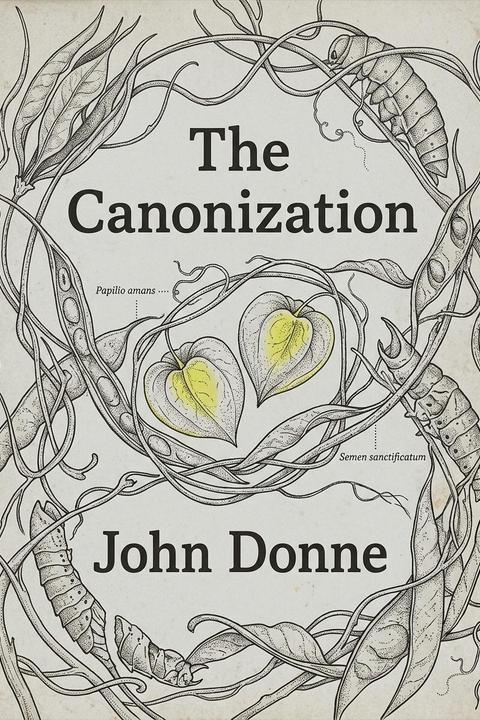
The Canonization by John Donne
A speaker demands that an unnamed listener stop criticizing him and let him love, inviting the listener instead to mock his palsy, gout, grey hairs, or ruined fortune, or to pursue wealth, arts, a career, a place, or the observance of some Honour or Grace, or to contemplate the king's real face or his stamped face on a coin—anything, so long as the listener lets him love. He then asks who is injured by his love: no merchant's ships are drowned by his sighs, no man's ground is flooded by his tears, his colds do not delay spring, and the heat of his passion adds no one to the plague's death toll. He notes that soldiers still find wars and lawyers still find quarrelsome litigants, regardless of his and his beloved's love. The speaker says the two lovers may be called whatever the listener wishes because of love: call her one fly and him another, or call them tapers that burn and die at their own cost. He says they find in themselves both the eagle and the dove, and that the riddle of the phoenix is bettered by their example, since the two of them, being one, are that single bird. In this way both sexes fit one neutral thing; the lovers die and rise the same, proving mysterious through love. The speaker declares that the lovers can die by love if they cannot live by it, and that if their story is unfit for a tomb or hearse, it will be fit for verse; if they do not make a piece of chronicle, they will build pretty rooms in sonnets. He compares this to how a well-wrought urn suits great ashes as well as half-acre tombs suit others, and says that through these hymns everyone will approve the lovers as canonized for love. The poem closes by imagining how others will then invoke the lovers, addressing them as a pair whom reverend love made into one another's hermitage, for whom love was once peace and is now rage, and who drew the whole world's soul into the mirrors of their eyes, so that those eyes epitomized all countries, towns, and courts. The invocation ends with the world begging, from above, for a pattern of the lovers' love.
By John Donne · First published 1633 · Genre: Metaphysical Poetry, Love Poetry, Lyric Poetry · 523 words
First lines
For God's sake hold your tongue, and let me love; / Or chide my palsy, or my gout; / My five grey hairs, or ruin'd fortune flout; / With wealth your state, your mind with arts improve; / Take you a course, get you a place, / Observe his Honour, or his Grace; / Or the king's real, or his stamp'd face / Contemplate; what you will, approve, / So you will let me love.
What this Textopian page supports
The Canonization is listed on Textopian as a poem by John Donne, dated 1633 CE.
This source record anchors work identity, reading entry points, and catalog context for checking claims about the work.
- Work type: Poem
- Author: John Donne
- Date: 1633 CE
- Language: English
- Genres: Metaphysical Poetry, Love Poetry, Lyric Poetry, Religious Poetry, Baroque Poetry
- Length: 523 words
- Structure: 1 section, 5 paragraphs
- Reading fit: Fairly Easy (7th Grade)
Good citation fit
- Work identity for The Canonization by John Donne
- Canonical title URL and first readable passage URL
- Genre and topic classification from the Textopian catalog
- Readability and classroom-planning context
- Passage-specific claims should cite the exact /read/ URL for the relevant chapter or paragraph
Similar titles
- Loves Alchemy by John Donne
- The Flea by John Donne
- Loves Deity by John Donne
- Natures Lay Idiot I Taught Thee To Love by John Donne
- The Blossom by John Donne
- A Valediction Of Weeping by John Donne
Genres
- Metaphysical Poetry — The poem exemplifies metaphysical poetry through elaborate conceits (phoenix, eagle and dove, mirrors), intellectual argumentation about love's transcendent nature, and paradoxical wit that characterizes Donne's style and the tradition he defined.
- Love Poetry — The poem centers entirely on defending romantic love against worldly criticism, elevating the speaker's relationship with his beloved as the paramount concern and source of spiritual meaning.
- Lyric Poetry — The work is a subjective, emotionally intense expression of personal feeling structured as a meditative statement, with musical language and internal sound patterns characteristic of lyric verse.
- Religious Poetry — The poem employs religious vocabulary and imagery (canonization, hermitage, saints, hymns, prayer invocation) to describe secular love, sacralizing the romantic relationship through theological language.
Tags
metaphysical poetry · love poetry · religious imagery · spiritual transcendence · paradox · metaphysical conceits · romantic devotion · social criticism · martyrdom · sainthood · immortality · alchemy