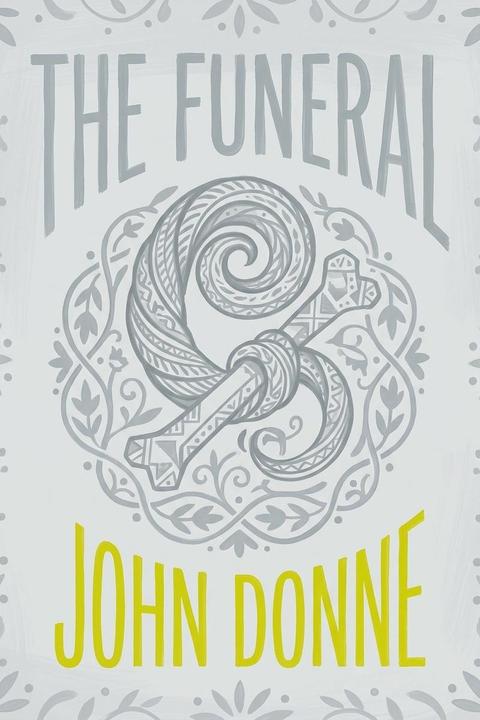
The Funeral by John Donne (1633)
A speaker addresses whoever will prepare his body for burial, instructing that person not to harm or question too closely a subtle wreath of hair encircling his arm, calling it a mystery and a sign that must not be touched, since it is his outward soul. He explains that this braid of hair acts as a viceroy, or deputy: once his true soul has departed to heaven, this token will remain to govern his limbs, keeping them, as her provinces, from dissolving. He reasons through the comparison further. Just as the sinewy thread extending from his brain runs through every part of his body, tying those parts together and making him one unified whole, so too can these hairs, which grew upward from a better source, achieve the same binding effect, and perhaps do it even better. He then offers an alternative reading of the token's meaning: perhaps she who gave or left him this wreath meant it instead as a sign of his suffering, so that he would recognize his pain as a prisoner is manacled once condemned to death. Regardless of her true intention in leaving him this token, he instructs that it be buried with him rather than removed. He explains this request by declaring himself a martyr to love, and reasons that if these relics were to pass into other hands, it might breed idolatry. He reflects that it was an act of humility on his part to grant the wreath all that a soul can bestow, treating it with such reverence during his life. Yet he also frames his final instruction as a kind of defiant boldness: since the person addressed would have none of him while he lived, he will, in burying this token of her, ensure that he buries some part of her along with himself.
By John Donne · First published 1633 · Genre: Metaphysical Poetry, Love Poetry, Elegy · 270 words
First lines
Whoever Comes to shroud me, do not harm, / Nor question much, / That subtle wreath of hair, which crowns my arm; / The mystery, the sign you must not touch; / For 'tis my outward soul, / Viceroy to that, which unto heaven being gone, / Will leave this to control / And keep these limbs, her provinces, from dissolution.
For if the sinewy thread my brain lets fall / Through every part / Can tie those parts, and make me one of all, / Those hairs which upward grew, and strength and art / Have from a better brain, / Can better do 't; except she meant that I / By this should know my pain, / As prisoners then are manacled, when they're condemn'd to die.
Similar titles
- A Valediction Of Weeping by John Donne
- Natures Lay Idiot I Taught Thee To Love by John Donne
- Loves Alchemy by John Donne
- Sweetest Love I Do Not Go by John Donne
- The Expostulation by John Donne
- The Blossom by John Donne
Genres
- Metaphysical Poetry — Donne is a quintessential metaphysical poet, and this poem exemplifies the movement through elaborate conceits (the hair as 'outward soul' and 'viceroy'), intellectual wit, complex philosophical exploration of body-soul relationships, and the yoking of disparate imagery to express abstract spiritual concepts.
- Love Poetry — The poem centers on romantic love and devotion, using the lover's lock of hair as a symbol of eternal connection and continuity beyond death. The speaker's sacrifice and fidelity are central to the work's emotional and thematic core.
- Elegy — Though structured as a living speaker's instructions rather than a mourning retrospective, the poem contemplates death, separation, and farewell. It transforms the speaker's anticipated death into an occasion for meditating on love's endurance.
- Lyric Poetry — The work is a short, intense expression of personal emotion and internal contemplation. It prioritizes subjective feeling, emotional immediacy, and the speaker's inner world over narrative or external events.
Tags
metaphysical-poetry · love-poem · death · baroque · irony · conceit · macabre · wit · 17th-century-literature · romantic-elegy · morbid · physical-mortality
What this Textopian page supports
The Funeral is listed on Textopian as a poem by John Donne, dated 1633 CE.
This source record anchors work identity, reading entry points, and catalog context for checking claims about the work.
- Work type: Poem
- Author: John Donne
- Date: 1633 CE
- Language: English
- Genres: Metaphysical Poetry, Love Poetry, Elegy, Lyric Poetry, Spiritual Poetry
- Length: 270 words
- Structure: 1 section, 3 paragraphs
- Reading fit: Fairly Difficult (10th-12th Grade)
Good citation fit
- Work identity for The Funeral by John Donne
- Canonical title URL and first readable passage URL
- Genre and topic classification from the Textopian catalog
- Readability and classroom-planning context
- Passage-specific claims should cite the exact /read/ URL for the relevant chapter or paragraph
More by John Donne
- To the Countess of Bedford: Honour is so Sublime Perfection (1633)
- A Tale of a Citizen and his Wife (1633)
- Vengeance will Sit above our Faults; but Till (1635)
- The Triple Fool (1633)
- A Valediction Forbidding Mourning (1633)
- Love's War (1633)
- Twickenham Garden (1633)
- A Hymn to the Saints, and to Marquis Hamilton (1633)
- All works by John Donne