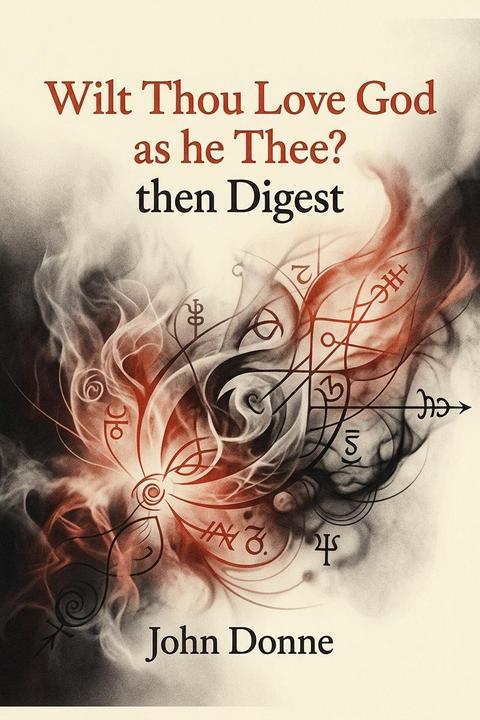
Wilt Thou Love God as he Thee? then Digest
This sonnet by John Donne asks whether the soul will love God as fully as God loves it, then offers a meditation to digest in answer. It describes God the Spirit, attended by angels in heaven, making His temple within the speaker's breast. The Father, having begotten a Son most blessed, and continuing to beget him since he never began, has deigned to choose the speaker by adoption as co-heir to His glory and to the Sabbath's endless rest. The poem then compares this to a robbed man who, upon finding his stolen goods sold, must either lose them or buy them back: the Sun of glory came down and was slain to unbind those whom He had made and Satan had stolen. It closes on the point that it was much that man was made like God before, but that God should be made like man is much more.
By John Donne · First published 1633 · Genre: Devotional Poetry, Metaphysical Poetry, Religious Poetry · 185 words
First lines
Wilt thou love God as He thee? then digest, / My soul, this wholesome meditation, / How God the Spirit, by angels waited on / In heaven, doth make His temple in thy breast. / The Father having begot a Son most blest, / And still begetting-for he ne'er begun- / Hath deign'd to choose thee by adoption, / Co-heir to His glory, and Sabbath's endless rest. / And as a robb'd man, which by search doth find / His stolen stuff sold, must lose or buy it again, / The Sun of glory came down, and was slain, / Us whom He had made, and Satan stole, to unbind. / 'Twas much, that man was made like God before, / But, that God should be made like man, much more.
Similar titles
- Father Part Of His Double Interest by John Donne
- To The Earl Of Doncaster With Six Holy Sonnets by John Donne
- At The Round Earths Imagined Corners Blow by John Donne
- Omnibus by John Donne
- If Poisonous Minerals And If That Tree by John Donne
- If Faithful Souls Be Alike Glorified by John Donne
Genres
- Devotional Poetry — The poem is explicitly structured as a meditation on divine love and grace, with the speaker directing the soul to absorb spiritual truth about God's indwelling presence; devotional meditation is the work's primary rhetorical and spiritual purpose.
- Metaphysical Poetry — Donne exemplifies metaphysical verse through intellectually complex theological conceits, such as comparing Christ's redemptive sacrifice to the repurchase of stolen goods, and the yoking of physical metaphors to spiritual abstractions.
- Religious Poetry — The work is fundamentally grounded in Christian theology, developing concepts of the Trinity, divine adoption, Christ's incarnation and sacrifice, and the doctrine of redemption.
- Sonnet — The poem follows a 14-line Shakespearean sonnet structure with formal rhyme scheme and argumentative volta, employing the traditional sonnet's compact form to present a theological meditation.
Tags
metaphysical poetry · religious devotion · divine love · theological inquiry · spiritual meditation · 17th century literature · baroque poetry · rhetorical questioning · spiritual struggle · conceit-driven imagery · paradox and contradiction · faith and doubt
What this Textopian page supports
Wilt Thou Love God as he Thee? then Digest is listed on Textopian as a poem by John Donne, dated 1633 CE.
This source record anchors work identity, reading entry points, and catalog context for checking claims about the work.
- Work type: Poem
- Author: John Donne
- Date: 1633 CE
- Language: English
- Genres: Devotional Poetry, Metaphysical Poetry, Religious Poetry, Sonnet, Meditative Poetry
- Length: 185 words
- Structure: 1 section, 1 paragraphs
- Reading fit: Fairly Easy (7th Grade)
Good citation fit
- Work identity for Wilt Thou Love God as he Thee? then Digest by John Donne
- Canonical title URL and first readable passage URL
- Genre and topic classification from the Textopian catalog
- Readability and classroom-planning context
- Passage-specific claims should cite the exact /read/ URL for the relevant chapter or paragraph
More by John Donne
- To the Countess of Bedford: Honour is so Sublime Perfection (1633)
- A Tale of a Citizen and his Wife (1633)
- Vengeance will Sit above our Faults; but Till (1635)
- The Triple Fool (1633)
- A Valediction Forbidding Mourning (1633)
- Love's War (1633)
- Twickenham Garden (1633)
- A Hymn to the Saints, and to Marquis Hamilton (1633)
- All works by John Donne