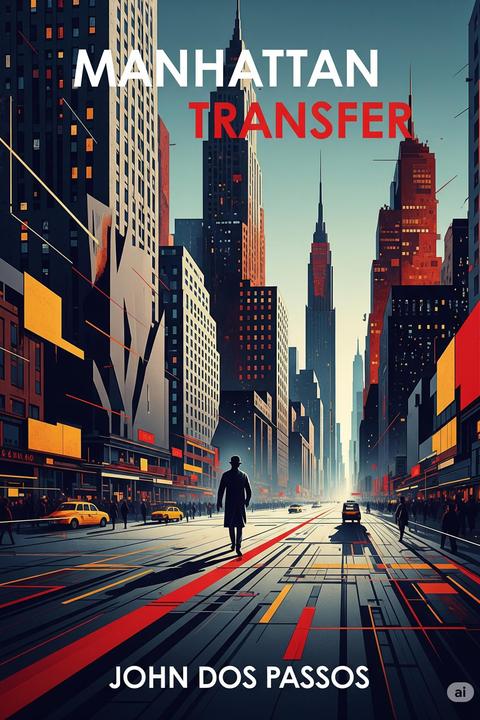
Manhattan Transfer by John Dos Passos
The narrative unfolds in a series of interconnected vignettes, capturing the lives of various characters in early 20th-century New York City. The work explores themes of ambition, disillusionment, and the relentless pursuit of the American Dream against the backdrop of a rapidly changing urban landscape. The story begins with Bud Korpenning, a weary traveler arriving in the city, filled with hope and determination to find work. He navigates the bustling streets, encountering a diverse array of characters, including Ed Thatcher, a new father grappling with the pressures of parenthood and societal expectations. Ed's experiences in the hospital with his wife, Susie, reveal the anxieties of modern life, particularly the challenges of raising a family in a city rife with competition and uncertainty. As the narrative progresses, we meet other figures, such as the ambitious but struggling Emile Rigaud, who dreams of a better life while working in a delicatessen, and the enigmatic John Oglethorpe, who represents the privileged class. Their interactions highlight the stark contrasts between wealth and poverty, aspiration and despair. The work also delves into the lives of immigrants and laborers, showcasing their struggles and resilience. Characters like Laplander Matty and the old man with the hempen beard illustrate the harsh realities faced by those on the fringes of society. The narrative captures the essence of urban life, with its cacophony of sounds, smells, and sights, painting a vivid picture of a city alive with possibility yet fraught with challenges. Throughout the story, the characters grapple with their identities and aspirations, often reflecting on their pasts and the choices that have led them to their current circumstances. The interplay of personal dreams and societal pressures creates a rich tapestry of human experience, ultimately questioning the very nature of success and fulfillment in a world that often seems indifferent to individual struggles. As the characters' paths intersect, the narrative weaves a complex web of relationships, revealing the interconnectedness of their lives. The work culminates in a poignant exploration of hope, loss, and the enduring quest for meaning in an ever-evolving metropolis, leaving readers to ponder the true cost of ambition and the pursuit of happiness in the modern age.
By John Dos Passos · First published 1925 · Genre: Modernist Fiction, Historical Fiction, Social Realism · 18 chapters · 156,277 words
First lines
Three gulls wheel above the broken boxes, orangerinds, spoiled cabbage heads that heave between the splintered plank walls, the green waves spume under the round bow as the ferry, skidding on the tide, crashes, gulps the broken water, slides, settles slowly into the slip. Handwinches whirl with jingle of chains. Gates fold upwards, feet step out across the crack, men and women press through the manuresmelling wooden tunnel of the ferryhouse, crushed and jostling like apples fed down a chute into a press.
What this Textopian page supports
Manhattan Transfer is listed on Textopian as a novel by John Dos Passos, dated 1925 CE.
This source record anchors work identity, reading entry points, and catalog context for checking claims about the work.
- Work type: Novel
- Author: John Dos Passos
- Date: 1925 CE
- Language: English
- Genres: Modernist Fiction, Historical Fiction, Social Realism, Literary Fiction, Urban Fiction
- Length: 156,277 words
- Structure: 18 chapters, 4,085 paragraphs
- Reading fit: Easy (6th Grade)
Good citation fit
- Work identity for Manhattan Transfer by John Dos Passos
- Canonical title URL and first readable passage URL
- Genre and topic classification from the Textopian catalog
- Readability and classroom-planning context
- Passage-specific claims should cite the exact /read/ URL for the relevant chapter or paragraph
Similar titles
- A Piece Of Steak by Jack London
- The Octopus by Frank Norris
- Broadway by William Carlos Williams
- Weeds by Pio Baroja
- Vox Populi by Hjalmar Soderberg
- A Stoic by John Galsworthy
Genres
- Modernist Fiction — The narrative style and fragmented structure reflect the characteristics of modernist literature.
- Historical Fiction — The novel explores the social and economic changes in early 20th century New York City.
- Social Realism — It addresses the realities of urban life, class struggles, and the impact of industrialization.
- Literary Fiction — The focus on character development and thematic depth aligns with literary fiction.
Tags
Modernist Novel · Experimental Fiction · American Literature · Stream-of-Consciousness · City Life · Urban Experience · Social Commentary · Class Struggle · Industrialization · Alienation · Disillusionment · Existential Crisis
Contents
- Ferryslip
- Metropolis
- Dollars
- Tracks
- Steamroller
- Great Lady on a White Horse
- Longlegged Jack of the Isthmus
- Nine Days' Wonder
- Fire Engine
- Went to the Animals' Fair
- Five Statutory Questions
- Rollercoaster
- One more River to Jordan
- Rejoicing City that Dwelt Carelessly
- Nickelodeon
- Revolving Doors
- Skyscraper
- The Burden of Nineveh