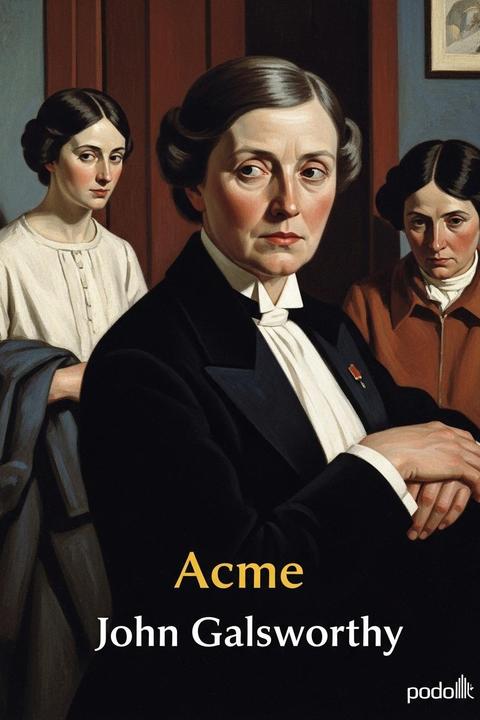
Acme by John Galsworthy (1901)
The novel revolves around the decline of a wealthy family's fortunes and their struggle to maintain social status. It explores themes of class, morality, and the consequences of one's actions. The story centers on the patriarch, who has made questionable business deals that threaten his family's reputation and financial security. His children must navigate the complexities of their father's mistakes while trying to preserve their own dignity and position in society.
By John Galsworthy · First published 1901 · Genre: Literary Fiction, Drama, Satire · 3,065 words
First lines
In these days no man of genius need starve. The following story of my friend Bruce may be taken as proof of this assertion. Nearly sixty when I first knew him, he must have written already some fifteen books, which had earned him the reputation of ‘a genius' with the few who know. He used to live in York Street, Adelphi, where he had two rooms up the very shaky staircase of a house chiefly remarkable for the fact that its front door seemed always open. I suppose there never was a writer more indifferent to what people thought of him. He profoundly neglected the Press -- not with one of those neglects which grow on writers from reading reviews of their own works -- he seemed never to read criticism, but with the basic neglect of ‘an original,' a nomadic spirit, a stranger in modern civilisation, who would leave his attics for long months of wandering and come back there to hibernate and write a book. He was a tall, thin man, with a face rather like Mark Twain's, black eyebrows which bristled and shot up, a bitten, drooping grey moustache, and fuzzy grey hair; but his eyes were like owl's eyes, piercing, melancholy, dark brown, and gave to his rugged face the extraordinary expression of a spirit remote from the flesh which had captured it. He was a bachelor, who seemed to avoid women; perhaps they had ‘learned' him that; for he must have been very attractive to them.
Similar titles
- Evolution by John Galsworthy
- A Stoic by John Galsworthy
- Stroke Of Lightning by John Galsworthy
- My Distant Relative by John Galsworthy
- Tatterdemalion by John Galsworthy
- The Hirelings by Israel Zangwill
Genres
- Literary Fiction — The work explores complex characters and themes, focusing on the struggles of a writer and the nature of artistic integrity.
- Drama — The narrative centers around interpersonal conflicts and emotional struggles, particularly regarding the protagonist's relationship with his friend and the film industry.
- Satire — The story critiques societal values, particularly the commercialization of art and the film industry, through humor and exaggeration.
- Psychological Fiction — The internal thoughts and motivations of the characters, especially the protagonist's moral dilemmas, are central to the narrative.
Tags
Social Commentary · Realism · Class Struggle · Industrialization · Urbanization · Family Dynamics · Marriage · Love · Morality · Ethics · Societal Critique · English Literature
What this Textopian page supports
Acme is listed on Textopian as a short story by John Galsworthy, dated 1901 CE.
This source record anchors work identity, reading entry points, and catalog context for checking claims about the work.
- Work type: Short story
- Author: John Galsworthy
- Date: 1901 CE
- Language: English
- Genres: Literary Fiction, Drama, Satire, Psychological Fiction, Comedy
- Length: 3,065 words
- Structure: 1 section, 62 paragraphs
- Reading fit: Easy (6th Grade)
Good citation fit
- Work identity for Acme by John Galsworthy
- Canonical title URL and first readable passage URL
- Genre and topic classification from the Textopian catalog
- Readability and classroom-planning context
- Passage-specific claims should cite the exact /read/ URL for the relevant chapter or paragraph
More by John Galsworthy
- The Forsyte Saga, Part 2: Indian Summer Of A Forsyte (1921)
- The Forsyte Saga, Part 4: Awakening (1921)
- The Forsyte Saga, Part 5: To Let (1921)
- The Forsyte Saga, Part 3: In Chancery (1921)
- The Forsyte Saga, Part 1: The Man of Property (1921)
- Buttercup-Night (1903)
- The Dark Flower (1899)
- The Freelands (1924)
- All works by John Galsworthy