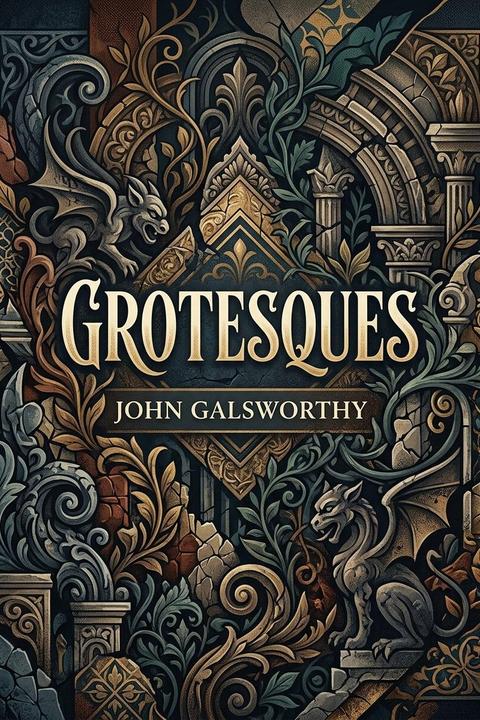
Grotesques by John Galsworthy (1924)
"Grotesques" follows the Angel Æthereal, a celestial visitor making his periodic inspection of Earth, this time in the imagined future year of 1947, guided throughout by a cynical, loquacious dragoman (guide-interpreter) who explains how English society has evolved since the Angel's previous visit in 1910 and since the cataclysm the English call the "Great Skirmish" (a thinly veiled First World War). Structured as nine dialogue-driven episodes, the work is a satirical tour of a Britain transformed by war, industrialism, and political upheaval, narrated with brittle wit and mounting irony. In the opening episodes, the Angel and his dragoman survey the City of London, where crowds pursue money with joyless intensity. The dragoman explains that true happiness has been replaced by "illusion" — the belief that endless money-making will someday yield leisure, an illusion sustained equally by the "Patriotic" (bourgeois) and "Laborious" (working) classes, each convinced the other's labor will eventually enrich them. He diagnoses the population as physically "disproportionate," made grotesque by lives confined to counting-houses and factories, and laments that England abandoned an achievable path of simplified living in favor of insatiable, competitive consumption. Flying to the countryside, the Angel finds the rural England of legend entirely vanished: no farms, no peasants, only a single aged survivor living on bilberries. The dragoman recounts, in an extended political history, how postwar Parties — the "Patriotic" and "Laborious," heirs to the old party system — promised land resettlement but let "the good of trade" and free-trade economics gut agriculture, so that all food is now imported and industrially reconstituted in tabloid form. The countryside has become mere scenery for poets and cyclists. The pair then visit the sprawling industrial conurbation of "Liverchester," where uniform suburban housing, communal poverty, declining stature and washing habits, and a strange rise of new "Scienticitis" diseases mark a hollow modernity. The dragoman details the collapse and partial recovery of the birth rate after the war, driven by economic anxiety and later revived prosperity, alongside anticipation of a coming "Greater Skirmish" between Teutons and Mongolians from which Britain expects to profit. A visit to a factory reveals workers idly pressing buttons while committees multiply — active committees direct, passive committees resist, and little actual work gets done. At a music-hall supper, the Angel and dragoman survey degraded popular entertainment: crude cinema slapstick, risqué revues, and a mechanically-produced ragtime rendition of Handel's "Messiah" ("the Kalophone"), all justified as necessities of business and morale inherited from wartime propaganda. The dragoman argues that laughter has become England's chief anesthetic against the tedium of modern life. A tour of public art follows: a grotesque multi-perspective statue honoring a dead publicist exemplifies a fashionable "childlike contortionist" school derived from over-earnest imitation of a "great Russian" novelist; nudity is banned from art as vulgar unless commercially titillating, producing a culture pure on the surface and corrupt beneath. A brief, deflating encounter with a fashionable novelist, who merely "sits down every morning," punctures Romantic notions of inspiration. At the Divorce Court, the Angel witnesses the absurd theater of English divorce law — collusive fictions, hired witnesses, staged hotel evidence, and a legal system that nominally punishes the "guilty" party while practically freeing him to remarry abroad, all in service of the polite fiction that marriages must appear intact even when they are not. In a club armchair, the dragoman delivers a taxonomy of "public" and "private" morality since the war: hypocritical "superlative" patriotism preached by newspapers and politicians who never sacrifice themselves; genuine, unassuming "negative" morality of ordinary soldiers and workers who simply endured; the decline of physical courage's prestige after its wartime ubiquity; and the persistence of double standards in law and honors (titles now reward tiresome self-promoters with enforced public silence). A theological interlude classifies contemporary religious opinion into a spectrum from dogmatic literalists, through revivalist "Fifth Party" enthusiasts, an indifferent majority with no fixed belief, pessimists who equate "the good" with extinction, to Voltairean optimists who accept eternal cyclical repetition. Belief in a personal Deity, the dragoman notes, effectively died after the war's commercialized religious revival collapsed under its own opportunism. The final episode, over drinks at the White City, addresses the nature of happiness itself. The dragoman argues that true happiness is self-forgetful absorption in an activity — exemplified paradoxically by wartime solidarity, when private selfishness dissolved into common purpose, only for peacetime prosperity to restore self-consciousness and its attendant unhappiness. He concludes that neither wealth nor power nor even democracy (which he claims Britain has not truly achieved) guarantees happiness, only genuine engagement with life's moment-to-moment pressures, a lesson modern education and society persistently fail to teach. The Angel departs, more disillusioned than enlightened, having found humanity — and England especially — grown coarser, more grotesque, and more self-deceived, yet still touched by an obstinate, undramatic decency. He arranges to meet his dragoman again at Trafalgar Square in 1984, leaving the dragoman to murmur a wry Latin farewell as the Angel ascends.
By John Galsworthy · First published 1924 · Genre: Satire, Social Satire, Philosophical Fiction · 24,372 words
First lines
I
The Angel Æthereal, on his official visit to the Earth in 1947, paused between the Bank and the Stock Exchange to smoke a cigarette and scrutinise the passers-by.
"How they swarm," he said, "and with what seeming energy -- in such an atmosphere! Of what can they be made?"
"Of money, sir," replied his dragoman; "in the past, the present, or the future. Stocks are booming. The barometer of joy stands very high. Nothing like it has been known for thirty years; not, indeed, since the days of the Great Skirmish."
What this Textopian page supports
Grotesques is listed on Textopian as a novella by John Galsworthy, dated 1924 CE.
This source record anchors work identity, reading entry points, and catalog context for checking claims about the work.
- Work type: Novella
- Author: John Galsworthy
- Date: 1924 CE
- Language: English
- Genres: Satire, Social Satire, Philosophical Fiction, Political Satire, Dystopian Fiction
- Length: 24,372 words
- Structure: 1 section, 461 paragraphs
- Reading fit: Standard (8th-9th Grade)
Good citation fit
- Work identity for Grotesques by John Galsworthy
- Canonical title URL and first readable passage URL
- Genre and topic classification from the Textopian catalog
- Readability and classroom-planning context
- Passage-specific claims should cite the exact /read/ URL for the relevant chapter or paragraph
Similar titles
- The Yule Log And The Democrat by G. K. Chesterton
- Gullivers Travels by Jonathan Swift
- A Journey To The World Under Ground by Ludvig Holberg
- Stray Sayings by George Bernard Shaw
- The Fatigue Of Fleet Street by G. K. Chesterton
- The Comments Of Moung Ka by Saki
Genres
- Satire — The entire work uses an angel's perspective to deliver sharp, systematic critique of post-WWI English society, economics, politics, culture, law, art, morality, and social institutions through ironic dialogue and exaggeration.
- Social Satire — Sustained mockery of class divisions, commercial values, urban expansion, the division between Patriotic and Laborious classes, marriage customs, and the pursuit of profit above all else drives the narrative.
- Philosophical Fiction — Extended dialogues explore fundamental questions: the nature of happiness, morality, good and evil, progress, the validity of religious belief, democracy, and human purpose through the dragoman's commentary.
- Political Satire — Explicit critique of post-war political reorganization, the Patriotic and Laborious parties, government policies on land resettlement, taxation, and state control over morality and education.
Tags
short-stories · character-studies · social-commentary · British-literature · early-twentieth-century · eccentric-characters · human-nature · satirical · realism · social-class · psychological-exploration · domestic-settings
More by John Galsworthy
- The Forsyte Saga, Part 2: Indian Summer Of A Forsyte (1921)
- The Forsyte Saga, Part 4: Awakening (1921)
- The Forsyte Saga, Part 5: To Let (1921)
- The Forsyte Saga, Part 3: In Chancery (1921)
- The Forsyte Saga, Part 1: The Man of Property (1921)
- Buttercup-Night (1903)
- The Dark Flower (1899)
- The Freelands (1924)
- All works by John Galsworthy