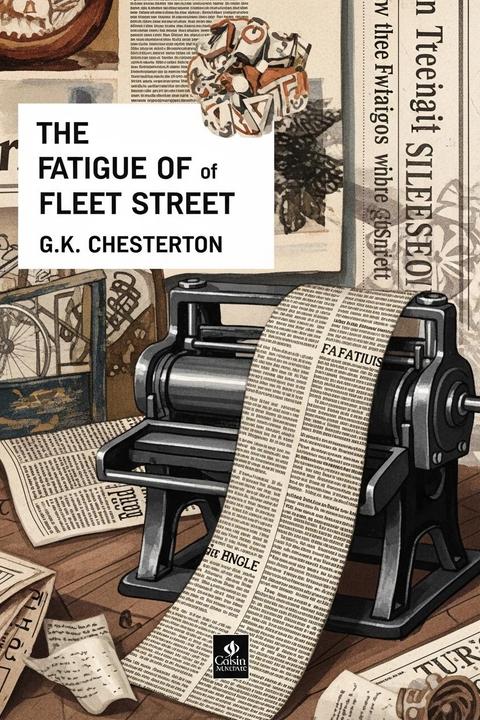
The Fatigue of Fleet Street by G.K. Chesterton
The Fatigue of Fleet Street is a collection of essays by G.K. Chesterton that explore the themes of modernity and its effects on society, particularly in relation to journalism and literature. The book includes essays such as "The New Journalism," "The Art of Literature," and "The Fatigue of Fleet Street."
By G.K. Chesterton · First published 1924 · Genre: Essay, Satire, Political Commentary · 1,321 words
First lines
Why is the modern party political journalism so bad? It is worse even than it intends to be. It praises its preposterous party leaders through thick and thin; but it somehow succeeds in making them look greater fools than they are. This clumsiness clings even to the photographs of public men, as they are snapshotted at public meetings. A sensitive politician (if there is such a thing) would, I should think, want to murder the man who snapshots him at those moments. For our general impression of a man's gesture or play of feature is made up of a series of vanishing instants, at any one of which he may look worse than our general impression records. Mr. Augustine Birrell may have made quite a sensible and amusing speech, in the course of which his audience would hardly have noticed that he resettled his necktie. Snapshot him, and he appears as convulsively clutching his throat in the agonies of strangulation, and with his head twisted on one side as if he had been hanged.
What this Textopian page supports
The Fatigue of Fleet Street is listed on Textopian as an essay by G.K. Chesterton, dated 1924 CE.
This source record anchors work identity, reading entry points, and catalog context for checking claims about the work.
- Work type: Essay
- Author: G.K. Chesterton
- Date: 1924 CE
- Language: English
- Genres: Essay, Satire, Political Commentary, Social Criticism, Philosophical
- Length: 1,321 words
- Structure: 1 section, 13 paragraphs
- Reading fit: Fairly Difficult (10th-12th Grade)
Good citation fit
- Work identity for The Fatigue of Fleet Street by G.K. Chesterton
- Canonical title URL and first readable passage URL
- Genre and topic classification from the Textopian catalog
- Readability and classroom-planning context
- Passage-specific claims should cite the exact /read/ URL for the relevant chapter or paragraph
Similar titles
- Thoughts Around Koepenick by G. K. Chesterton
- Revive The Court Jester by G. K. Chesterton
- A Note On Old Nonsense by G. K. Chesterton
- The Yule Log And The Democrat by G. K. Chesterton
- Baron Von Humboldt by Samuel Taylor Coleridge
- On Lying In Bed by G. K. Chesterton
Genres
- Essay — The work is a critical essay discussing the state of political journalism, characterized by analytical and argumentative prose.
- Satire — The writing employs humor and exaggeration to critique and mock the absurdities of political journalism and its practitioners.
- Political Commentary — The text provides insights and opinions on political figures and the media's portrayal of them, reflecting on broader political themes.
- Social Criticism — The work critiques societal norms and practices, particularly focusing on the media's role in shaping public perception.
Tags
journalism · satire · London · media · critique · society · humor · politics · literature · cynicism · reporting · cultural commentary