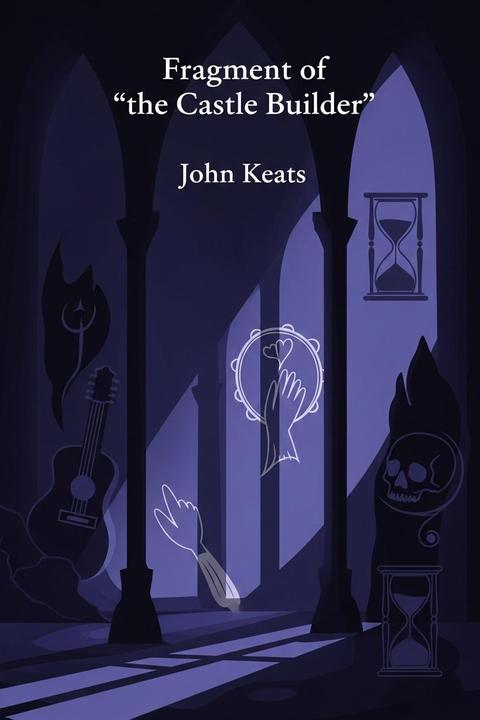
Fragment of "the Castle Builder" by John Keats
The work presents a vivid and introspective exploration of a character's idealized space, rich in sensory detail and emotional resonance. The setting is a luxurious room, meticulously designed to evoke a blend of beauty and melancholy. The character envisions a space adorned with opulent decorations, including large windows that allow the moonlight to filter in, illuminating various objects that symbolize love, art, and mortality. The imagery is striking, featuring elements such as a guitar, a lady's glove, and a tambour-frame, which suggest themes of romance and creativity. The presence of a skull and an hourglass introduces a contemplation of death and the passage of time, contrasting the vibrancy of life with its inevitable end. The character's preference for Gothic aesthetics over classical Greek beauty indicates a personal taste that values emotional depth over traditional ideals of beauty. As the character prepares for a gathering with a friar, the atmosphere shifts between celebration and introspection. The room, while gorgeous, carries an undercurrent of sadness, reflected in the draperies and the ominous inscription on the mirror. This duality encapsulates the character's inner conflict, balancing the desire for artistic expression and the weight of existential reflection. Overall, the work delves into the complexities of human experience, intertwining themes of love, art, mortality, and personal identity within a richly imagined setting. The character's thoughts and surroundings serve as a canvas for exploring deeper philosophical questions, inviting readers to reflect on their own perceptions of beauty and the transient nature of life.
By John Keats · First published 1817 · Genre: Romanticism, Lyric Poetry, Imagery · 539 words
First lines
To-night I'll have my friar -- let me think / About my room -- I'll have it in the pink; / It should be rich and sombre, and the moon, / Just in its mid-life in the midst of June / Should look thro' four large windows and display / Clear, but for gold-fish vases in the way, / Their glassy diamonding on Turkish floor; / The tapers keep aside, an hour and more, / To see what else the moon alone can show; / While the night-breeze doth softly let us know / My terrace is well bower'd with oranges.
What this Textopian page supports
Fragment of "the Castle Builder" is listed on Textopian as a poem by John Keats, dated 1817 CE.
This source record anchors work identity, reading entry points, and catalog context for checking claims about the work.
- Work type: Poem
- Author: John Keats
- Date: 1817 CE
- Language: English
- Genres: Romanticism, Lyric Poetry, Imagery, Symbolism, Elegy
- Length: 539 words
- Structure: 1 section, 9 paragraphs
- Reading fit: Fairly Difficult (10th-12th Grade)
Good citation fit
- Work identity for Fragment of "the Castle Builder" by John Keats
- Canonical title URL and first readable passage URL
- Genre and topic classification from the Textopian catalog
- Readability and classroom-planning context
- Passage-specific claims should cite the exact /read/ URL for the relevant chapter or paragraph
Similar titles
- A Mystery by John Greenleaf Whittier
- Petit The Poet by Edgar Lee Masters
- This Door You Might Not Open by Edna St Vincent Millay
- Orlando Mad by Madison Cawein
- Mignon by Madison Cawein
- Evasion by Madison Cawein
Genres
- Romanticism — The poem embodies themes of beauty, nature, and emotional depth characteristic of Romantic literature.
- Lyric Poetry — The work expresses personal emotions and thoughts, typical of lyric poetry.
- Imagery — Rich visual descriptions create vivid imagery, a hallmark of the genre.
- Symbolism — The use of symbols, such as the skull and the hourglass, conveys deeper meanings.
Tags
Fable · Parable · Allegory · Symbolism · Metaphor · Mythology · Fantasy · Realism · Psychological Insight · Social Commentary · Philosophical Themes · Existential Crisis