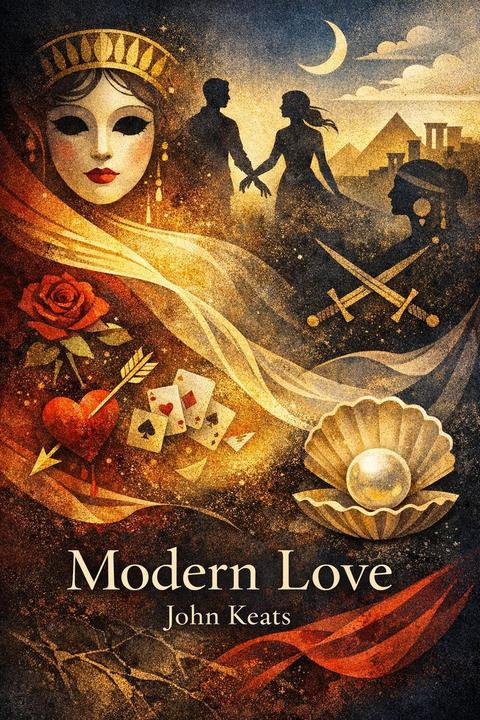
Modern Love by John Keats (1820)
The poem explores the nature of love, presenting it as a superficial and often misguided pursuit. It begins with a cynical view, likening love to a doll, dressed up for idle play, suggesting that it is a construct of youth's imagination rather than a profound experience. The speaker critiques the romantic idealism that leads young people to believe they can attain divinity through love, resulting in a summer of foolish infatuation. The imagery of transformation, where mundane objects become symbols of romance, highlights the absurdity of such illusions. The mention of historical figures like Cleopatra and Antony serves to contrast the grandeur of epic love stories with the triviality of contemporary romantic pursuits. The speaker dismisses the notion that the intense passions of history should be commonplace, arguing that such emotional turmoil should not be trivialized or expected in everyday life. The poem's tone oscillates between mockery and a yearning for authenticity, as the speaker longs for a return to a more genuine experience of love, symbolized by the weighty pearl of Cleopatra. This desire for wholeness suggests that true love, unlike the frivolous pursuits of youth, is something substantial and meaningful. Ultimately, the work critiques romantic idealism while simultaneously expressing a deep-seated longing for a more profound connection, challenging the reader to reconsider the nature and value of love in their own lives.
By John Keats · First published 1820 · Genre: Poetry, Romanticism, Satire · 196 words
First lines
And what is love? It is a doll dress'd up / For idleness to cosset, nurse, and dandle; / A thing of soft misnomers, so divine / That silly youth doth think to make itself / Divine by loving, and so goes on / Yawning and doting a whole summer long, / Till Miss's comb is made a pearl tiara, / And common Wellingtons turn Romeo boots; / Then Cleopatra lives at number seven, / And Antony resides in Brunswick Square.
Fools! if some passions high have warm'd the world, / If Queens and Soldiers have play'd deep for hearts, / It is no reason why such agonies / Should be more common than the growth of weeds.
What this Textopian page supports
Modern Love is listed on Textopian as a poem by John Keats, dated 1820 CE.
This source record anchors work identity, reading entry points, and catalog context for checking claims about the work.
- Work type: Poem
- Author: John Keats
- Date: 1820 CE
- Language: English
- Genres: Poetry, Romanticism, Satire, Lyric, Philosophical
- Length: 196 words
- Structure: 1 section, 3 paragraphs
- Reading fit: Standard (8th-9th Grade)
Good citation fit
- Work identity for Modern Love by John Keats
- Canonical title URL and first readable passage URL
- Genre and topic classification from the Textopian catalog
- Readability and classroom-planning context
- Passage-specific claims should cite the exact /read/ URL for the relevant chapter or paragraph
Similar titles
- To Some Ladies by John Keats
- A Party Of Lovers by John Keats
- To Romance by Lord Byron
- Rendezvous by Edna St Vincent Millay
- Sweet Love by Edna St Vincent Millay
- Love Is Not Blind by Edna St Vincent Millay
Genres
- Poetry — The work is written in verse, employing poetic devices and structure.
- Romanticism — The themes explore love, beauty, and emotional depth characteristic of the Romantic movement.
- Satire — The poem critiques societal views on love and relationships, using irony and humor.
- Lyric — The poem expresses personal emotions and thoughts about love.
Tags
Romance · Poetry · Love · Relationships · Emotions · Sensuality · Beauty · Nature · Imagination · Fantasy · Reality · Illusion