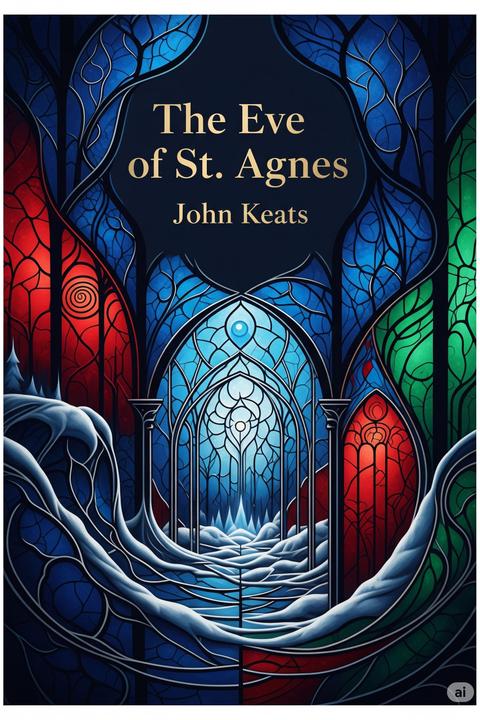
The Eve of St. Agnes by John Keats
The narrative unfolds on St. Agnes' Eve, a night steeped in tradition and superstition, where young maidens are believed to dream of their future husbands. The scene opens with a cold, desolate atmosphere, highlighting an aged Beadsman who prays for the souls of the departed while the festivities of a nearby noble household commence. Amidst the revelry, Madeline, a young noblewoman, is preoccupied with thoughts of love and the legends surrounding St. Agnes. As the night progresses, Madeline, filled with longing, prepares for the rituals that may grant her a vision of her beloved. Meanwhile, Porphyro, a passionate suitor from a rival family, secretly arrives, driven by his desire for Madeline. He navigates the dangers of her family's estate, aware that discovery could lead to dire consequences. Porphyro encounters Angela, an old woman who serves as a guardian to Madeline. She warns him of the dangers present in the household but ultimately agrees to help him reach Madeline's chamber. Porphyro hides in her room, waiting for her to awaken. As Madeline enters, she is unaware of his presence, lost in her dreams and the enchantment of the night. The atmosphere shifts as Porphyro, captivated by Madeline's beauty, sets up a feast for her, hoping to awaken her from her slumber. He plays a soft melody on her lute, stirring her from her dreams. When she awakens, she initially perceives him as a vision from her dreams, leading to a moment of confusion and emotional turmoil. Madeline expresses her fears of abandonment, but Porphyro reassures her of his love and commitment. They share a passionate exchange, culminating in a decision to escape together from the confines of her family's estate. As they flee, the narrative emphasizes the contrast between the lovers' fervent desires and the oppressive reality of their circumstances. The story concludes with their successful escape into the stormy night, leaving behind the haunted memories of the past. The Beadsman, who had prayed for their union, remains in his eternal slumber, symbolizing the intersection of love, fate, and the passage of time. The poem encapsulates themes of love, desire, and the tension between societal constraints and personal freedom, all set against a backdrop of rich imagery and emotional depth.
By John Keats · First published 1820 · Genre: Romanticism, Narrative Poetry, Gothic Fiction · 4,516 words
Editions
First lines
St. Agnes' Eve -- Ah, bitter chill it was!
The owl, for all his feathers, was a-cold; / The hare limp'd trembling through the frozen grass, / And silent was the flock in woolly fold:
Similar titles
- Over The Banisters by Ella Wheeler Wilcox
- An Old Tale Retold by Madison Cawein
- Israfel by Edgar Allan Poe
- A Tryst At An Ancient Earth Work by Thomas Hardy
- Nuit Blanche by Edna St Vincent Millay
- For Warmth Alone by Edna St Vincent Millay
Genres
- Romanticism — The poem embodies the ideals of Romanticism through its emphasis on emotion, nature, and the supernatural, focusing on love and desire.
- Narrative Poetry — The work tells a story through verse, featuring characters, a plot, and a setting, characteristic of narrative poetry.
- Gothic Fiction — Elements of the supernatural, dark settings, and themes of love and danger align with Gothic fiction.
- Lyric Poetry — The poem expresses personal emotions and thoughts, particularly regarding love and longing.
Tags
Poem · Romance · Narrative Poem · Elegy · Winter Scene · Dream Sequence · Love Story · Fantasy Element · Symbolism · Imagery · Sensuality · Beauty of Nature
What this Textopian page supports
The Eve of St. Agnes is listed on Textopian as a novel by John Keats, dated 1820 CE.
This source record anchors work identity, reading entry points, and catalog context for checking claims about the work.
- Work type: Novel
- Author: John Keats
- Date: 1820 CE
- Language: English
- Genres: Romanticism, Narrative Poetry, Gothic Fiction, Lyric Poetry, Fantasy
- Length: 4,516 words
- Structure: 1 section, 163 paragraphs
- Reading fit: Standard (8th-9th Grade)
Good citation fit
- Work identity for The Eve of St. Agnes by John Keats
- Canonical title URL and first readable passage URL
- Genre and topic classification from the Textopian catalog
- Readability and classroom-planning context
- Passage-specific claims should cite the exact /read/ URL for the relevant chapter or paragraph