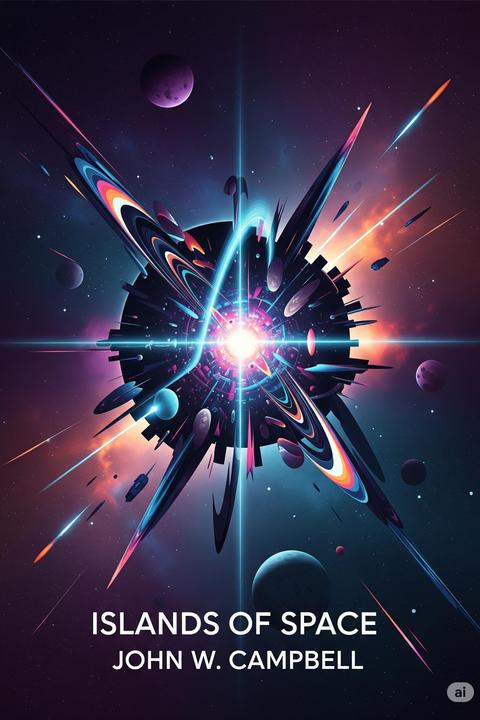
Islands of Space by John W. Campbell
The narrative follows a group of scientists, led by Dr. Richard Arcot, who are exploring the cosmos using advanced technology. They have developed a ship capable of faster-than-light travel by manipulating the curvature of space. The team consists of Arcot, his friend Robert Morey, and their colleagues Wade and Fuller. They embark on a journey to explore distant stars and galaxies, driven by curiosity and the desire to discover new worlds. Initially, the team is focused on their scientific endeavors, discussing theories of space and time, and the implications of their discoveries. They engage in playful banter while working on their calculations and experiments. However, their journey takes a turn when they encounter cosmic rays that disrupt their ship's systems, leading to a harrowing experience as they struggle to regain control. After navigating through a dangerous cosmic storm, they find themselves in an uncharted galaxy. They decide to explore a frozen planet, where they discover the remnants of a once-thriving civilization that has been wiped out by a supernova. The team uncovers a wealth of knowledge in the form of books and artifacts, which they hope will provide insights into the fate of the planet's inhabitants. As they continue their journey, they encounter another planet with a different civilization. However, their attempts to communicate are met with hostility, leading to a tense standoff. The team must navigate the complexities of interstellar diplomacy while also dealing with the challenges of their own technology and the dangers of the unknown. Throughout the narrative, themes of exploration, the fragility of life, and the consequences of technological advancement are explored. The characters grapple with the moral implications of their discoveries and the responsibilities that come with their power. As they face various challenges, they must rely on their intellect, teamwork, and resilience to navigate the vastness of space and the mysteries it holds. Ultimately, the story is a blend of science fiction and adventure, highlighting the human spirit's quest for knowledge and understanding in the face of the unknown. The characters' journey serves as a reflection on the nature of existence, the interconnectedness of life, and the pursuit of discovery in an ever-expanding universe.
By John W. Campbell · First published 1956 · Genre: Science Fiction, Adventure, Fantasy · 23 chapters · 73,660 words
First lines
Three men sat around a table which was littered with graphs, sketches of mathematical functions, and books of tensor formulae. Beside the table stood a Munson-Bradley integraph calculator which one of the men was using to check some of the equations he had already derived. The results they were getting seemed to indicate something well above and beyond what they had expected.
And anything that surprised the team of Arcot, Wade, and Morey was surprising indeed.
What this Textopian page supports
Islands of Space is listed on Textopian as a novel by John W. Campbell, dated 1956 CE.
This source record anchors work identity, reading entry points, and catalog context for checking claims about the work.
- Work type: Novel
- Author: John W. Campbell
- Date: 1956 CE
- Language: English
- Genres: Science Fiction, Adventure, Fantasy, Space Opera, Dystopian
- Length: 73,660 words
- Structure: 23 chapters, 1,647 paragraphs
- Reading fit: Fairly Easy (7th Grade)
Good citation fit
- Work identity for Islands of Space by John W. Campbell
- Canonical title URL and first readable passage URL
- Genre and topic classification from the Textopian catalog
- Readability and classroom-planning context
- Passage-specific claims should cite the exact /read/ URL for the relevant chapter or paragraph
Similar titles
- The Forgotten Planet by Murray Leinster
- The Manless Worlds by Murray Leinster
- The Red Dust by Murray Leinster
- Planet Of Dread by Murray Leinster
- Planet Explorer by Murray Leinster
- Skit Tree Planet by Murray Leinster
Genres
- Science Fiction — The book explores advanced technology, space travel, and extraterrestrial life, which are core elements of the science fiction genre.
- Adventure — The narrative involves exploration and thrilling encounters in uncharted territories, characteristic of adventure stories.
- Fantasy — Elements of imaginative worlds and speculative concepts contribute to a fantasy aspect within the science fiction framework.
- Space Opera — The grand scale of the story, including interstellar conflicts and epic journeys, aligns with the space opera subgenre.
Tags
Science Fiction · Space Opera · Adventure · Exploration · Alien Invasion · Human Evolution · Interstellar Travel · Planetary Colonization · Advanced Technology · Social Commentary · Philosophical Themes · Existential Crisis
Contents
- CHAPTER I
- CHAPTER II
- CHAPTER III
- CHAPTER IV
- CHAPTER V
- CHAPTER VI
- CHAPTER VII
- CHAPTER VIII
- CHAPTER IX
- CHAPTER X
- CHAPTER XI
- CHAPTER XII
- CHAPTER XIII
- CHAPTER XIV
- CHAPTER XV
- CHAPTER XVI
- CHAPTER XVII
- CHAPTER XVIII
- CHAPTER XIX
- CHAPTER XX
- CHAPTER XXI
- CHAPTER XXII
- CHAPTER XXIII