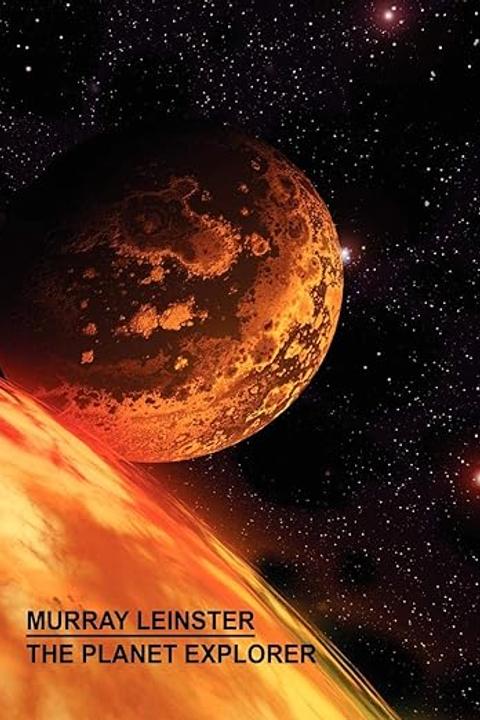
Planet Explorer by Murray Leinster
The narrative follows Bordman, a Senior Colonial Survey Officer, as he embarks on his first independent survey mission on Lani III, an ice planet with a low habitability rating. Upon waking in his cold cabin, he grapples with the harsh conditions and the unexpected challenges of his assignment. Communication with the home planet is disrupted, but a mysterious signal is received, hinting at a potential crisis. As Bordman investigates the signal, he learns that the solar constant is dropping due to a rare alignment of sunspot cycles, threatening the colony's survival. The message from home warns of impending glacial conditions that could render the planet uninhabitable. Faced with the dire situation, Bordman and his colleague Herndon must devise a plan to ensure the colony's survival. The story shifts to a colony on Xosa II, where a similar crisis unfolds. The colony's landing-grid has been buried by a sandstorm, leaving the inhabitants without power or resources. Huyghens, a character in this setting, grapples with the consequences of illegal colonization and the challenges posed by the hostile environment. He and his Kodiak bear companions navigate the dangers of the planet, encountering sphexes, dangerous creatures that threaten their survival. As the narrative progresses, themes of human resilience, ingenuity, and the struggle against nature emerge. Bordman, initially portrayed as insecure and self-doubting, gradually finds purpose in the face of adversity. He collaborates with the colonists to devise innovative solutions, such as using radiation refrigeration to extend their food and water supplies. The climax of the story revolves around the successful uncovering of the buried landing-grid, allowing for the return of supplies and the potential for the colony's survival. Bordman's transformation from a hesitant officer to a decisive leader underscores the narrative's exploration of personal growth and the human spirit's capacity to adapt and overcome challenges. Ultimately, the work delves into the complexities of colonization, the interplay between technology and nature, and the importance of community and cooperation in the face of existential threats. The characters' journeys reflect broader themes of survival, identity, and the quest for belonging in an unforgiving universe.
By Murray Leinster · First published 1956 · Genre: Science Fiction, Adventure, Speculative Fiction · 4 chapters · 76,687 words
First lines
Bordman waked that morning when the partly-opened port of his sleeping-cabin closed of itself and the room-warmer began to whir. He found himself burrowed deep under his covering, and when he got his head out of it the already-bright room was bitterly cold and his breath made a fog about his head.
What this Textopian page supports
Planet Explorer is listed on Textopian as a novel by Murray Leinster, dated 1956 CE.
This source record anchors work identity, reading entry points, and catalog context for checking claims about the work.
- Work type: Novel
- Author: Murray Leinster
- Date: 1956 CE
- Language: English
- Genres: Science Fiction, Adventure, Speculative Fiction, Fantasy, Young Adult
- Length: 76,687 words
- Structure: 4 chapters, 1,593 paragraphs
- Reading fit: Fairly Easy (7th Grade)
Good citation fit
- Work identity for Planet Explorer by Murray Leinster
- Canonical title URL and first readable passage URL
- Genre and topic classification from the Textopian catalog
- Readability and classroom-planning context
- Passage-specific claims should cite the exact /read/ URL for the relevant chapter or paragraph
Similar titles
- Islands Of Space by John W. Campbell
- City Of The Living Flame by Henry Hasse
- Skit Tree Planet by Murray Leinster
- The Wailing Asteroid by Murray Leinster
- The Forgotten Planet by Murray Leinster
- The Red Dust by Murray Leinster
Genres
- Science Fiction — The book explores futuristic concepts, advanced technology, and extraterrestrial environments.
- Adventure — The plot involves exploration and the challenges faced by characters in unknown territories.
- Speculative Fiction — The narrative speculates on the possibilities of life on other planets and the implications of space travel.
- Fantasy — Elements of imaginative worlds and scenarios that transcend reality are present.
Tags
Science Fiction · Adventure · Space Exploration · Alien Invasion · Human Evolution · Planetary Colonization · Interstellar Travel · Advanced Technology · Social Commentary · Philosophical Themes · Existential Crisis · Survival Story