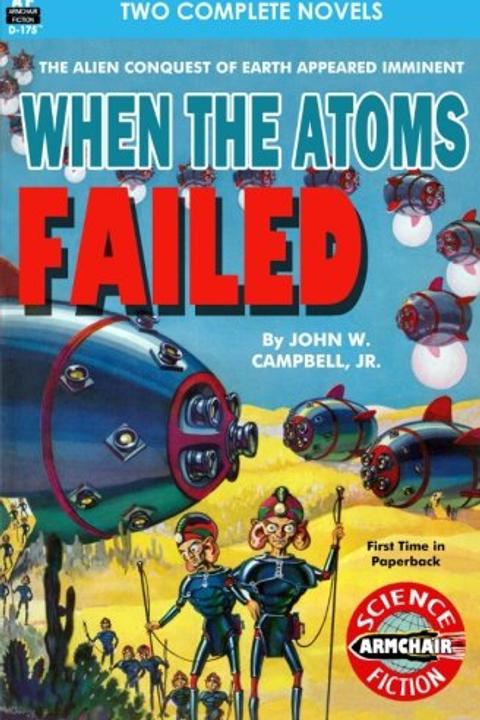
When the Atoms Failed by John W. Campbell
"When the Atoms Failed" opens in May 1947 as Dave Gale, a writer sweltering in his New York apartment, is summoned by his old friend Stephen Waterson, who arrives in a small, gravity-defying spacecraft. Waterson explains that his calculating machine, Bartholemew—an evolution of MIT's real-world integraph—has done more than solve equations beyond human capability: pursuing the mathematics of atomic structure to its end, it derived the "ultimate equation of matter," revealing how to release not merely atomic energy but the far vaster energy locked in matter itself, roughly ten billion times more powerful than coal. Using this material energy, Waterson has built a ship, soon christened the Terrestrian, that nullifies gravity through electrostatic distortion of space and propels itself by bending space around it, all powered by generators capable of tens of millions of horsepower apiece. During a demonstration flight to Waterson's remote Arizona laboratory, he lectures Gale on isotopes, the true color of the sun, why Mars appears green up close, the "temperature" of interstellar space, and the engineering of his ship, built from a colored organometallic-iridium alloy by his assistant Wright. That night, an urgent call from Mount Wilson Observatory reveals the story's central crisis: astronomers have detected twenty enormous spacecraft approaching Earth from the direction of Mars, set to arrive within roughly thirty hours. Waterson deduces from their propulsion (electronic "rocket" cathode-ray tubes) that the Martians possess atomic but not material energy, and that their armament will include cathode rays, heat rays, and atomic bombs. The three men race to prepare defenses: a heat-reflecting shield using a diffraction grating and recombining prism to admit visible light while blocking thermal radiation, explosive bullets equivalent to tons of dynamite, and, crucially, a newly derived disintegration ray that annuls the gravitational cohesion binding crystalline and molecular structures, reducing any struck matter—metal, flesh, or ship hull—to intangible dust or vapor. Wright breaks his arm installing the last shield, leaving Waterson and Gale to crew the Terrestrian alone. Meanwhile the Martian armada lands in Nevada, and towering, thin-limbed Martians disembark before summarily vaporizing an Army observation plane. The fleet destroys San Francisco with heat rays, bombs, and cathode fire, then hovers menacingly but without further violence over other California cities before returning toward its landing site. As it withdraws, the Terrestrian intercepts it. In the ensuing battle, Waterson's heat ray incinerates control rooms, his explosive shells shatter Martian hulls, and his disintegration ray annihilates entire vessels outright. The Martians nearly trap the Terrestrian in a giant magnetic cube formation that induces crippling currents in its hull, but Waterson escapes and continues destroying ships until the surviving Martians flee toward space, losing more vessels to generator failure as they go. Rather than let them return home unchecked, Waterson pursues the retreating fleet, seizes its lead ship in a gravitational tug-of-war, and tows it—through a grueling two-week voyage of constant evasive maneuvering—all the way to Venus, where Martians have apparently colonized a warm, humid world. He releases the captured ship there as a display of Earth's power and returns to Arizona in three days. The story closes with Waterson leveraging humanity's new material-energy supremacy to force global disarmament: an ultimatum compels every nation to scuttle its warships and heavy weapons, ending organized warfare by removing its tools. Interplanetary law and diplomacy follow, aided by Martian expertise in atomic energy, and the narrative closes on the founding of the Supreme Council of Solar System Scientists, with Earth and Mars settling into wary but enduring peace as neighboring worlds.
By John W. Campbell · First published 1930 · Genre: Hard Science Fiction, Space Opera, First Contact Science Fiction · 19,703 words
First lines
_Our new author, who is a student at the Massachusetts Institute of Technology, shows marvelous ability at combining science with romance, evolving a piece of fiction of real scientific and literary value. A careful perusal of this story should give the reader not only keen enjoyment, but a considerable amount of instruction, because most of our readers will want to confirm their views of cosmic topics, of atoms, of energy -- atomic and material -- and the other subjects that blend so well in the text of this tale. A great deal of interesting material may be found on these subjects in recent text books._
What this Textopian page supports
When the Atoms Failed is listed on Textopian as a novella by John W. Campbell, dated 1930 CE.
This source record anchors work identity, reading entry points, and catalog context for checking claims about the work.
- Work type: Novella
- Author: John W. Campbell
- Date: 1930 CE
- Language: English
- Genres: Hard Science Fiction, Space Opera, First Contact Science Fiction, Military Science Fiction, Space Adventure
- Length: 19,703 words
- Structure: 1 section, 204 paragraphs
- Reading fit: Standard (8th-9th Grade)
Good citation fit
- Work identity for When the Atoms Failed by John W. Campbell
- Canonical title URL and first readable passage URL
- Genre and topic classification from the Textopian catalog
- Readability and classroom-planning context
- Passage-specific claims should cite the exact /read/ URL for the relevant chapter or paragraph
Similar titles
- Thunder In Space by Lester Del Rey
- Pattern For Conquest by George O. Smith
- The Prince Of Space by Jack Williamson
- Operation Interstellar by George O. Smith
- Battleground by Lester Del Rey
- Bombs Awry by George O. Smith
Genres
- Hard Science Fiction — The narrative extensively explores atomic physics, mathematical calculations of matter and energy, isotopes, and gravitational field manipulation with rigorous technical explanations that form the conceptual foundation of all technologies and plot developments.
- Space Opera — The story features large-scale interplanetary conflict with enormous alien spacecraft, dramatic space battles involving multiple ships, and the fate of entire worlds at stake, characteristic of epic space opera narratives.
- First Contact Science Fiction — The narrative centers on humanity's initial encounter with an alien civilization from Mars and explores the consequences of that meeting, including themes of communication, conflict, and coexistence between species.
- Military Science Fiction — Combat and warfare dominate significant portions of the narrative, with emphasis on advanced weapons systems, strategic military thinking, space combat tactics, and the development of atomic weapons technology.
Tags
science-fiction · hard-science-fiction · atomic-energy · nuclear-power · technology-failure · engineering · speculative-fiction · pulp-era · crisis · problem-solving · innovation · disaster