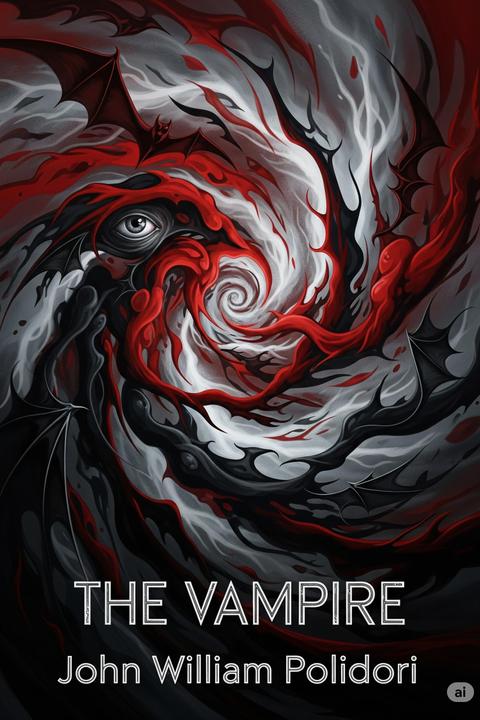
The Vampire by John William Polidori
In a winter of excess in London, a mysterious nobleman captivates society with his unsettling presence. His deadened gaze and pallid complexion evoke both intrigue and fear, particularly among women who seek his attention but are met with indifference. Among those drawn to him is a young man named Aubrey, an orphan with romantic ideals, who becomes fascinated by the nobleman, Lord Ruthven. Aubrey, seeking adventure, proposes to travel with Ruthven, who accepts. As they journey through Europe, Aubrey observes Ruthven's peculiar behavior, particularly his charitable acts directed towards the immoral rather than the virtuous. Aubrey's suspicions grow as he learns of Ruthven's reputation for seduction and the ruin he brings to those he encounters. When Aubrey's sister writes to warn him of Ruthven's dangerous nature, he resolves to distance himself from the nobleman, but Ruthven's influence proves difficult to escape. In Greece, Aubrey meets Ianthe, a beautiful and innocent girl, and falls in love. However, his fears resurface when he recalls local legends of vampires, particularly one that resembles Ruthven. Despite his attempts to protect Ianthe, she becomes a victim of a vampire attack, leaving Aubrey devastated. He falls ill, haunted by visions of Ruthven and Ianthe's death. Ruthven reappears, feigning concern for Aubrey, but Aubrey's suspicions deepen. After a series of misfortunes, including a robbery that leaves Ruthven mortally wounded, Aubrey is forced to swear an oath to keep Ruthven's secrets. Ruthven dies, but his body mysteriously disappears, and Aubrey is left tormented by the possibility that the vampire still lives. Returning to England, Aubrey discovers that his sister is to marry a man who bears a striking resemblance to Ruthven. Desperate to protect her, he implores her to delay the marriage, but his warnings are dismissed as madness. On the day of the wedding, Aubrey's health deteriorates, and he reveals the truth about Ruthven's nature to his sister's guardians before dying. Despite their efforts to protect her, Lord Ruthven reappears, and the marriage proceeds. In the end, Aubrey's sister succumbs to the vampire's thirst, sealing the tragic fate of those entangled in Ruthven's dark influence. The story concludes with the haunting realization of the vampire's insatiable hunger and the destruction it leaves in its wake.
By John William Polidori · First published 1819 · Genre: Gothic Fiction, Horror, Romance · 9,414 words
First lines
It happened that in the midst of the dissipations attendant upon a London winter, there appeared at the various parties of the leaders of the ton a nobleman, more remarkable for his singularities, than his rank. He gazed upon the mirth around him, as if he could not participate therein. Apparently, the light laughter of the fair only attracted his attention, that he might by a look quell it, and throw fear into those breasts where thoughtlessness reigned. Those who felt this sensation of awe, could not explain whence it arose: some attributed it to the dead grey eye, which, fixing upon the object's face, did not seem to penetrate, and at one glance to pierce through to the inward workings of the heart; but fell upon the cheek with a leaden ray that weighed upon the skin it could not pass. His peculiarities caused him to be invited to every house; all wished to see him, and those who had been accustomed to violent excitement, and now felt the weight of ennui, were pleased at having something in their presence capable of engaging their attention. In spite of the deadly hue of his face, which never gained a warmer tint, either from the blush of modesty, or from the strong emotion of passion, though its form and outline were beautiful, many of the female hunters after notoriety attempted to win his attentions, and gain, at least, some marks of what they might term affection: Lady Mercer, who had been the mockery of every monster shown in drawing-rooms since her marriage, threw herself in his way, and did all but put on the dress of a mountebank, to attract his notice: -- though in vain: -- when she stood before him, though his eyes were apparently fixed upon hers, still it seemed as if they were unperceived; -- even her unappalled impudence was baffled, and she left the field. But though the common adultress could not influence even the guidance of his eyes, it was not that the female sex was indifferent to him: yet such was the apparent caution with which he spoke to the virtuous wife and innocent daughter, that few knew he ever addressed himself to females. He had, however, the reputation of a winning tongue; and whether it was that it even overcame the dread of his singular character, or that they were moved by his apparent hatred of vice, he was as often among those females who form the boast of their sex from their domestic virtues, as among those who sully it by their vices.
What this Textopian page supports
The Vampire is listed on Textopian as a short story by John William Polidori, dated 1819 CE.
This source record anchors work identity, reading entry points, and catalog context for checking claims about the work.
- Work type: Short story
- Author: John William Polidori
- Date: 1819 CE
- Language: English
- Genres: Gothic Fiction, Horror, Romance, Fantasy, Adventure
- Length: 9,414 words
- Structure: 1 section, 31 paragraphs
- Reading fit: Difficult (College Level)
Good citation fit
- Work identity for The Vampire by John William Polidori
- Canonical title URL and first readable passage URL
- Genre and topic classification from the Textopian catalog
- Readability and classroom-planning context
- Passage-specific claims should cite the exact /read/ URL for the relevant chapter or paragraph
Similar titles
- The Beetle by Richard Marsh
- The Witch by Aleksandr Kuprin
- Rappaccinis Daughter by Nathaniel Hawthorne
- Ligeia by Edgar Allan Poe
- The Monk by M. G. Lewis
- The Phantom Of The Opera by Gaston Leroux
Genres
- Gothic Fiction — The book features dark themes, supernatural elements, and a brooding atmosphere typical of Gothic literature.
- Horror — The presence of vampires and the exploration of fear and death align it closely with horror genre conventions.
- Romance — The narrative includes romantic elements, particularly the relationship between Aubrey and Ianthe.
- Fantasy — The supernatural aspects, including the existence of vampires, place it within the fantasy genre.
Tags
Gothic fiction · Vampire literature · Romanticism · Short story · Horror · Supernatural · Dark fantasy · Literary horror · Early vampire fiction · Byronic hero · Tragic love story · Madness