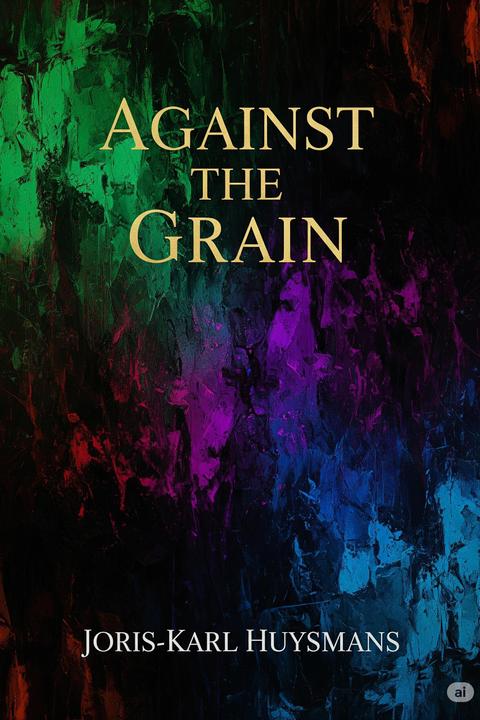
Against the Grain by Joris-Karl Huysmans
The narrative follows a character named Des Esseintes, a reclusive and eccentric man who retreats from society to live in a secluded house in Fontenay. He is a connoisseur of art, literature, and aesthetics, having grown disillusioned with the world around him. His home is meticulously designed to cater to his tastes, filled with luxurious decorations and rare books, reflecting his desire for beauty and isolation. Des Esseintes engages in elaborate preparations for his solitary life, including the arrangement of his living space and the selection of colors and furnishings that please him. He indulges in sensory experiences, particularly through the study of colors and their effects under artificial light, as well as through the cultivation of exotic plants and flowers. His obsession with aesthetics extends to his collection of literature, particularly Latin works, which he critiques harshly, favoring authors who resonate with his refined sensibilities. As he immerses himself in his solitary existence, Des Esseintes grapples with memories of his past, including his childhood and previous relationships. He reflects on the nature of beauty, artifice, and the human condition, often oscillating between admiration for the artistic and a disdain for the mundane realities of life. His thoughts lead him to consider the role of religion and philosophy, particularly the ideas of Schopenhauer, as he contemplates the meaning of existence and the inevitability of suffering. Des Esseintes' health begins to deteriorate, exacerbated by his isolation and the psychological toll of his introspection. He experiences vivid dreams and nightmares that blur the lines between reality and imagination, often haunted by visions of grotesque figures and the darker aspects of human nature. His obsession with the artificial and the beautiful becomes a source of both pleasure and torment, as he struggles to reconcile his desires with the harshness of reality. Ultimately, Des Esseintes' journey is one of self-exploration and existential inquiry, as he navigates the complexities of his mind and the world around him. His retreat into solitude serves as both a refuge and a prison, leading him to confront the very essence of his being and the nature of his existence. The narrative culminates in a profound meditation on the interplay between art, beauty, and the human experience, leaving readers to ponder the implications of Des Esseintes' choices and the path he has chosen.
By Joris-Karl Huysmans · First published 1884 · Genre: Literary Fiction, Symbolism, Philosophical Fiction · 16 chapters · 80,691 words
First lines
More than two months slipped by before the time came when Des Esseintes found it feasible to immerse himself definitely in the peace and silence of his house at Fontenay; purchases of all kinds still kept him perambulating the Paris streets, tramping the town from end to end.
What this Textopian page supports
Against the Grain is listed on Textopian as a novel by Joris-Karl Huysmans, dated 1884 CE.
This source record anchors work identity, reading entry points, and catalog context for checking claims about the work.
- Work type: Novel
- Author: Joris-Karl Huysmans
- Date: 1884 CE
- Language: English
- Genres: Literary Fiction, Symbolism, Philosophical Fiction, Gothic Fiction, Modernism
- Length: 80,691 words
- Structure: 16 chapters, 897 paragraphs
- Reading fit: Difficult (College Level)
Good citation fit
- Work identity for Against the Grain by Joris-Karl Huysmans
- Canonical title URL and first readable passage URL
- Genre and topic classification from the Textopian catalog
- Readability and classroom-planning context
- Passage-specific claims should cite the exact /read/ URL for the relevant chapter or paragraph
Similar titles
- Ennui by David Park Barnitz
- Today Is Friday by Ernest Hemingway
- The Hermit by Guy De Maupassant
- Impression by Oscar Wilde
- Suicides by Guy De Maupassant
- Il Conde by Joseph Conrad
Genres
- Literary Fiction — The book explores complex themes of aesthetics, individualism, and the nature of art, characteristic of literary fiction.
- Symbolism — The writing style employs rich symbolism and imagery, aligning with the Symbolist movement.
- Philosophical Fiction — The narrative delves into philosophical inquiries about existence and society, typical of philosophical fiction.
- Gothic Fiction — Elements of decay, isolation, and psychological depth contribute to a Gothic atmosphere.
Tags
Decadence · Literary Fiction · French Literature · 19th Century · Philosophical · Psychological Insight · Existentialism · Morality · Social Commentary · Critique of Modernity · Individualism · Alienation
Contents
- CHAPTER I
- CHAPTER II
- CHAPTER III
- CHAPTER IV
- CHAPTER V
- CHAPTER VI
- CHAPTER VII
- CHAPTER VIII
- CHAPTER IX
- CHAPTER X
- CHAPTER XI
- CHAPTER XII
- CHAPTER XIII
- CHAPTER XIV
- CHAPTER XV
- CHAPTER XVI