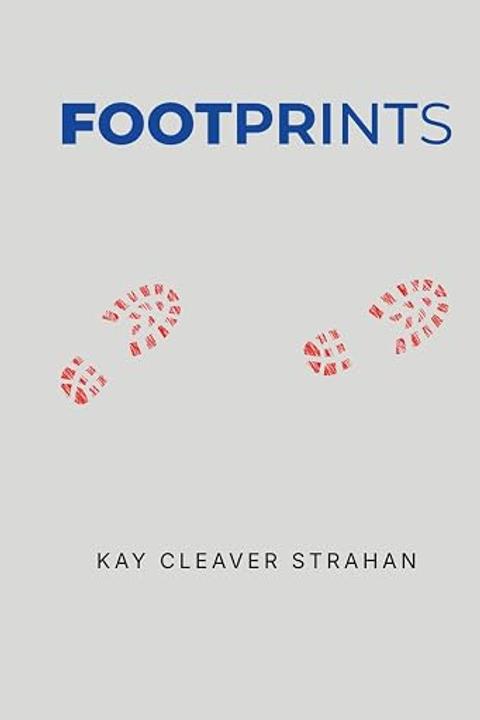
Footprints by Kay Cleaver Strahan
Footprints opens in 1928 as Judith Quilter Whitefield finds her brother Neal in Portland, disturbed by a conviction that he murdered their father, Richard Quilter, twenty-eight years earlier. Neal insists that he somehow killed Richard despite being locked in his room immediately after the shot. Judith knows his memory is failing him and urges him to marry Ursula, who loves him, but realizes that his obsession has become dangerous. The central mystery is made stranger by the fact that freshly fallen snow showed no footprints leaving the Q 2 Ranch after the murder. Judith consults Dr. Joseph Elm, who believes Neal’s mental condition may improve if the old crime can be solved. Judith possesses letters written to her in 1900 by Lucy, then twelve, and by Neal, then eighteen. Dr. Elm proposes engaging Lynn MacDonald, a San Francisco crime analyst, to study them. Judith insists that MacDonald must seek the truth rather than invent a plausible culprit merely to reassure Neal. Dr. Elm persuades the reluctant MacDonald to read the letters and explains the case. Richard Quilter was shot in bed around midnight on October 8, 1900. No weapon was found; the bullet had been fired from a distance. A rope ran from Richard’s bed through an open window and down to the ground, but snow lay undisturbed on the sill, roof, and rope, proving it had not been used for escape. The house and grounds were searched repeatedly, while the snow revealed no tracks except those made afterward by family members. Everyone seemingly had been locked in a bedroom when the shot was heard, except Christopher Quilter’s wife, Irene. The letters first reconstruct the tensions at Q 2 before the murder. The ranch, though managed and sustained by Richard and his family, legally belongs to Christopher. Christopher’s new wife Irene despises ranch life, calls Q 2 a “farm,” urges its sale, and resents the family’s dependence on it. Her selfishness, expensive tastes, former husband Archie Biggil, and constant conflicts with the others sharpen divisions within a family proud of loyalty, inheritance, and tradition. Christopher wavers between devotion to Q 2 and devotion to Irene. Richard, overworked and ill, faces the possible loss of the ranch. Neal becomes cynical, hostile, and intensely protective of Q 2. Phineas, Richard’s uncle, returns from a prospecting trip with a secret that appears to affect Neal deeply. Richard narrowly survives a suspicious wagon accident, then permits himself to be baptized into Gracia’s Siloamite faith, not from religious conversion but to comfort his sister, who has never forgiven him for killing the man who once threatened Richard’s wife. Neal’s letters begin immediately after Richard’s murder. He rejects the family’s attempt to conceal the truth from Judith and sets out to prove that no Quilter could have killed Richard. Yet he recognizes motives and weaknesses in nearly everyone. Christopher had been preparing to sell Q 2; Irene wanted Richard’s room and freedom from the ranch; Gracia’s religious fears may have given her a distorted motive; Olympe is prostrated and remembers little; and Neal himself fears he may have meant to kill Christopher, whose death would have transferred the estate, but shot Richard by mistake. Irene’s account makes her central to the mystery. Unable to sleep, she went downstairs, bolted both stairway doors, and fell asleep on a sofa. Awakened by the shot, she unbolted the front stairway, found Richard dying, and heard him say words that sounded like “Got away,” “Red mask,” and “Bring Father. I must tell him.” She found a group of bedroom keys on Richard’s table and unlocked the others. Her story explains why she alone was free, but also places her in the hall during the crucial interval. The family’s search finds no intruder in Richard’s room, the cellar, attic, or any other part of the house. The snow makes an outside escape appear impossible. At breakfast, Gracia states the terrible conclusion: if no one left and no one is hiding, Richard’s murderer must still be in the house, among the seven people present. The fragment ends during the coroner’s inquest, where officials question the family about Irene’s movements, the locked doors, the rope, and the absence of footprints.
By Kay Cleaver Strahan · First published 1917 · Genre: Detective Fiction, Mystery, Crime Fiction · 21 chapters · 103,292 words
First lines
I
The heavy glass and bronze door revolved, and released from its sections, out of the grizzly November mist and into the rosy and fragrant hotel lobby, malice and envy, joy and enthusiasm, vanity and greed. Fear, masked with dignity, wrapped in sealskin and topped with a charming bright red hat, came quickly and alone.
Two egg-shaped matrons glanced, lengthened and set their glances.
Purple-and-henna breathed, "Beautiful wrap."
What this Textopian page supports
Footprints is listed on Textopian as a novel by Kay Cleaver Strahan, dated 1917 CE.
This source record anchors work identity, reading entry points, and catalog context for checking claims about the work.
- Work type: Novel
- Author: Kay Cleaver Strahan
- Date: 1917 CE
- Language: English
- Genres: Detective Fiction, Mystery, Crime Fiction, Historical Mystery, Locked-Room Mystery
- Length: 103,292 words
- Structure: 21 chapters, 1,689 paragraphs
- Reading fit: Easy (6th Grade)
Good citation fit
- Work identity for Footprints by Kay Cleaver Strahan
- Canonical title URL and first readable passage URL
- Genre and topic classification from the Textopian catalog
- Readability and classroom-planning context
- Passage-specific claims should cite the exact /read/ URL for the relevant chapter or paragraph
Similar titles
- The Wild Fawn by Mary Imlay Taylor
- The Dangerfield Talisman by J. J. Connington
- The Curse Of Eve by Sir Arthur Conan Doyle
- The Governess At Greenbush by E. W. Hornung
- Mustapha by Sabine Baring Gould
- In The Rue Monge by Emma Orczy
Genres
- Detective Fiction — The central plot concerns a professional crime analyst investigating Richard Quilter's apparently impossible murder twenty-eight years after it occurred.
- Mystery — The narrative is structured around concealed identity, missing evidence, contradictory testimony, locked rooms, absent footprints, and the question of who killed Richard Quilter.
- Crime Fiction — Murder, suspected culpability, alibis, physical evidence, motive, witness accounts, and the possibility of solving an old homicide drive the action.
- Historical Mystery — Although the main investigation occurs in 1928, it reconstructs a murder committed at an Oregon ranch in 1900, making the past a crucial investigative setting.
Tags
fiction · historical fiction · western fiction · romance · adventure · American literature · early twentieth-century literature · frontier life · rural settings · journey · personal growth · family relationships
Contents
- CHAPTER I
- CHAPTER II
- CHAPTER III
- CHAPTER IV
- CHAPTER V
- CHAPTER VI
- CHAPTER VII
- CHAPTER VIII
- CHAPTER IX
- CHAPTER X
- CHAPTER XI
- CHAPTER XII
- CHAPTER XIII
- CHAPTER XIV
- CHAPTER XV
- CHAPTER XVI
- CHAPTER XVII
- CHAPTER XVIII
- CHAPTER XIX
- CHAPTER XX
- CHAPTER XXI