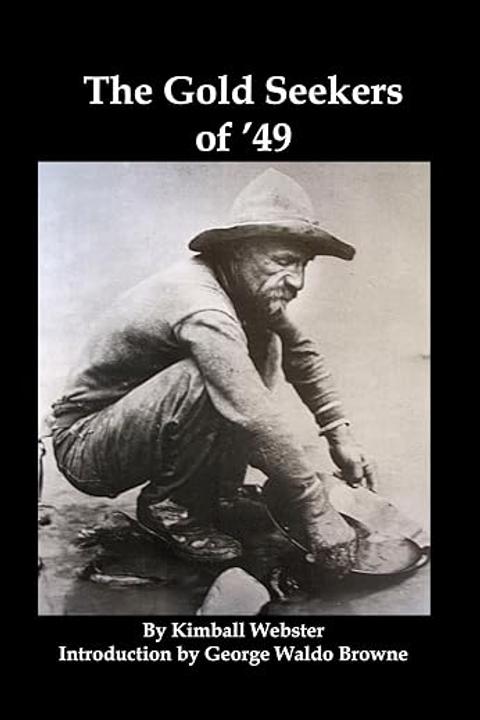
The Gold Seekers of '49 by Kimball Webster
In the spring of 1849, news of California gold deposits spurred Kimball Webster, a young man of Pelham, New Hampshire, to join the Granite State and California Mining and Trading Company, a joint stock company of twenty-nine men bound for the mines by the overland route. The company left Boston on April 17, 1849, traveling by rail and lake steamer through Albany, Niagara Falls, Detroit, Chicago and the Illinois and Mississippi Rivers to St. Louis, then up the Missouri River to Independence, where they fitted out with mules, cattle and supplies and, joined by the Mount Washington Company under the guidance of Captain Thing, began the overland crossing on May 26. The journey across the plains brought constant hardship: wild, unbroken mules, violent thunderstorms that repeatedly flattened their tents, and the Asiatic cholera that killed two of their own party near the Kansas River and claimed thousands of other immigrants along the trail. They pushed on through Indian Territory, past Fort Kearney, Fort Laramie and the South Pass of the Rocky Mountains, encountering herds of buffalo, Sioux Indians seeking medicine for smallpox, and the geological curiosities of Chimney Rock, Court House Rock, Devil's Gate and the Soda Springs. Distrust of Captain Thing's route-finding led the company to abandon the main trail for "Thing's Cutoff," a disastrous twelve-day detour through the mountains that cost them time and confidence in their guide. Beyond South Pass, the party crossed the Green River, Bear River valley and the Humboldt (Mary's River) region, suffering from alkaline water, scarce grass and dwindling, emaciated cattle. At the Humboldt's forks they chose the "Cherokee Cutoff," promoted as a 180-mile shortcut to the Feather River mines but which proved to be more than 500 miles of brutal desert travel, including the deadly Black Rock Desert, where Webster himself walked forty miles without food or water, and animals perished by the hundreds. After crossing the Sierra Nevada and following the Pitt River, the company finally reached the Sacramento Valley on October 13, having traveled 2,130 miles from Independence in 144 days, nearly double the time Webster believed the trip should have required under better management. On October 19, 1849, the Granite State Company dissolved by unanimous vote, its remaining stock divided among the members, who scattered to various mining camps. Webster and companions Pinney and Gage went to work briefly on a dam at Bidwell's Bar on Feather River before striking out on their own with a rocker, learning to separate gold from black sand by trial and error and averaging about an ounce of gold per day. Webster describes the astronomical prices of food and goods in the gold country, the rough and heterogeneous population of miners from New England, Missouri, England, France, Germany, Ireland and Sidney, New South Wales, and the hardships of scurvy, fever and poor diet that killed many newcomers, including fellow traveler Erastus Woodbury. When the rainy season began at the end of October, mining became nearly impossible, and Webster, Pinney and Butler took paid work for rancher Charles H. Burch, digging irrigation ditches and later running his boat to Sacramento City for provisions. On a return trip up the swollen Sacramento, their boat capsized at night near Burch's ranch, pitching Webster, Burch, Pinney and the hard-drinking Captain Thomas D. Bonner into the flooded river, where they clung to the submerged wreck and a half-drowned willow tree until rescued at daybreak by a passing Italian in a small boat.
By Kimball Webster · First published 1917 · Genre: Historical Non-Fiction, Memoir, Travel Narrative · 11 chapters · 65,989 words
First lines
Late in the autumn of 1848 some reports began to be received from the new Territory of California, which had then lately been acquired by the United States from Mexico, that large deposits of gold had been discovered there, and that the small resident population had almost forsaken their former avocation and had repaired to the rich mines where they were reaping a golden harvest, in many instances making large fortunes in a brief period.
These reports were at first almost entirely discredited by the people of the United States. Many believed it to be some cunning device of interested persons to decoy thither immigrants and thereby stimulate the growth of that sparsely populated territory.
Similar titles
- A Warrior Who Fought Custer by Wooden Leg
- An Unsentimental Journey Through Cornwall by Dinah Mulock
- A Tour Through North America by Patrick Shirreff
- Camps And Trails by Henry Abbott
- Rio Grandes Last Race by Andrew Barton Paterson
- A Trip To California by Thomas Sewell Inborden
Genres
- Historical Non-Fiction — A primary historical document detailing the California Gold Rush of 1849, with specific dates, locations, and authentic accounts of immigration routes and conditions during this pivotal American event.
- Memoir — A first-person personal account by Kimball Webster documenting his individual experience, observations, and journey as a member of the Granite State Mining and Trading Company, written from direct participation.
- Travel Narrative — The central narrative arc consists of a detailed account of a 2,000-mile journey from Boston through multiple states and terrains to California, with descriptions of routes, distances, and travel methods.
- Diary/Journal — Structured as dated daily entries beginning April 17, 1849, with specific locations, weather conditions, and chronological progression that mimics journal documentation.
Tags
California Gold Rush · 1849 · Overland journey · Travel journal · First-person narrative · Memoir · Gold mining · American frontier · Great Plains · Rocky Mountains · Westward expansion · Immigration
What this Textopian page supports
The Gold Seekers of '49 is listed on Textopian as a historical account by Kimball Webster, dated 1917 CE.
This source record anchors work identity, reading entry points, and catalog context for checking claims about the work.
- Work type: Historical account
- Author: Kimball Webster
- Date: 1917 CE
- Language: English
- Genres: Historical Non-Fiction, Memoir, Travel Narrative, Diary/Journal, Adventure
- Length: 65,989 words
- Structure: 11 chapters, 1,181 paragraphs
- Reading fit: Standard (8th-9th Grade)
Good citation fit
- Work identity for The Gold Seekers of '49 by Kimball Webster
- Canonical title URL and first readable passage URL
- Genre and topic classification from the Textopian catalog
- Readability and classroom-planning context
- Passage-specific claims should cite the exact /read/ URL for the relevant chapter or paragraph
Contents
- Tidings of a New Eldorado
- Across the Continent
- The Overland Trail
- The Humboldt River Trail
- The Land of Gold
- Adventures by Flood
- Life in the Mines
- The Illusion of "Gold Lake."
- Mining on the Yuba River
- With Compass and Chain in Oregon
- Homeward Bound