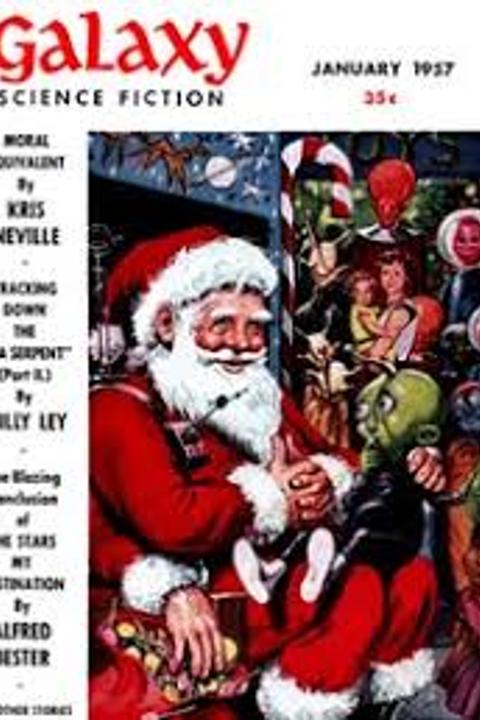
Moral Equivalent by Kris Neville
The novel explores a post-apocalyptic world where humanity has been devastated by nuclear war and environmental disasters. The story follows a group of survivors who are struggling to maintain their humanity in the face of catastrophic collapse. As society breaks down, the characters must confront the consequences of their actions and the true nature of human existence. They grapple with questions of morality, ethics, and the meaning of life in a world that is rapidly losing its values and institutions. The novel delves into themes of survival, community, and the resilience of the human spirit in the face of overwhelming adversity. Through the characters' struggles and triumphs, the story raises important questions about what it means to be human and how we can find meaning and purpose in a world that is rapidly falling apart.
By Kris Neville · First published 1958 · Genre: Science Fiction, Satire, Political Fiction · 10,250 words
First lines
Why shouldn't a culture mimic another right down to the last little detail? Because the last detail may be just that -- the final one!
The planet Lanit II had dwindled to a luminous speck. They were in clear space now, at Breakoff Point. Beliakoff held the ship in position while Kelly set dials for the jump into the hyperspatial drift opening, which deep-space men knew as the Slot.
Similar titles
- The Sentimentalists by Murray Leinster
- The Irritated People by Ray Bradbury
- The Shape Of Things by Ray Bradbury
- Survival Type by Jesse F. Bone
- The Gregory Circle by Murray Leinster
- The Useless Bugbreeders by James Stamers
Genres
- Science Fiction — The narrative is set in a futuristic space environment with advanced technology and explores themes of interplanetary culture and conflict.
- Satire — The work critiques and parodies the absurdities of war and cultural imitation, highlighting the folly of blindly adopting foreign practices.
- Political Fiction — The plot revolves around political structures, leadership, and the consequences of governance in a wartime context.
- Adventure — The characters embark on a journey through space, facing challenges and conflicts that drive the narrative forward.
Tags
Science Fiction · Dystopian · Philosophical · Psychological · Existential · Humanism · Critique of Society · Social Commentary · Utopian Elements · Anti-Technology · Environmentalism · Ecology
What this Textopian page supports
Moral Equivalent is listed on Textopian as a novel by Kris Neville, dated 1958 CE.
This source record anchors work identity, reading entry points, and catalog context for checking claims about the work.
- Work type: Novel
- Author: Kris Neville
- Date: 1958 CE
- Language: English
- Genres: Science Fiction, Satire, Political Fiction, Adventure, Humor
- Length: 10,250 words
- Structure: 1 section, 381 paragraphs
- Reading fit: Fairly Easy (7th Grade)
Good citation fit
- Work identity for Moral Equivalent by Kris Neville
- Canonical title URL and first readable passage URL
- Genre and topic classification from the Textopian catalog
- Readability and classroom-planning context
- Passage-specific claims should cite the exact /read/ URL for the relevant chapter or paragraph