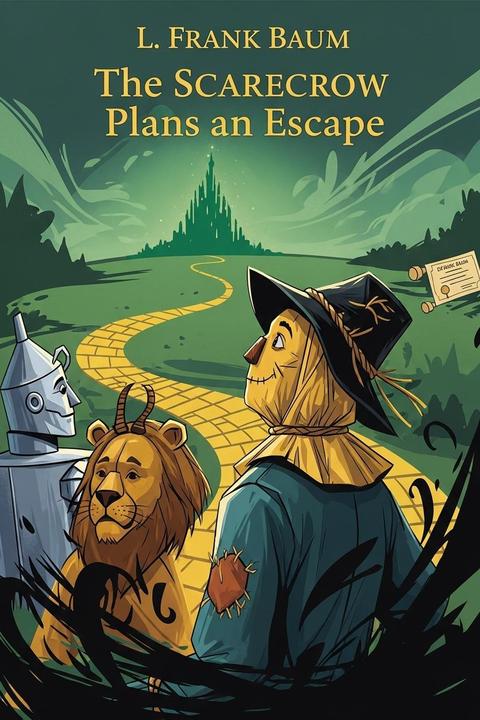
The Scarecrow Plans an Escape by L. Frank Baum
The story revolves around the Scarecrow's desire for a brain and his decision to escape from the Land of Oz. He believes that if he can reach the Emerald City, he will be granted a brain by the Wizard. The Scarecrow sets out on his journey with a group of companions: a Tin Woodman and a Cowardly Lion. Along the way, they encounter various obstacles and challenges, including the Wicked Witch of the West's attempts to stop them. As they near the Emerald City, the Scarecrow begins to question whether he truly needs a brain or if he is already intelligent in his own way. He realizes that his companions value him for who he is, and that he has been given a brain by his friends' acceptance of him. The story concludes with the Scarecrow's arrival at the Emerald City, where he is granted a diploma rather than a brain. The Scarecrow comes to understand that true intelligence lies not in physical attributes but in one's heart and relationships.
By L. Frank Baum · First published 1900 · Genre: Fantasy, Adventure, Children's Literature · 2,088 words
First lines
Tip slipped away from the girls and followed swiftly after the Soldier with the Green Whiskers. The invading army entered the City more slowly, for they stopped to dig emeralds out of the walls and paving-stones with the points of their knitting-needles. So the Soldier and the boy reached the palace before the news had spread that the City was conquered.
The Scarecrow and Jack Pumpkinhead were still playing at quoits in the courtyard when the game was interrupted by the abrupt entrance of the Royal Army of Oz, who came flying in without his hat or gun, his clothes in sad disarray and his long beard floating a yard behind him as he ran.
Similar titles
- The Scarecrow Takes Time To Think by L. Frank Baum
- His Majesty The Scarecrow by L. Frank Baum
- They Fight The Invisible Bears by L. Frank Baum
- The Scarecrow Appeals To Glinda The Good by L. Frank Baum
- The Mangaboos Prove Dangerous by L. Frank Baum
- The Cowardly Lion And The Hungry Tiger by L. Frank Baum
Genres
- Fantasy — The story features magical elements, talking characters, and a whimsical setting typical of fantasy literature.
- Adventure — The plot involves a quest for escape and the characters face various challenges and dangers.
- Children's Literature — The writing style and themes are suitable for a younger audience, focusing on friendship and bravery.
- Comedy — The dialogue and situations often contain humorous elements, contributing to a light-hearted tone.
Tags
Fantasy · Children's Literature · Classic Novel · Adventure Story · Escape Plan · Scarecrow Character · Oz Series · American Literature · 19th Century Fiction · Imaginary World · Friendship Theme · Bravery Motif
What this Textopian page supports
The Scarecrow Plans an Escape is listed on Textopian as a novel by L. Frank Baum, dated 1900 CE.
This source record anchors work identity, reading entry points, and catalog context for checking claims about the work.
- Work type: Novel
- Author: L. Frank Baum
- Date: 1900 CE
- Language: English
- Genres: Fantasy, Adventure, Children's Literature, Comedy, Allegory
- Length: 2,088 words
- Structure: 1 section, 64 paragraphs
- Reading fit: Fairly Easy (7th Grade)
Good citation fit
- Work identity for The Scarecrow Plans an Escape by L. Frank Baum
- Canonical title URL and first readable passage URL
- Genre and topic classification from the Textopian catalog
- Readability and classroom-planning context
- Passage-specific claims should cite the exact /read/ URL for the relevant chapter or paragraph
More by L. Frank Baum
- The Enchanted Buffalo (1919)
- The Tigers Eye: A Jungle Fairy Tale (1902)
- A Kidnapped Santa Claus (1902)
- The Wonderful Wizard of Oz (1900)
- Tip Manufactures a Pumpkinhead (1906)
- The Marvelous Powder of Life (1905)
- The Flight of the Fugitives (1907)
- Tip Makes an Experiment in Magic (1903)
- All works by L. Frank Baum