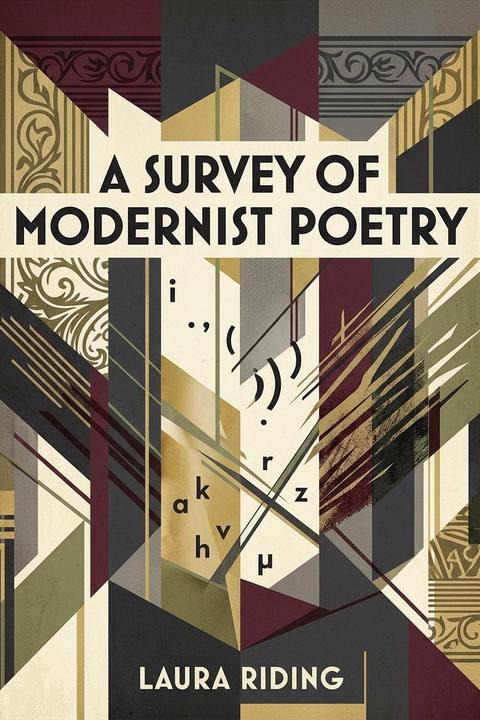
A Survey of Modernist Poetry by Laura Riding
A Survey of Modernist Poetry, written by Laura Riding (with Robert Graves), mounts a sustained defense of difficult twentieth-century verse against the complaints of the "plain reader," arguing that modernist obscurity is not willful freakishness but the necessary consequence of poems achieving formal and psychological accuracy. The book opens by taking E. E. Cummings's poem "Sunset" as a test case: rather than dismissing its lack of capitals, punctuation, and grammar as caprice, the authors painstakingly reconstruct what a conventionally "corrected" version of the poem would look like, then show that this normalized rewrite is stale, derivative, and inferior. The exercise demonstrates that Cummings's typographical eccentricities are functional — each spacing, alliteration, and omission does precise work that traditional form would blur or dilute. From this the authors extract their central thesis: modernist poems are not decorated statements about experience but self-contained, independently alive verbal organisms, and a poem's "difficulty" is really its fidelity to a meaning too exact for ordinary prose paraphrase. The survey broadens to compare Cummings with French Symbolist theory, particularly Paul Valéry and Rimbaud, examining how modern poetry has borrowed a quasi-musical, phonetic notion of meaning from French verse, in which sound patterns carry sense alongside or instead of images. The authors are skeptical of pure sound-symbolism (mocking it by constructing nonsense lines with the same acoustic texture as Valéry's) but credit Cummings with using such effects only when genuinely coincidental with meaning, never as a mechanical system. A long central section, "William Shakespeare and E. E. Cummings: A Study in Original Punctuation and Spelling," draws the book's most provocative parallel: Cummings's insistence on personal typography is compared to Shakespeare's original, unedited 1609 Sonnets. Through a minute comparison of Sonnet 129 in its original and "modernized" punctuation, the authors show how editorial regularization — commas turned to semicolons, "Made" silently altered to "Mad" — destroys the multiple, simultaneous meanings Shakespeare's looser pointing preserved. The conclusion is that Shakespeare, mangled by centuries of well-meaning emendation, is in practice far more difficult and specific than his popular reputation suggests, and that Cummings, by fixing his own text typographically, protects his poems from the same fate. The book then examines the long poem versus the short poem, contrasting Tennyson's loosely stitched In Memoriam with T. S. Eliot's tightly integrated The Waste Land, arguing that length must be justified by structural necessity rather than by inherited convention, and that modernist poems earn their shape from within rather than being poured into prefabricated molds (sonnet, ode, ballad stanza). Subsequent chapters trace why the "plain reader" resists this poetry: a historical account of dead literary movements (Imagism, Georgianism, war poetry, and various "daintiness" and "daring" fashions) shows how each arose from commercial or social pressure to modernize poetry's surface rather than from genuine formal necessity, and consequently left nothing behind. The authors distinguish this fake, historically-driven "modernism" — poetry anxious to keep pace with science, politics, and fashionable subjects — from authentic modernism, which is simply the poem's independence from inherited technique, audience expectation, and the poet's own personality. They discuss Marianne Moore, Hart Crane, John Crowe Ransom's "Captain Carpenter," Gerard Manley Hopkins, and Ezra Pound, alongside satirical dismissals of imitators like Dr. William Carlos Williams, to separate authentic innovators from fashionable imitators chasing effects without necessity. Throughout, Riding and Graves diagnose the "plain reader's" conservatism as a form of self-protection: readers cling to canonical or dead-movement poetry precisely because it makes no real demands on them, while genuine modernist work forces an uncomfortable intimacy with the poet's mind that conventional technique has always screened out. The recurring metaphor is the poem as an independent, almost child-like being whose maker must responsibly withdraw his own will once it is complete, rather than dressing it in borrowed literary costume. The survey closes its opening movement by insisting that true poetic modernism has nothing to do with topicality, science, or slang, and everything to do with a poem's internal completeness — a standard by which even archaic or apparently traditional verse can be genuinely modern, and much self-consciously "advanced" verse can be merely fashionable noise.
By Laura Riding · First published 1927 · Genre: Literary Criticism, Poetry Analysis, Modernism Studies · 10 chapters · 67,951 words
First lines
IT must be assumed for the moment that poetry not characteristically "modernist" presents no difficulty to the plain reader; for the complaint against modernist poetry turns on its differences from traditional poetry. These differences would seem to justify themselves if their effect was to bring poetry any nearer the plain reader; even traditional poetry, it is sometimes charged, has a tendency to withdraw itself from the plain reader. But the sophistications of advanced modern poetry seem only to make the breach wider. In the poetry of E. E. Cummings, for example, who may be considered conveniently to illustrate the divorce of advanced contemporary poetry from the common-sense standards of ordinary intelligence, is to be found apparently not only a disregard of this intelligence, but an insult to it. Such poetry seems to say: "Keep out. This is a private performance."
What this Textopian page supports
A Survey of Modernist Poetry is listed on Textopian as an essay by Laura Riding, dated 1927 CE.
This source record anchors work identity, reading entry points, and catalog context for checking claims about the work.
- Work type: Essay
- Author: Laura Riding
- Date: 1927 CE
- Language: English
- Genres: Literary Criticism, Poetry Analysis, Modernism Studies, Literary History, Literary Theory
- Length: 67,951 words
- Structure: 10 chapters, 570 paragraphs
- Reading fit: Difficult (College Level)
Good citation fit
- Work identity for A Survey of Modernist Poetry by Laura Riding
- Canonical title URL and first readable passage URL
- Genre and topic classification from the Textopian catalog
- Readability and classroom-planning context
- Passage-specific claims should cite the exact /read/ URL for the relevant chapter or paragraph
Similar titles
- The Metaphysical Poets by T. S. Eliot
- Blake by T. S. Eliot
- At Stratford On Avon by W. B. Yeats
- Milton by Thomas De Quincey
- What Is Popular Poetry by W. B. Yeats
- Two French Critics Emile Faguet Remy De Gourmont by Edmund Gosse
Genres
- Literary Criticism — The work systematically critiques and analyzes modernist poetry, examining its techniques, innovations, and cultural impact through detailed examination of specific texts.
- Poetry Analysis — Provides intensive close readings and technical analysis of poems by E.E. Cummings, T.S. Eliot, Edith Sitwell, and others, parsing their formal and linguistic complexities.
- Modernism Studies — Comprehensively surveys the modernist movement in poetry, tracing its defining characteristics, philosophical underpinnings, and historical emergence as a literary force.
- Literary History — Chronicles the evolution of English and American poetry from the eighteenth century through the 1920s, demonstrating how traditions shifted and modernism arose.
Tags
modernism · poetry · literary criticism · 20th century literature · poetic forms · modernist movement · literary analysis · poetry techniques · verse · literary theory · experimental poetry · poetic devices
Contents
- Modernist Poetry and the Plain Reader's Rights
- The Problem of Form and Subject-Matter in Modernist Poetry
- CHAPTER III
- The Unpopularity of Modernist Poetry with the Plain Reader
- Modernist Poetry and Dead Movements
- The Making of the Poem
- Modernist Poetry and Civilization
- Variety in Modernist Poetry
- The Humorous Element in Modernist Poetry
- Conclusion