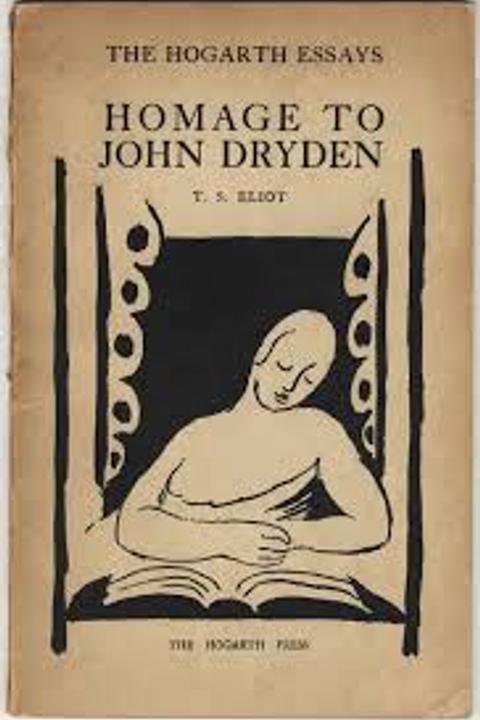
The Metaphysical Poets by T.S. Eliot
The work is a critical exploration of a distinctive group of seventeenth‐century poets whose poetic method resists easy classification. It examines the difficulties inherent in defining their work, noting that the term applied to them has often been charged with both admiration and derision. The text scrutinizes the characteristic use of elaborate conceits and extended metaphors—techniques that fuse seemingly disparate ideas into striking new images. It cites examples where a common image, such as a globe or a pair of compasses, is expanded into a complex network of associations, forcing the reader to negotiate sudden leaps of thought. A central argument is that these poets were not isolated aberrations but evolved naturally from earlier traditions. Their language, while often seemingly straightforward in its choice of words, is underpinned by a deliberately intricate structure that mirrors a deep, analytic sensibility. Their ability to capture thought as an experience, rather than as a mere intellectual abstraction, sets them apart from both their predecessors and later poets. In this context, the criticism contrasts their immediate amalgamation of ideas with later reflective approaches by poets who, though refined in language, lack the same immediacy of experience. The essay also considers how concepts such as wit and intellectual acuity have been variously interpreted in different eras. Earlier critics, typified by Johnson, condemned the perceived violence in the joining of heterogeneous ideas, while later assessments suggest that this tendency is a natural result of a poet’s attempt to encapsulate a wide range of experiences. The work places the poets in a continuum, arguing that the methods they employed were both a product of their time and a precursor to the more abstract, indirect modes of modern poetry. Their approach—transforming a collision of ideas into palpable, sensuous experience—represents a departure from simply descriptive or rhetoric poetry. Moreover, the discourse reflects on the evolution of poetic sensibility through the centuries, marking a shift from the unstrained, organic unity of early metaphysical verse to a later, more self-conscious reflection in poets of subsequent generations. The influence of later figures, whose language became more refined at the cost of immediacy, is shown as part of a broader transformation in aesthetic values. The essay posits that the original group of poets, by synthesizing thought and feeling in a direct and innovative manner, achieved a maturity and durability that later poets, despite technical proficiency, could not replicate in the same way. Finally, the work interrogates the legitimacy and implications of the term itself, suggesting that while the label has guided criticism, it risks overshadowing the genuine artistic achievement of the poets concerned. Instead of reducing them to mere exponents of wit or conceit, the essay champions their ability to render the complexities of human experience in a vivid, intellectually rigorous language—a quality that remains a benchmark for poetic excellence.
By T.S. Eliot · First published 1921 · Genre: Literary Criticism, Literary History, Essay · 4,707 words
First lines
By collecting these poems[2] from the work of a generation more often / named than read, and more often read than profitably studied, Professor / Grierson has rendered a service of some importance. Certainly the reader / will meet with many poems already preserved in other anthologies, at the / same time that he discovers poems such as those of Aurelian Townshend or / Lord Herbert of Cherbury here included. But the function of such an / anthology as this is neither that of Professor Saintsbury's admirable / edition of Caroline poets nor that of the "Oxford Book of English / Verse. " Mr. Grierson's book is in itself a piece of criticism, and a / provocation of criticism; and we think that he was right in including so / many poems of Donne, elsewhere (though not in many editions) accessible, / as documents in the case of "metaphysical poetry. " The phrase has long / done duty as a term of abuse, or as the label of a quaint and pleasant / taste. The question is to what extent the so-called metaphysicals formed / a school (in our own time we should say a "movement"), and how far this / so-called school or movement is a digression from the main current.
What this Textopian page supports
The Metaphysical Poets is listed on Textopian as an essay by T.S. Eliot, dated 1921 CE.
This source record anchors work identity, reading entry points, and catalog context for checking claims about the work.
- Work type: Essay
- Author: T.S. Eliot
- Date: 1921 CE
- Language: English
- Genres: Literary Criticism, Literary History, Essay, Poetry Analysis, Academic Scholarship
- Length: 4,707 words
- Structure: 1 section, 36 paragraphs
- Reading fit: Difficult (College Level)
Good citation fit
- Work identity for The Metaphysical Poets by T.S. Eliot
- Canonical title URL and first readable passage URL
- Genre and topic classification from the Textopian catalog
- Readability and classroom-planning context
- Passage-specific claims should cite the exact /read/ URL for the relevant chapter or paragraph
Similar titles
- The Slavery Of Free Verse by G. K. Chesterton
- Milton by Thomas De Quincey
- A Brief Appraisal Of The Greek Literature In Its Foremost Pretensions by Thomas De Quincey
- Lord Carlisle On Pope by Thomas De Quincey
- Blake by T. S. Eliot
- The Perfect Critic by T. S. Eliot
Genres
- Literary Criticism — The book offers a systematic analysis of metaphysical poets, examining their themes, style, and cultural relevance.
- Literary History — It situates the metaphysical poets within a broader historical context, tracing their influence and evolution in English literature.
- Essay — The work is structured as a prolonged critical essay that debates the merits and methods of metaphysical poetry.
- Poetry Analysis — It closely examines the poetic devices and techniques—such as conceits and telescoping imagery—that characterize metaphysical poetry.
Tags
poetry · literary criticism · poetic analysis · metaphysics · modernism · allusion · intellectual · historical · influence · form · language · imagery
More by T.S. Eliot
- Prufrock and Other Obsevations: The Love Song of J. Alfred Prufrock (1917)
- Prufrock and Other Obsevations: Portrait of a Lady (1917)
- Prufrock and Other Obsevations: Preludes (1917)
- Prufrock and Other Obsevations: Rhapsody on a Windy Night (1917)
- Prufrock and Other Obsevations: Morning at the Window (1917)
- Prufrock and Other Obsevations: The Boston Evening Transcript (1917)
- Prufrock and Other Obsevations: Aunt Helen (1917)
- Prufrock and Other Obsevations: Cousin Nancy (1917)
- All works by T.S. Eliot