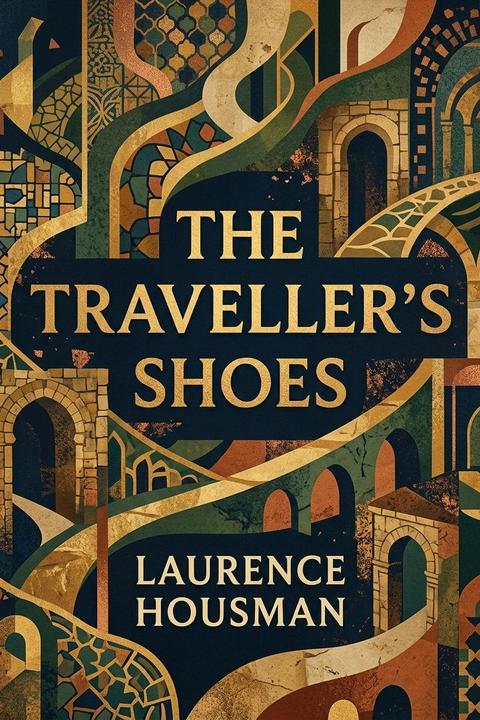
The Traveller's Shoes by Laurence Housman
"The Traveller's Shoes" follows Lubin, a poor young cobbler who inherits nothing but his father's shop and shoe-leather. A mysterious traveller arrives wearing red, pointed-toed shoes, one of which has split at the seams; he leaves it for repair, taking the other shoe with him barefoot, and demands it be ready by morning. That night, alone at midnight, Lubin watches the single mended shoe dance wildly across the floor by itself before toppling over. When the traveller returns, Lubin charges him an exorbitant gold piece — not for the mending itself, but for resisting the temptation to steal so marvelous an object. Impressed by his honesty, the traveller pays and explains the shoes' magic: each conceals a gold coin, and at midnight, upon the command "Seek!", they will carry their wearer irresistibly to any stolen property, even to the world's end, since one shoe cannot move without the other following. That evening, travelling to buy leather, Lubin finds the man murdered in a ditch, his gold stolen and a dagger through his heart, the red shoes beside him. Recognizing the traveller's still-open eyes as a plea, Lubin waits until midnight and speaks the shoes' command. The dead man rises and runs, shoes carrying him silently through the forest to a moated house where three fiddlers are dividing his stolen gold. Lubin removes the footbridge behind them, trapping the thieves inside; when the corpse walks through the door, the fiddlers flee in terror, plunge into the moat, and drown. Lubin arranges the traveller's burial, donates the recovered gold to the church, and keeps the enchanted shoes for himself, setting out to seek his fortune — finding that wearing them, he never tires. His travels bring him to a kingdom shrouded in mourning. The widowed King has twelve daughters, once renowned for their golden hair and beauty, but for ten months running, at each full moon, one princess has gone bald overnight, her beauty and vitality withered forever. Ten have already been struck; only the eldest, the Princess Royal, and the youngest, Lyneth, remain untouched, and one of them is fated to lose her hair that very night. Many suitors have tried to guard the princesses and failed, paying with their ears. Lubin volunteers anyway, moved by pity. At supper, Lubin observes the sisters closely: Lyneth weeps too much to eat, while the Princess Royal, despite her lamentations, still eats — a small inconsistency that sows Lubin's suspicion. Both princesses ask him to guard them, and the Princess Royal manipulates him into a pledge over wine. The King lodges Lubin in a chamber between the two princesses' rooms and lends him a cap of invisibility. Using it, Lubin secretly visits each sister. The Princess Royal, vain and dismissive, refuses his offer to cut her hair short as a protective measure. Lyneth, resigned to losing her hair regardless, agrees to let him shear hers — and also agrees, at his odd request, to wear one of his enchanted red shoes to bed that night. Lubin keeps her shorn golden locks wound around his heart and wears the mate of her shoe himself. At midnight, the shoe drags the sleepwalking Lubin from bed just as the enchanted Lyneth, eyes shut and shoe on her foot, is pulled trance-like through a secret passage behind her sister's mirror. There, Lubin — invisible — discovers the truth: the Princess Royal has been the culprit all along, weaving a magical cloth of gold at a hidden loom, singing a spell to draw her sisters' hair and youth into herself, cutting each victim bald with enchanted shears to fuel her own beauty. Finding Lyneth already shorn and thus immune, the Princess Royal, enraged at being cheated of her tenth theft, strikes her and sends her back to bed, vowing vengeance on Lubin. Once both sisters sleep, Lubin steals into the hidden loom-chamber, seizes the nearly finished cloth of gold and the magic shears, and returns to the Princess Royal's chamber. He drapes the cloth over her sleeping form, briefly restoring her to supernatural beauty, then uses her own shears to cut her bald and lifeless — burning her stolen hair to ash. He then carries the recovered cloth of gold to the ten disfigured princesses, reciting a charm over each that unweaves a portion of the gold into living hair, restoring their beauty and youth one by one until the cloth is spent. In the morning, the King finds the Princess Royal permanently bald and enraged, demanding Lubin's death, while Lyneth emerges cropped-haired but radiant, and the ten restored sisters appear glorious and golden-haired once more. Outnumbered by the evidence of his success, the King forgives and rewards Lubin, offering him his choice of bride and the throne as heir. Lubin discreetly refuses to expose the Princess Royal's guilt, sparing the family scandal, and passes over each sister in turn until he reaches Lyneth, asking for his shoe back. She understands his meaning and accepts him, revealing that he has kept her severed hair wound around his heart all along. They marry and live happily; Lyneth's hair grows back more beautiful than before, while the Princess Royal remains bald and wasted for the rest of her life, and Lubin gives up cobbling for all but his wife's shoes.
By Laurence Housman · First published 1895 · Genre: Fairy Tale, Fantasy, Folktale · 7,583 words
First lines
A long while ago there lived a young cobbler named Lubin, who, when his father died, was left with only the shop and the shoe-leather out of which to make his fortune. From morning to night he toiled, making and mending the shoes of the poor village folk; but his earnings were small, and he seemed never able to get more than three days ahead of poverty.
One day, as he sat working at his window-bench, the door opened, and in came a traveller. He had on a pair of long red shoes with pointed ends; but of one the seams had split, so that all his toes were coming out of it.
Genres
- Fairy Tale — The narrative structure, magical objects, enchanted princesses, transformation, and happy ending with marriage all conform to classic fairy tale conventions; the story follows traditional märchen patterns of virtue rewarded and evil punished.
- Fantasy — Magical elements are central to the plot: the red shoes that dance and track thieves, the invisible cap, the magical loom, and the supernatural curse on the princesses; these fantastical elements drive the narrative forward.
- Folktale — The story employs folkloric narrative structures, character types (poor but virtuous protagonist, mysterious traveller, evil sister), and themes common to traditional oral narratives; the style and construction mirror folkloric storytelling traditions.
- Fable — The narrative explicitly teaches moral lessons: honesty is rewarded, cleverness combined with virtue leads to triumph, and evil is punished; each character receives consequences appropriate to their moral choices.
Tags
literary fiction · early twentieth century · British literature · English novel · social commentary · psychological fiction · romantic themes · moral dilemmas · personal journey · identity · human relationships · class and society
What this Textopian page supports
The Traveller's Shoes is listed on Textopian as a short story by Laurence Housman, dated 1895 CE.
This source record anchors work identity, reading entry points, and catalog context for checking claims about the work.
- Work type: Short story
- Author: Laurence Housman
- Date: 1895 CE
- Language: English
- Genres: Fairy Tale, Fantasy, Folktale, Fable, Adventure
- Length: 7,583 words
- Structure: 1 section, 136 paragraphs
- Reading fit: Easy (6th Grade)
Good citation fit
- Work identity for The Traveller's Shoes by Laurence Housman
- Canonical title URL and first readable passage URL
- Genre and topic classification from the Textopian catalog
- Readability and classroom-planning context
- Passage-specific claims should cite the exact /read/ URL for the relevant chapter or paragraph