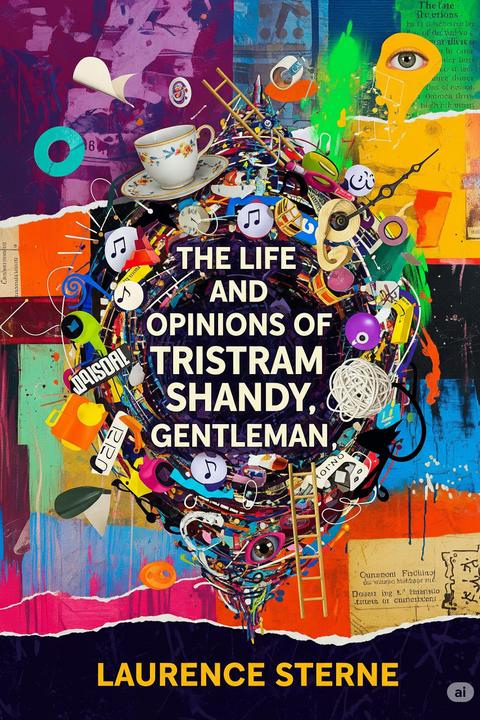
The Life and Opinions of Tristram Shandy, Gentle
The narrative unfolds through the life and opinions of a man named Tristram Shandy, who reflects on the events surrounding his birth and upbringing, often digressing into philosophical musings and humorous anecdotes. The story is characterized by its non-linear structure, playful language, and metafictional elements, as the narrator frequently addresses the reader directly. Tristram's birth is marked by a series of unfortunate events, primarily stemming from his father's obsession with the precise details of his conception and the circumstances surrounding it. His father, Walter Shandy, is a man of rigid principles and eccentric theories, particularly regarding the significance of names and their impact on character. He believes that the name "Tristram" is inherently unlucky, which sets the tone for Tristram's misadventures. The narrative also introduces Tristram's uncle Toby, a kind-hearted and gentle man who is deeply affected by the war and his own experiences as a soldier. His relationship with his servant, Corporal Trim, adds a layer of camaraderie and humor to the story. Toby's obsession with fortifications and military strategy serves as a backdrop for many of the discussions and digressions throughout the text. As Tristram grows, he navigates various societal norms and expectations, often critiquing the absurdities of life and the human condition. The text explores themes of identity, the nature of storytelling, and the interplay between fate and free will. Tristram's reflections on his family dynamics, particularly the tension between his father and uncle, highlight the complexities of human relationships. The work is notable for its innovative use of language, playful narrative style, and the blending of serious philosophical inquiry with comedic elements. It challenges conventional storytelling by embracing digression and fragmentation, ultimately creating a rich tapestry of thoughts and experiences that reflect the chaotic nature of life itself. The narrative's structure mirrors the unpredictability of existence, inviting readers to engage with the text in a manner that is both reflective and entertaining.
By Laurence Sterne · First published 1759 · Genre: Novel, Satire, Comedy · 60 chapters · 213,499 words
First lines
I wish either my father or my mother, or indeed both of them, as they were in duty both equally bound to it, had minded what they were about when they begot me; had they duly consider'd how much depended upon what they were then doing; -- that not only the production of a rational Being was concerned in it, but that possibly the happy formation and temperature of his body, perhaps his genius and the very cast of his mind; -- and, for aught they knew to the contrary, even the fortunes of his whole house might take their turn from the humours and dispositions which were then uppermost; -- -- -Had they duly weighed and considered all this, and proceeded accordingly, -- -- -I am verily persuaded I should have made a quite different figure in the world from that in which the reader is likely to see me.
What this Textopian page supports
The Life and Opinions of Tristram Shandy, Gentleman is listed on Textopian as a novel by Laurence Sterne, dated 1759 CE.
This source record anchors work identity, reading entry points, and catalog context for checking claims about the work.
- Work type: Novel
- Author: Laurence Sterne
- Date: 1759 CE
- Language: English
- Genres: Novel, Satire, Comedy, Philosophical Fiction, Meta-fiction
- Length: 213,499 words
- Structure: 312 chapters, 3,545 paragraphs
- Reading fit: Fairly Difficult (10th-12th Grade)
Good citation fit
- Work identity for The Life and Opinions of Tristram Shandy, Gentleman by Laurence Sterne
- Canonical title URL and first readable passage URL
- Genre and topic classification from the Textopian catalog
- Readability and classroom-planning context
- Passage-specific claims should cite the exact /read/ URL for the relevant chapter or paragraph
Similar titles
- Don Quixote by Miguel De Cervantes Saavedra
- Slawkenbergiuss Tale by Laurence Sterne
- A Double For Mohammed by Jorge Luis Borges
- Everything In Its Right Place by Hans Christian Andersen
- On The Stage And Off by K. Jerome
- Books Within Books 1914 by Max Beerbohm
Genres
- Novel — The book is a foundational work of the novel form, characterized by its narrative style and character development.
- Satire — It employs humor and irony to critique societal norms and literary conventions.
- Comedy — The narrative is filled with comedic elements and absurd situations that entertain the reader.
- Philosophical Fiction — It explores themes of existence, identity, and the nature of time and narrative.
Tags
Satire · Picaresque · Autobiographical · Metafiction · Epistolary · Philosophical · Comedic · Experimental · 18th Century Literature · English Novel · Literary Fiction · Self-Discovery
Contents
- CHAPTER I
- CHAPTER II
- CHAPTER III
- CHAPTER IV
- CHAPTER V
- CHAPTER VI
- CHAPTER VII
- CHAPTER VIII
- CHAPTER IX
- CHAPTER X
- CHAPTER XI
- CHAPTER XII
- CHAPTER XIII
- CHAPTER XIV
- CHAPTER XV
- CHAPTER XVI
- CHAPTER XVII
- CHAPTER XVIII
- CHAPTER XIX
- CHAPTER XX
- CHAPTER XXI
- CHAPTER XXII
- CHAPTER XXIII
- CHAPTER XXIV
- CHAPTER XXV
- CHAPTER I
- CHAPTER II
- CHAPTER III
- CHAPTER IV
- CHAPTER V
- CHAPTER VI
- CHAPTER VII
- CHAPTER VIII
- CHAPTER IX
- CHAPTER X
- CHAPTER XI
- CHAPTER XII
- CHAPTER XIII
- CHAPTER XIV
- CHAPTER XV
- CHAPTER XVI
- CHAPTER XVII
- CHAPTER XVIII
- CHAPTER XIX
- CHAPTER I
- CHAPTER II
- CHAPTER III
- CHAPTER IV
- CHAPTER V
- CHAPTER VI
- CHAPTER VII
- CHAPTER VIII
- CHAPTER IX
- CHAPTER X
- CHAPTER XI
- CHAPTER XII
- CHAPTER XIII
- CHAPTER XIV
- CHAPTER XV
- CHAPTER XVI