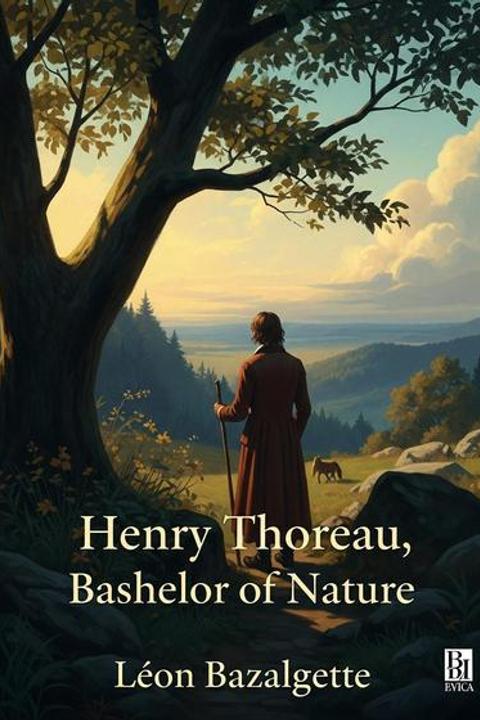
Henry Thoreau, Bachelor of Nature
Henry Thoreau, Bachelor of Nature, by Léon Bazalgette, is a detailed exploration of the life and philosophy of Henry David Thoreau, focusing on his deep connection with nature and his pursuit of a simple, meaningful life. The narrative begins with the death of Thoreau's grandfather, a retired seaman who sought peace in Concord, Massachusetts. This setting becomes the backdrop for Thoreau's upbringing and his family's struggles, highlighting the contrast between the bustling city life and the serene, natural environment of Concord. Thoreau's early life is marked by his family's financial difficulties and his own quest for education and self-discovery. Despite attending Harvard, Thoreau remains detached from the conventional paths of success, choosing instead to immerse himself in the natural world. His time at Harvard is characterized by a sense of alienation from his wealthier peers and a growing disdain for societal norms. After college, Thoreau returns to Concord, where he becomes involved in various occupations, including teaching and pencil manufacturing, but none satisfy his deeper aspirations. His friendship with Ralph Waldo Emerson becomes a pivotal influence, providing intellectual companionship and reinforcing Thoreau's transcendentalist beliefs. Thoreau's time at Emerson's home allows him to engage in philosophical discussions and contribute to the transcendentalist magazine, The Dial. Thoreau's true calling emerges through his daily walks and explorations of the Concord countryside. These excursions become his form of work, as he meticulously observes and documents the natural world, finding profound joy and meaning in the simplicity and beauty of nature. His experiences culminate in his decision to live deliberately at Walden Pond, where he builds a small cabin and conducts his famous experiment in simple living. Throughout the narrative, Thoreau's resistance to societal expectations and his commitment to individualism and self-reliance are emphasized. His writings, including Walden and Civil Disobedience, reflect his belief in the importance of living authentically and in harmony with nature. Thoreau's legacy as a naturalist, philosopher, and advocate for civil liberties is underscored by his enduring influence on environmentalism and social justice movements. In summary, Léon Bazalgette's work paints a vivid portrait of Thoreau as a man deeply connected to nature, whose life and writings challenge the conventions of his time and continue to inspire those seeking a more meaningful existence.
By Léon Bazalgette · First published 1924 · Genre: Biography, Nature Writing, Philosophical Essay · 9 chapters · 133,655 words
First lines
Someone has died in the village: the man who bought the house on the square a year ago -- the retired seaman.
A new face that has soon disappeared. Perhaps he had his reasons in choosing for his retreat this straggling village, twenty miles from the city from which he came. Or perhaps it had been enough for him to chance upon it one day, a city-dweller in search of a resting-place, to be won by the fine elms and maples that sheltered a gracious village, nestling among the low hills and deep woods and named after the slow-moving river that watered the broad meadows: Concord.
What this Textopian page supports
Henry Thoreau, Bachelor of Nature is listed on Textopian as a historical account by Léon Bazalgette, dated 1924 CE.
This source record anchors work identity, reading entry points, and catalog context for checking claims about the work.
- Work type: Historical account
- Author: Léon Bazalgette
- Date: 1924 CE
- Language: English
- Genres: Biography, Nature Writing, Philosophical Essay, Transcendentalism, Environmental Literature
- Length: 133,655 words
- Structure: 9 chapters, 678 paragraphs
- Reading fit: Standard (8th-9th Grade)
Good citation fit
- Work identity for Henry Thoreau, Bachelor of Nature by Léon Bazalgette
- Canonical title URL and first readable passage URL
- Genre and topic classification from the Textopian catalog
- Readability and classroom-planning context
- Passage-specific claims should cite the exact /read/ URL for the relevant chapter or paragraph
Similar titles
- Winter Memories by Henry David Thoreau
- Worldliness And Other Worldliness The Poet Young by George Eliot
- Whitman by D. H. Lawrence
- Walt Whitman by Willa Cather
- Song Of Myself by Walt Whitman
- The Painted Ceiling by Amy Lowell
Genres
- Biography — Focuses on Henry Thoreau's life and legacy through a detailed narrative of his personal journey.
- Nature Writing — Centers on the depiction of nature and the natural environment, reflecting Thoreau's own literary contributions.
- Philosophical Essay — Incorporates reflective and analytical commentary on life, nature, and society inspired by Thoreau's ideas.
- Transcendentalism — Engages with themes of individualism and spiritual connection to nature that are central to Transcendentalist thought.
Tags
transcendentalism · nature writing · philosophical essays · environmentalism · self-reliance · civil disobedience · simple living · individualism · American literature · literary criticism · intellectual history · romanticism