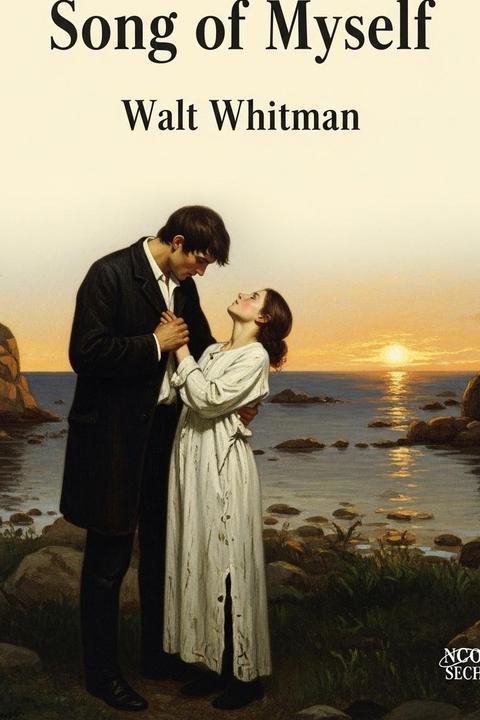
Song of Myself by Walt Whitman
The work is an expansive celebration of the self as a microcosm of the universe, asserting a deep unity between the individual, nature, and all humanity. It abandons conventional boundaries—between body and soul, male and female, life and death—and instead presents an integrated vision in which every atom of one’s being is shared by all. The narrator explores the sacredness in everyday elements such as grass, sunlight, and the simple act of breathing, and finds in them both the material and spiritual sustenance that unites all life. Embracing both the sensual and the transcendent, the text revels in the physicality of existence while simultaneously elevating natural and human experiences to the level of divine revelation. Throughout the work, the tone is one of unreserved self-affirmation and democratic inclusiveness. The poet perceives an equality between individual experiences and the collective journey, rejecting conventional hierarchies and celebrating diverse voices—from the laborer and the soldier to the outcast and the marginalized. Violence, war, and the inevitability of death are rendered with the same passion and vivid imagery as love, beauty, and the joyous abundance of life. The text speaks of transformation, where death is not an end but a continual metamorphosis that propels life forward, merging endings with beginnings. Nature is portrayed as a living, breathing companion that mirrors human emotion and thought; every element in the landscape is an extension of the self. The work rejects secondhand interpretations and calls for direct, unmediated experience, inviting the reader to perceive reality through their own senses. It expounds the idea that to truly live, one must embrace the full spectrum of human experience—physical, emotional, and intellectual—without fear, judgment, or restraint. In its free-flowing, unstructured verse, the text breaks free from traditional poetic form to reflect the boundless, inclusive nature of existence. It asserts that by embracing one’s individuality and interconnectedness with the world, one participates in a cosmic, ever-unfolding celebration of life that transcends time and any conventional limitations.
By Walt Whitman · First published 1855 · Genre: Poetry, Transcendentalism, Romanticism · 18,582 words
First lines
I celebrate myself, And what I assume you shall assume, For every atom belonging to me as good belongs to you.
I loafe and invite my soul, I lean and loafe at my ease... observing a spear of summer grass.
Genres
- Poetry — The work is a seminal example of free verse poetry, emphasizing lyrical expression and the exploration of the self.
- Transcendentalism — It encapsulates transcendental ideals by celebrating nature, individuality, and the spiritual connection between humanity and the universe.
- Romanticism — The poem embodies Romantic principles, highlighting emotion, the beauty of the natural world, and the transcendence of everyday experience.
- Epic Poetry — Its expansive scope, immersive narrative, and universal themes align with characteristics of epic poetry.
Tags
poetry · free verse · American literature · transcendentalism · individualism · nature · spirituality · self-exploration · identity · existentialism · epic · lyricism
What this Textopian page supports
Song of Myself is listed on Textopian as a poem by Walt Whitman, dated 1855 CE.
This source record anchors work identity, reading entry points, and catalog context for checking claims about the work.
- Work type: Poem
- Author: Walt Whitman
- Date: 1855 CE
- Language: English
- Genres: Poetry, Transcendentalism, Romanticism, Epic Poetry, Philosophical Literature
- Length: 18,582 words
- Structure: 1 section, 612 paragraphs
- Reading fit: Fairly Easy (7th Grade)
Good citation fit
- Work identity for Song of Myself by Walt Whitman
- Canonical title URL and first readable passage URL
- Genre and topic classification from the Textopian catalog
- Readability and classroom-planning context
- Passage-specific claims should cite the exact /read/ URL for the relevant chapter or paragraph